

American democracy is undergoing a profound structural shift as we navigate the political landscape of 2026. High-stakes redistricting battles and an unprecedented surge of influence leave many voters searching for clarity. This episode of The Legal Lens peels back the layers of this shift to reveal what is at stake.
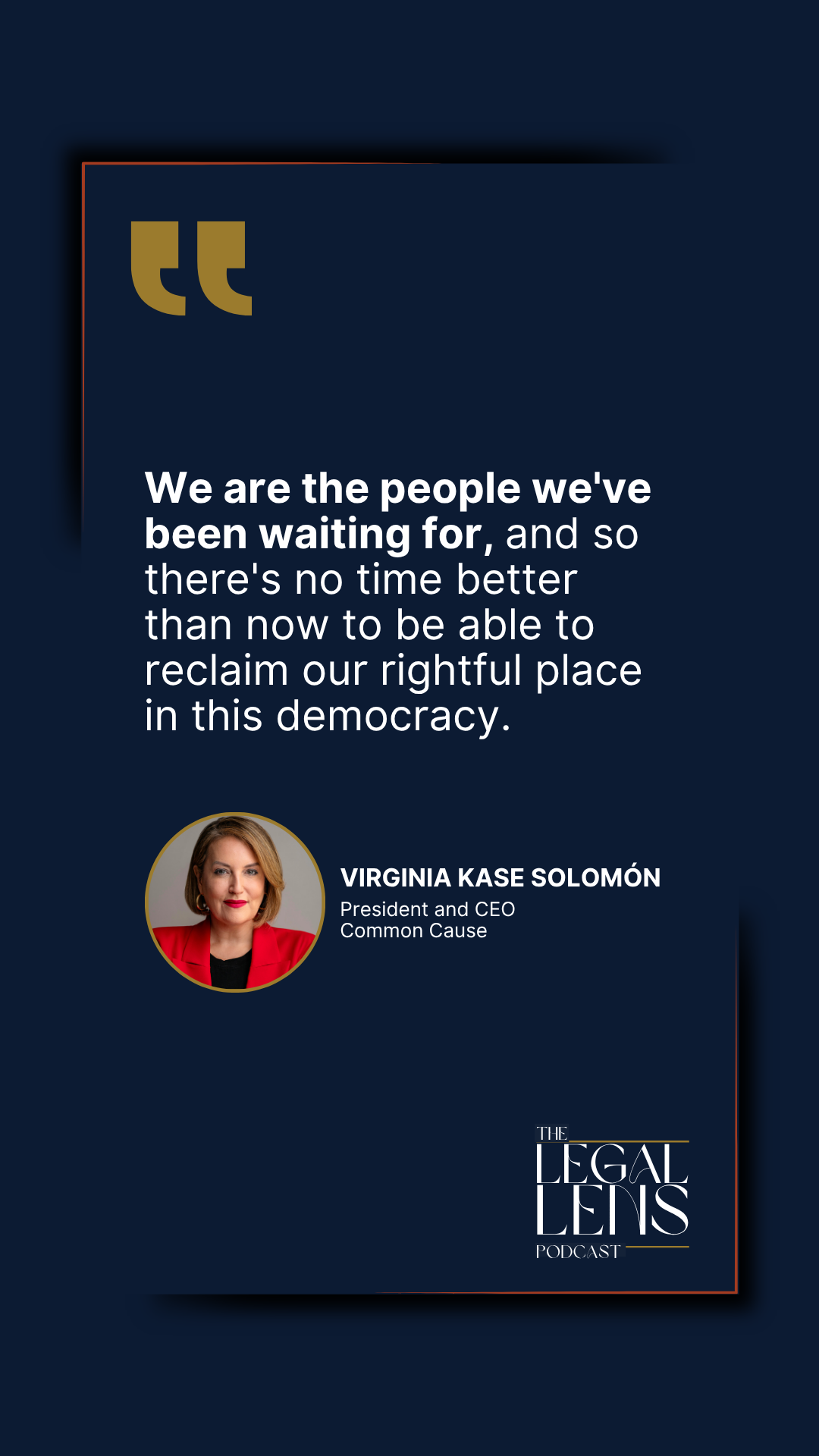
This week, I welcomed Virginia Kase Solomón, the President and CEO of Common Cause, to discuss the work of Common Cause and their efforts to protect voting and civil rights. As a nationally recognized advocate with over three decades of experience, she provides an essential eyewitness perspective from Washington, D.C.
Together, we explore how grassroots action can counter institutional hurdles and restore true government accountability.
Navigating the Episode: Time Stamps
- 00:40 – Introducing Virginia Kase Solomón: A Lifetime of Civic Engagement
- 02:49 – The Catalyst: A Foster Mother’s Battle at the Ballot Box
- 06:08 – Understanding Common Cause: The History of the People’s Lobby
- 08:55 – Confronting Modern Bias: The Four Pillars of Advocacy
- 10:18 – A Tale of Two Cities: Inside the Social Climate of Washington, D.C.
- 14:17 – The New Era of Disparate Impact: Capital, Tech, and Voting Rights
- 17:49 – The Domino Effect: Deconstructing the Post-Callais Decision Redistricting Wars
- 22:34 – Structural Overhauls: Historic Reversions and the Power Challenge
- 27:25 – The 2026 Voter Action Checklist: How to Protect Your Ballot
- 34:53 – Media Consolidation: The Corporate Control of Public Information
- 37:50 – A Radical Note of Hope: Reclaiming Community Resiliency
Who is Virginia Kase Solomón?
Veteran civil rights advocate Virginia Kase Solomón is a nationally recognized leader with over three decades of experience in civic engagement, voter mobilization, and institutional oversight. Before stepping into her current executive role, she built a highly distinguished career steering major advocacy networks across the country.
Solomón’s professional background includes serving as the Chief Executive Officer of the League of Women Voters and leading CASA, an organization dedicated to advancing immigration rights. This extensive foundation in structural organizing informs her strategic approach to constitutional protection and government accountability as we observe shifting socio-political dynamics across the United States.
The Catalyst: A Foster Mother’s Battle at the Ballot Box
Personal histories frequently shape the trajectories of the nation’s foremost civil rights advocates, providing foundational perspectives that inform a lifetime of public service.
During our talk, Solomón shared a pivotal coming-of-age experience in Hartford, Connecticut, where she accompanied her foster mother to a polling station. While her own sign-in process proceeded without interruption, her foster mother—an Afro-Latina domestic worker and consistent voter—faced intense scrutiny and administrative hurdles.
This early encounter with institutional barriers crystallized the systemic inequities embedded within local electoral processes.
“She was a Brown woman who was Afro-Latina, and we didn’t look the same. And it was a moment in time for me as a young woman where I knew something wasn’t right… And they asked her to go home and get proof of residency, and she went home, she got her information, and she slammed it down on the table. And she said to them, ‘I am, I am voting today.’ But she was a factory worker and a domestic worker. She ended up having to lose money just to be able to vote. And again, from that moment on, I think it was something when we broke it down later on and we were able to have the discussion, and she just said, ‘Es racismo. It’s racism.'” — Virginia Kase Solomón
What is the Core Mission of Common Cause?
The core mission of Common Cause focuses on acting as a non-partisan government watchdog and grassroots organization dedicated to serving as “the people’s lobby” against corporate influence.
Established in 1970 by John Gardner amid the civil rights movement and the unfolding Watergate scandal, the organization was built to counteract the outsized financial leverage wielded by corporate lobbyists and billionaires in Washington, D.C.
By maintaining strict non-partisanship, the group operates independently of political parties, evaluating legislative integrity and civil liberties with objective standards. This structural independence allows the organization to challenge systemic corruption effectively at both the state and federal levels.
“Common Cause, we call ourselves the People’s Lobby… We are non-partisan, and so what we believe is that we see ourselves like umpires. We call balls and strikes, regardless of whether you’re a Democrat or Republican. We believe that we have a responsibility to speak the truth and to be able to make changes as we can, whether it’s through legislative advocacy or organizing.” — Virginia Kase Solomón
Confronting Modern Bias: The Four Pillars of Advocacy
Addressing institutional overreach in the modern era requires a multi-faceted advocacy framework that adapts to emerging technological and environmental challenges.
With a robust nationwide network, Virginia Kase Solomón directs targeted litigation, legislative organizing, and public education campaigns to elevate community struggles. The organization coordinates these grassroots operations across four distinct areas of emphasis to defend public interest systematically.
- Anti-Corruption and Accountability: Establishing strict ethical guardrails for public officials and eliminating backroom political deals.
- Voting and Fair Representation: Securing unhindered access to the ballot box for every eligible individual alongside equitable legislative districting.
- Media, AI, and Tech: Mitigating the digital divide and actively challenging algorithmic biases embedded in automated systems.
- Civil Rights and Civil Liberties: Defending core constitutional freedoms and protecting vulnerable populations from environmental and economic exploitation.
These strategic initiatives are executed through an intentional civil rights lens to shield marginalized populations from disproportionate societal harm. Our conversation highlighted how contemporary infrastructure developments, such as commercial data storage facilities, frequently impact neighborhoods along stark socioeconomic lines. This localized friction underscores the necessity of maintaining active community oversight as technology scales.
“We know AI is coming, and we also see the divide that is happening between people and AI, who’s gonna benefit from that, but also the people who will be disproportionately impacted. For example, where I live in Prince George’s County, Maryland, we have been fighting back against a data center in our neighborhood for some time, beating that back, and it’s an entirely Black and brown community… It’s just been a pull on the electric grid and the water and everything else.” — Virginia Kase Solomón
Related Article: AI-Driven Hiring Bias: The Next Frontier of EEOC Enforcement
A Tale of Two Cities: Inside the Social Climate of Washington, D.C.
For residents and advocates navigating the local climate, recent federal overhauls and aggressive structural adjustments have introduced significant economic and professional uncertainty. The sudden downsizing of public agencies has caused disruptions throughout regional communities that rely heavily on public sector employment. This shifting landscape has created a visible division between differing socioeconomic factions residing within the metropolitan district.
“I would describe DC right now as like a tale of two cities… For those people who do not support this president’s agenda, it has been really a very devastating time, both economically for people who live in this region when we see the number of people who have lost their jobs. But I think it’s also the attacks on DC home rule, for example. Seeing the National Guard in our metro stations and walking the streets in a way that feels very disproportionate and has become normalized by so many.” — Virginia Kase Solomón
How Do the Wealthy Impact Voting Rights?
Solomón posits that many wealthy individuals, on both sides of the aisle, influence modern voting rights by injecting unprecedented volumes of private capital directly into competitive electoral races.
The current civic landscape faces severe strain as hyper-wealthy individuals utilize vast financial resources to sway public discourse and alter traditional campaign dynamics. This concentration of capital allows corporate actors to finance extensive political operations, frequently overshadowing localized, grassroots organizing efforts.
The resulting financial disparity can create deep skepticism among the electorate regarding the potential erosion of voting rights across specific state jurisdictions.
“There’s an attack on voting rights that is probably as bad as it was during Jim Crow… we’re seeing this intersection between the, the oligarchy, for example, and technocrats in this country, and those are people who are billionaires, very wealthy, who can influence elections, like Elon Musk, who was able to contribute two hundred and eighty million dollars of his own wealth… The only way to un-rig the system is to have so much turnout that the election is undeniable.” — Virginia Kase Solomón
Why is Gerrymandering Accelerating After Recent Supreme Court Decisions?
Solomón argues that gerrymandering is accelerating across multiple states due to recent federal rulings that have dismantled long-standing guardrails against manipulative map-drawing. Historically, the reconfiguration of congressional districts occurred strictly on a decennial basis following the completion of the national census.
However, recent judicial shifts have permitted states to engage in mid-cycle redistricting maneuvers that alter the balance of local representation. This acceleration of partisan map manipulation gained significant legal momentum following the landmark Callais decision.
“The premise of the Callais case was that basically it gives a green light for gerrymandering. This is under the Supreme Court, this is under John Roberts and his court, where race no longer needs to be a consideration in drawing congressional districts, congressional maps. Because that happened, what we saw in a state like Alabama just a week or two ago, is they said, ‘We are gonna revert back to the original map that we had that only had one Black congressional district’…” — Virginia Kase Solomón
Related Podcast Episode: Kendall Scudder: Why the Texas Democratic Fight Defines the Future of America
Structural Overhauls: Historic Reversions and the Power Challenge
The contemporary friction surrounding electoral boundaries and institutional representation seems to reflect a historical cycle within American governance, according to Solomón. When marginalized communities experience significant political growth and capture key legislative seats, structural backlash tends to emerge to protect the status quo.
This systemic pushback often manifests as targeted rollbacks of equity initiatives, restrictions on educational restraints, and structural challenges to broad voting accessibility. Understanding these modern cultural debates requires analyzing them as direct responses to shifting demographic power structures.
“At its core there is a fear of Black and brown power in this country. There has always been that fear… As that power structure is challenged, it has never been given over freely. It was always a fight… What we’re seeing is attacks on affirmative action. We’re seeing attacks on DEI… When you make it harder for certain people to be competitive when running for office, you automatically are making it also easier for some people to have the advantage.” — Virginia Kase Solomón
Related Article: Professor Jared Clemons on the Role of Education in Solving Racial Inequality
The 2026 Voter Action Checklist: Protecting Your Ballot
Navigating a decentralized election system with rapidly changing local regulations demands a high degree of individual preparation and vigilance from the electorate. Because individual states possess wide latitude in managing their respective electoral processes, compliance rules regarding identification can vary dramatically.
To guarantee your voice is fully registered at the ballot box, Virginia Kase Solomón recommends following a disciplined protocol before heading to the polls.
- Verify Registration Status Regularly: Proactively check your voter file to confirm your information remains active amid widespread statewide voter purges.
- Understand Local Identification Requirements: Identify the precise forms of state-approved identification necessary to cast a valid ballot at your local precinct.
- Submit Mail-In Ballots Promptly: Avoid strict postal delivery deadlines by completing and returning mail-in ballots immediately upon receipt.
- Analyze Primary Ballot Guides: Conduct independent research on candidate platforms to understand deep policy distinctions within primary elections.
Engaging directly with the physical infrastructure of the electoral process provides an essential layer of security for local polling sites. Community members who possess the administrative capacity are encouraged to participate directly in official election operations as poll workers. This ground-level involvement remains a vital method for preserving transparency and operational integrity across local precincts.
“Know the rules for your state. That is number one, first and foremost… if you get the ballot in the mail, send it back as soon as you get it. Give yourself the time to know your candidates. The other thing when it comes to getting to know your candidates is using a voter guide and doing the research on the people that you are voting for.” — Virginia Kase Solomón
Media Consolidation: The Corporate Control of Public Information
Solomón went on to cover the systematic integration of independent news outlets into centralized corporate conglomerates and how it poses a significant threat to the diversity of public discourse.
When major digital platforms, regional networks, and metropolitan publications are acquired by a small cadre of billionaires, the range of available perspectives narrows. This consolidation filters complex regulatory and legislative issues through an exceptionally narrow corporate lens.
Protecting democratic accountability requires actively supporting localized, independent journalism networks that remain dedicated to unearthing comprehensive community narratives.
“Media has been consolidated to the point where we are seeing fewer and fewer diverse opinions and more singular lenses… We’re seeing a lot of the media we consume being controlled by certain individuals and their perspectives that are being pushed. And that’s why local journalism is really important to support. Listen to radio stations like yours and other people… we just need to find those stations so that we can get the full story and not just somebody’s picture, but the big picture.” — Virginia Kase Solomón
Related Article: The Right to Disconnect: New Laws in the Hybrid Work Era
A Note of Hope: Reclaiming Community Resiliency
Solomón concludes that the long-term realization of a truly inclusive and equitable society depends on sustained, collaborative grassroots mobilization rather than immediate political solutions.
Throughout American history, the expansion and preservation of basic civil liberties have required decades of persistent advocacy by everyday citizens who refused to yield to institutional cynicism. Re-establishing public accountability over governance mechanisms begins with strengthening local neighborhoods, fostering mutual trust, and committing to the enduring process of collective civic engagement.
“Women fought for 72 years to get the 19th Amendment, and then think about it, Black women in the South had to wait another 50 years to be able to exercise that right freely. And so, it’s a long game. This is not an overnight solution. We didn’t get here in one day. But when we come together as a community and as people who really care about building a beautiful multiracial democracy where everybody can thrive, we have to be able to go into this work together and trust one another and create a sense of community that allows us to be undeniable to our government…” — Virginia Kase Solomón
Want to Hear More from Experts Like Virginia Kase Solomón? Subscribe to the Legal Lens Podcast Today!
I have dedicated my career to helping litigants resolve their legal disputes through the mediation and dispute resolution process, and by helping dissect the legal issues that shape our public discourse and workplace dynamics, whether it be as a radio and podcast show host, or as a legal analyst in the news.
My mission as the host of the Legal Lens radio show and podcast is to empower you with objective, expert-driven insights born from years of practice at the intersection of law and society.
Download and subscribe to the Legal Lens podcast today to hear more insights from leading experts like Virginia Kase Solomón.
To download and listen to the show with Virginia Kase Solomón on Apple or Spotify, click below:


To learn about all things Legal Lens, follow me on Instagram @iamangelareddockwright.
Follow Virginia Kase Solomón and the team at Common Cause on their official platforms and social media at @CommonCause.
Angela’s Other Work
Learn more about my book – The Workplace Transformed: 7 Crucial Lessons from the Global Pandemic – here.
Learn more about my work as an employment and Title IX mediator at Angela J. Reddock-Wright | Signature Resolution and on LinkedIn @Angela J. Reddock-Wright, Esq., AWI-CH.
Book Angela
For media or booking inquiries, please reach out to danny@kwsmdigital.com.
This communication is not legal advice. It is educational only. For legal advice, consult with an experienced employment or civil rights law attorney in your state or city.