

As the legal landscape surrounding civil rights and environmental regulations continues to evolve, individuals and communities are navigating how these changes impact their daily lives.
This week on The Legal Lens, I was honored to welcome Attorney Qasim Rashid to the show. Qasim is a top human rights lawyer, author, former nominee for U.S. Congress, and the founder of Just Win, a creative representation firm dedicated to social justice.
Through his widely read Let’s Address This Substack, he reaches over 200,000 subscribers, breaking down complex human rights crises into clear, actionable frameworks.
In our wide-ranging conversation, Qasim and I unpack his formative years surrounded by civil rights leaders on the South Side of Chicago, the legal mechanics of wage theft and disaster relief, the perilous state of federal voting rights post-Callais, and the launch of the historic 1,000 Miles to Memphis, voter registration drive.
Navigating the Episode: Time Stamps
- 02:46: Sit at the Feet of Civil Rights Giants: Qasim’s Early Life in Chicago
- 06:25: The Pulse of Chicago: Labor, Culture, and Local Leadership
- 11:23: Defining a Human Rights Lawyer: Labor Rights, Wage Theft, and Advocacy
- 15:47: Let’s Address This: Rebuilding Local News and Independent Media Ecosystems
- 20:57: Protecting the Ballot: The Post-Shelby and Post-Callais Voting Rights Crisis
- 23:09: 1,000 Miles to Memphis: Grassroots Voter Mobilization Across the South
- 27:46: Climate Justice on the Front Lines: Legal Relief from Lahaina to Los Angeles
- 32:49: A Radical Note of Hope: Rebuilding Civil Discourse in Local Communities
Meet Qasim Rashid
Qasim Rashid is a human rights litigator, author, and media organizer based in Chicago. A former candidate for Congress in Virginia, Qasim has dedicated his legal career to representing survivors of domestic violence, asylees, refugees, and communities impacted by environmental disasters.
As the President of Just Win, he leads a media and advocacy team that leverages a collective social media reach of over 25 million followers to elevate grassroots civil rights campaigns across the nation.
Sitting at the Feet of Civil Rights Giants
Every dedicated advocate is shaped by their early environment. For Qasim, who immigrated to the United States from Pakistan as a young child in the 1980s, his worldview was forged on the South Side of Chicago.
Growing up, his family attended a local mosque where the elders were Black men and women who had actively marched in the Jim Crow-era Civil Rights Movement. Without realizing it at the time, Qasim was receiving his foundational education on American democracy directly from the individuals who built its modern civil rights infrastructure.
“We have something right now that people 60, 70 years ago didn’t necessarily have, and that is that we have their shoulders to stand on… We have the living color example of the people who marched in the Civil Rights Movement, and I think that gives us a leg up, an advantage that they didn’t necessarily have, and we can build upon that.”
— Qasim Rashid
This living legacy instilled in Qasim a deep responsibility to use the law as a vehicle for compassion and structural accountability.
What Does a Human Rights Lawyer Actually Do?
While the title “human rights lawyer” can sound abstract, Qasim grounds his practice in concrete human needs. He defines human rights law as any legal effort dedicated to securing basic human dignities: food, clean water, shelter, healthcare, education, clothing, and freedom of conscience.
“A human rights lawyer is anyone who dedicates their legal skills to fight for the basic human dignities that every person deserves.”
— Qasim Rashid
Qasim emphasizes that labor law and employment law are fundamental components of human rights. For instance, U.S. corporations unlawfully extract an estimated $50 billion annually from workers through wage theft — exploiting overtime rules, underpaying wages, and delaying checks. Defending workers’ paychecks directly impacts a family’s ability to put food on the table and keep a roof overhead.
Furthermore, Qasim acts as a “legal first responder” during major natural disasters through his work with Humanity First, an international disaster relief organization. Following disasters like the catastrophic wildfires in Lahaina, Hawaii, and Los Angeles, Qasim deployed to provide pro bono legal aid to residents and small business owners targeted by predatory investors seeking to buy up destroyed property for pennies on the dollar.
Let’s Address This: Rebuilding Independent Media
To address the challenges to local news outlets across the country, Qasim launched Let’s Address This, a publication designed to serve as an accessible “Wikipedia of human rights issues.”
The publication offers factual analysis on legislative rollbacks, voter suppression, and criminal justice reform, presenting the information without relying on complex legal jargon. To provide broader reach, the Let’s Address This Substack is expanding with local chapters in key states — including Illinois, Texas, Georgia, and California — ensuring that citizens have free, un-paywalled access to critical civic information.
The Voting Rights Crisis and the 1,000 Miles to Memphis March
Recent Supreme Court rulings have significantly impacted the legal framework surrounding the Voting Rights Act of 1965. Qasim argues that the progressive weakening of this legislation — beginning with the Supreme Court’s Shelby County v. Holder decision in 2013 and continuing through recent rulings like Louisiana v. Callais — has opened the door for aggressive racial gerrymandering and restrictive voter access laws.
“The only demographic in America who needs to have their voting rights restored every 30 years are Black people.”
— Qasim Rashid (citing Michigan State Representative Donovan McKinney)
To fight back against this systemic roll-back, Qasim and Just Win partnered with a broad coalition of Black-led organizations — including Black Voters Matter, the Equity Alliance, Common Defense, and local community leaders — to launch the 1,000 Miles to Memphis campaign.
Launching from Nashville, Tennessee, and traveling over 1,012 miles through Georgia, Alabama, Mississippi, and Arkansas before concluding in Memphis, this historic march and voter mobilization drive aims to register 100,000 voters online and on the ground. Ending in Memphis pays homage to Dr. Martin Luther King Jr.’s 1968 stand with striking sanitation workers for economic justice and human dignity.
“You don’t need to be a voice for the voiceless. You just need to learn to pass the mic.”
— Qasim Rashid (citing Dr. Su’ad Abdul Khabeer)
Related Article: The Legacy of the 1965 Voting Rights Act & Modern Workplace Voting Mandates
Climate Justice on the Front Lines
Qasim asserts that climate change is no longer a distant theoretical threat; it is an immediate environmental justice crisis impacting working-class communities today. From toxic air pollution events in the Midwest to extreme wildfire destruction in California and Hawaii, environmental degradation disproportionately harms vulnerable populations.
Qasim outlines a three-part legal strategy to combat climate injustice:
- Public Education: Countering corporate disinformation campaigns regarding climate resiliency and environmental health hazards.
- Political Accountability: Supporting legislative candidates who refuse corporate funding from fossil fuel companies and commercial data centers that strain local power grids.
- Direct Relief: Providing monetary support and legal aid to communities devastated by climate-induced natural disasters.
For legal professionals looking to help, Qasim urges attorneys to volunteer their transactional skills following natural disasters — whether drafting contracts for temporary remote learning labs for displaced students or reviewing insurance policies for families in crisis.
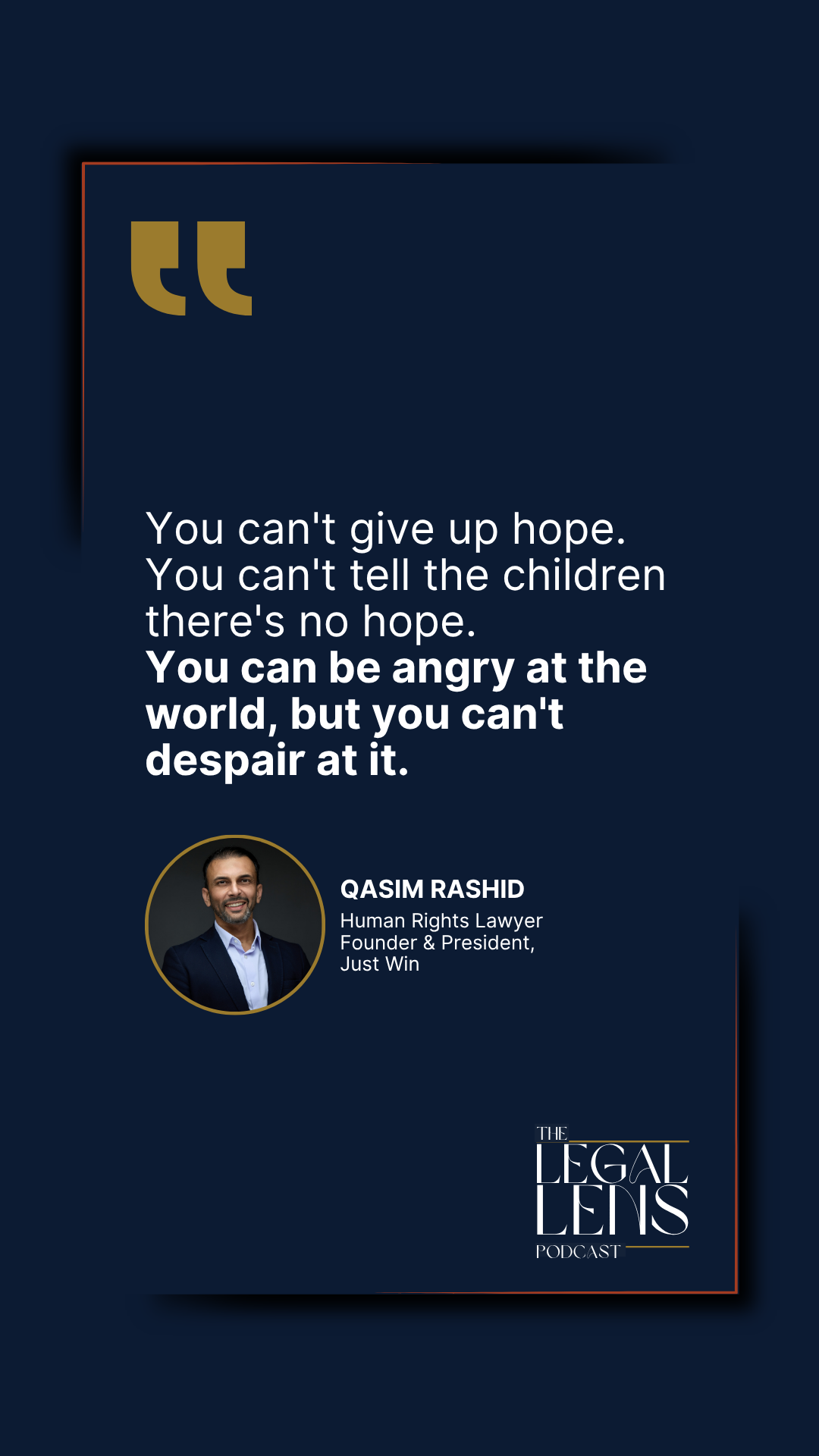
A Radical Note of Hope: Rebuilding Civil Discourse Locally
In an era marked by intense political polarization, Qasim concludes with an actionable blueprint for restoring civil discourse. He argues that polarization thrives when human beings allow one another to be dehumanized from behind digital screens. The antidote to bigotry is direct, localized engagement.
“There’s no better destruction of bigotry than breaking bread together… People have a very difficult time hating you when they see you advocating for the basic human dignities that every person deserves.”
— Qasim Rashid
By getting involved in local city council meetings, supporting neighborhood anti-poverty initiatives, and building multi-faith coalitions, everyday citizens can bypass national political cynicism and build tangible, resilient communities.
Hear More from Experts Like Qasim Rashid by Subscribing to the Legal Lens Podcast!
I have dedicated my career to helping litigants resolve complex legal disputes through mediation and dispute resolution, and to dissecting the legal issues that shape our public discourse and workplace dynamics.
My mission as the host of the Legal Lens radio show and podcast on KBLA Talk 1580 is to empower you with objective, expert-driven insights born from years of practice at the intersection of law and society. We are here to “Bring Light to Law” and break down complex concepts into clear, everyday language.
Download and subscribe to The Legal Lens podcast today by clicking below to hear more insights from leading experts like Qasim Rashid:


To learn about all things Legal Lens, follow me on Instagram @iamangelareddockwright.
More About Qasim Rashid
You can follow Qasim Rashid and learn more about his work at qasimrashid.com, subscribe to his Substack Let’s Address This, and support the voter registration drive at 1000milestomemphis.com.
Angela’s Other Work
Learn more about my book – The Workplace Transformed: 7 Crucial Lessons from the Global Pandemic – here.
Learn more about my work as an employment and Title IX mediator at Angela J. Reddock-Wright | Signature Resolution and on LinkedIn @Angela J. Reddock-Wright, Esq., AWI-CH.
Book Angela
For media or booking inquiries, please reach out to kyle@kwsmdigital.com.
This communication is not legal advice. It is educational only. For legal advice, consult with an experienced employment or civil rights law attorney in your state or city.