

As an employment law mediator and host of The Legal Lens on KBLA Talk 1580, I aim to “Bring Light to Law” by unpacking the complex laws and policies that shape our society.
Each week, I moderate timely conversations designed to educate, engage, and empower listeners to better understand the laws and rules governing our modern world.
This week, I had the privilege of welcoming Attorney Nora Ahmed to the show. Nora serves as the Legal Director for the American Civil Liberties Union (ACLU) of Louisiana, where she has built one of the most consequential civil rights dockets in the Deep South since joining the affiliate in 2020.
We explored her journey to the ACLU, the Justice Lab’s strategic mission, the unique challenges of litigating in the Fifth Circuit, and the ongoing fight for equitable voting rights in Louisiana.
Listen to the full conversation with Nora Ahmed below:
Navigating the Episode: Time Stamps
- 02:18: A Personal “Why”: A Sense of Belonging
- 06:01: The Journey to the ACLU
- 08:21: Changing the Face of Civil Rights Litigation
- 16:51: Policing Work as First Amendment Work
- 20:39: Navigating the Fifth Circuit Court of Appeals
- 28:54: The Justice Lab: Redefining Case Value in Policing
- 34:09: Voting Rights and Louisiana v. Callais
A Personal “Why”: Fighting for the Soul of the Nation
Born and raised in Oregon to an Egyptian Muslim father and a South Asian Indian Hindu mother, Nora shared that her commitment to civil rights is deeply personal. Growing up at the intersection of different cultures, she developed a profound understanding of what it means to seek a sense of belonging.
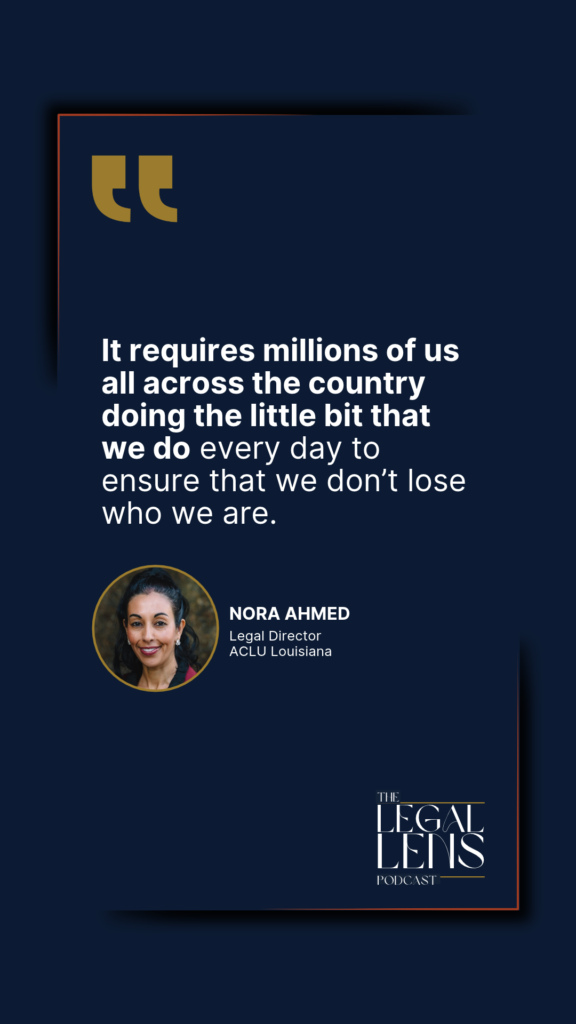
“Right now, we’re fighting for the soul of this nation. So, there’s nothing more that I would rather be doing right now than the work that we do every day… it requires millions of us all across the country doing the little bit that we do every day to ensure that we don’t lose who we are.”
– Nora Ahmed
Reframing Civil Rights in the Deep South
After graduating during the Great Recession and spending years at a large New York law firm, Nora transitioned to the ACLU of Louisiana during the pandemic. Under the leadership of Executive Director Alanah Odoms, the affiliate launched a deliberate mission to pivot its docket.
Nora explained that historically, leading civil rights cases often featured affluent, white litigants who actively sought out free legal representation for constitutional issues. The ACLU of Louisiana chose a different path: actively engaging the community to ensure its docket focused on Black voices.
According to Nora, this required breaking down social conditioning to recognize how constitutional principles apply across different scenarios. She pointed out that policing work is fundamentally First Amendment work.
When a police officer stops a young Black man without cause and issues a cover charge for resisting arrest simply because the individual asked why they were being stopped, Nora noted that this is a clear case of First Amendment retaliation.
Navigating the Fifth Circuit & Mass Detention
Litigating civil rights in the Deep South means navigating the United States Court of Appeals for the Fifth Circuit, which covers Texas, Louisiana, and Mississippi. Nora discussed how the court’s composition has changed over the years, making it a highly challenging venue for civil rights and civil liberties progress.
This dynamic is especially prominent in immigration. Nora shared that Louisiana is home to the only detention center attached to an airstrip, making it a massive hub for mass detention and deportation.
Nora highlighted Buenrostro, a key habeas corpus case before the Fifth Circuit, which challenged mandatory detention practices for long-term immigrants as a violation of basic due process.
Because the Fifth Circuit handles these cases, Nora explained that immigrants detained in this jurisdiction often face legal interpretations that make release much more difficult compared to other circuits.
The Justice Lab: Redefining Impact Litigation
To combat these hurdles, the ACLU of Louisiana utilizes the Justice Lab program. Nora detailed how their approach to impact litigation involves flooding the lower courts with cases to shift the narrative, rather than only taking cases involving severe physical injury or death.
Nora explained that the ACLU is redefining police liability by bringing cases that defendants historically deemed “valueless.”
The Johnson Case
A Black mother was being beaten by police while her son recorded the incident. When the officer pointed a taser at the boy and threatened him, the defense argued the boy suffered no physical injury and valued the claim at under $10,000. However, the ACLU fought to keep state tort claims of Intentional Infliction of Emotional Distress (IIED) alongside constitutional claims.
A jury ultimately awarded $185,000 (which grew to over $200,000 following Fifth Circuit appeals), fundamentally changing how insurance companies and municipalities value emotional trauma in Louisiana policing cases.
The Hankins Case
Three young Black boys were driving slowly through a neighborhood searching for a lost dog in a Mercedes, having pre-notified residents. Cops stopped and harassed them under the assumption the vehicle was stolen.
After losing at the trial court level due to qualified immunity, Nora and her team secured a landmark Fifth Circuit decision that established racial profiling can be evaluated directly through the Fourth Amendment without requiring explicit racial slurs.
Voting Rights and Louisiana v. Callais, and Local Action
Nora emphasized the critical importance of voter mobilization ahead of this year’s midterm elections.
The ACLU of Louisiana has been on the front lines of the state’s redistricting battles, serving as counsel on Robinson — which successfully fought to establish two Black opportunity districts in the state — before intervening in Louisiana v. Callais.
While legal battles over Section 2 of the Voting Rights Act continue, Nora stressed that real change requires making smaller, local races competitive. She pointed out that many school board, alderman, and municipal judicial seats run completely unopposed, leaving communities without true local representation.
“We have to believe change is possible, and part of believing change is possible is not accepting what those in power are saying the outcome will be.”
– Nora Ahmed
Subscribe to The Legal Lens Now for More from Experts Like Nora Ahmed
Whether dissecting civil rights litigation in the Deep South or navigating complex workplace dynamics, I have dedicated my career to helping individuals and organizations resolve conflict through mediation and dispute resolution.
My mission as the host of The Legal Lens podcast and radio show on KBLA Talk 1580 is to empower you with objective, expert-driven insights born from years of practice at the intersection of law and society.
We are here to “Bring Light to Law,” breaking down complex constitutional battles and everyday legal concepts into clear, actionable language.
Download and subscribe to the Legal Lens podcast today to hear more insights from leading experts like Nora Ahmed.
To download and listen to the show with Nora Ahmed on Apple or Spotify, click below:


Follow Nora Ahmed and the ACLU of Louisiana at laaclu.org to stay updated on their critical civil rights work.
Angela’s Other Work
Click here to learn about and order my book, The Workplace Transformed: 7 Crucial Lessons from the Global Pandemic.
Learn more about my work as an employment and Title IX mediator at Angela J. Reddock-Wright | Signature Resolution and on LinkedIn.
Book Angela
For media or booking inquiries, please reach out to kyle@kwsmdigital.com.
This communication is not legal advice. It is educational only. For legal advice, consult with an experienced employment or civil rights law attorney in your state or city.