

Many care professionals navigate a legal landscape where certain statutory workplace protections do not strictly apply to their daily employment. The National Domestic Workers Alliance focuses on establishing updated frameworks for the rights, wages, and employment conditions of the individuals within the private care economy. As our demographics shift and the need for care expands, analyzing the legal structures that govern this workforce becomes essential for both employers and employees.
My recent conversation with Jen Stowe on The Legal Lens podcast explored the structural efforts working to define this industry. By organizing nannies, house cleaners, and home care workers, advocates are systematically addressing historical labor laws that omit these professionals. We are currently observing a focused movement to secure both federal and state legislation that establishes standard parameters, such as paid sick leave and overtime regulations, for these essential roles.
Navigating the Episode: Time Stamps
- 00:00:00 – Introduction to Jen Stowe and Her Roots
- 00:04:30 – What is the National Domestic Workers Alliance?
- 00:06:21 – The Legacy of Dorothy Bolden, Mother of the Private Domestic Workers’ Movement
- 00:10:09 – The Current State of Care Professionals in the U.S.
- 00:14:45 – The Growing Need for the Care Economy
- 00:24:30 – Policy, Civic Engagement, and Voting Initiatives
- 00:29:57 – Community Organization and Looking Forward
How Does Personal Legacy Inform Labor Leadership?
Understanding the modern labor landscape often requires examining the personal histories of those leading the operational strategies today. Jen Stowe brings a deeply rooted, generational perspective to her role as Executive Director. Her connection to this sector is not solely academic; it’s intertwined with her family history and her identity as a Southern woman.
Stowe’s grandmother served as a house cleaner in the South for the majority of her life, and performed her duties within an industry that offered little in the way of formal legal security or traditional employment contracts. This generational background influences Stowe’s current mission to elevate the visibility of Black women, immigrant women, and women of color who constitute a large segment of the care economy.
By grounding her leadership in her family’s lived experience, Stowe bridges the gap between historical employment conditions and modern policy action. Through her organizational work, she highlights the importance of transitioning these roles into formally recognized and protected professions.
“I stand really tall on her shoulders, my other grandmother’s shoulders, our foremothers, and the generations before me. So I come to this work really as a descendant of a domestic worker, but also someone who deeply cares for my community and my daughter.” — Jen Stowe
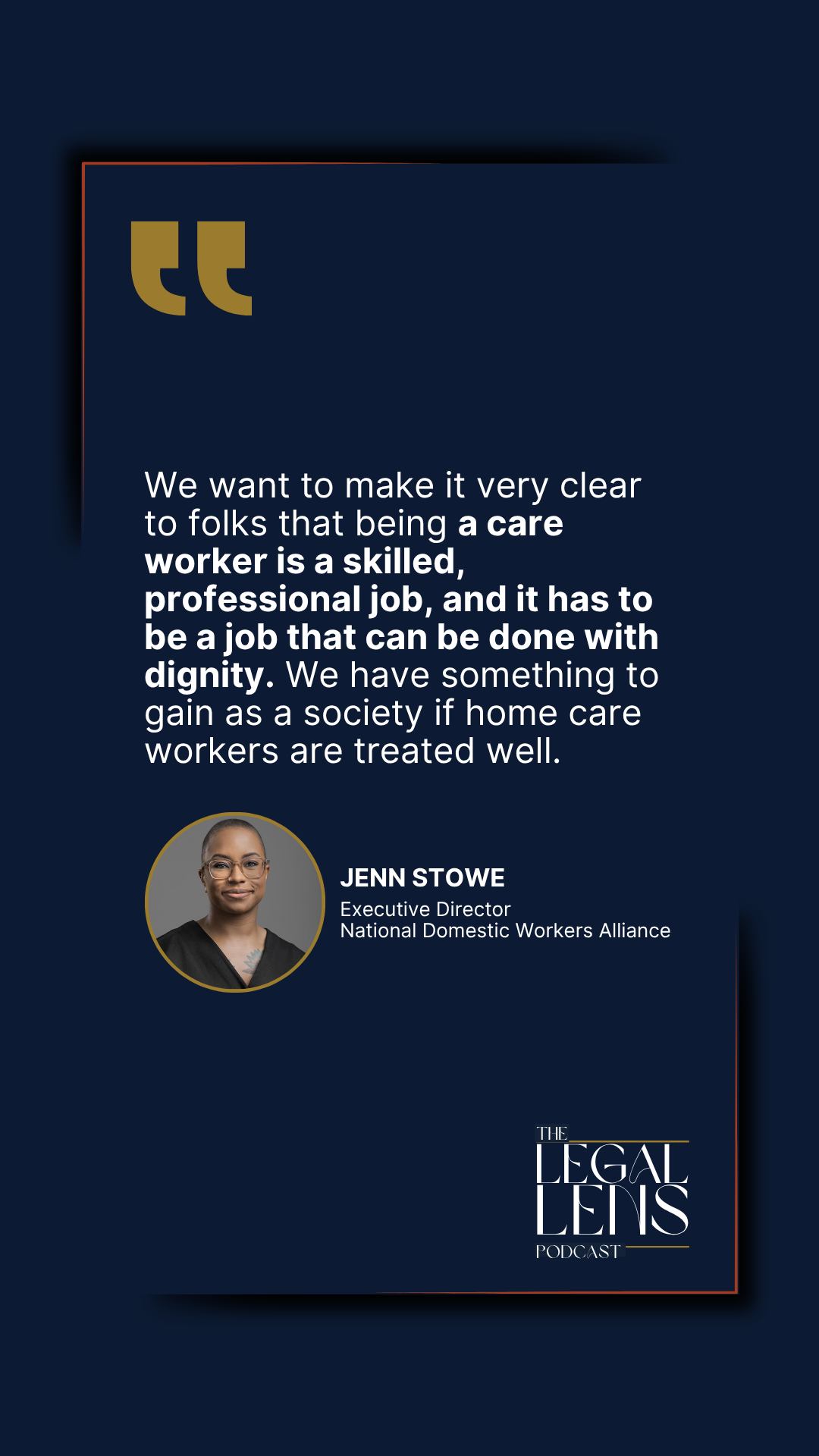
What is the National Domestic Workers Alliance?
The National Domestic Workers Alliance is a membership-driven organization focused on securing established wages, legal protections, and employment standards for nannies, house cleaners, and home care workers across the United States. Founded nearly two decades ago in 2007, this coalition serves as a primary representative body for a workforce that has historically operated independently inside private homes. Over the years, the organization has expanded to encompass over 70 affiliates and chapters nationwide, providing a centralized resource for a highly decentralized labor pool.
Unlike traditional labor unions, this alliance operates as a non-profit organizing body. Because these professionals work directly for individual families rather than large corporate entities, standard collective bargaining mechanisms under the National Labor Relations Act (NLRA) are often legally inapplicable. The organization steps into this void to provide a unified platform and legal guidance for these independent workers. The alliance provides resources to help workers navigate contracts, understand local wage laws, and address shifting responsibilities, such as those that occurred during the remote work transition.
“We represent the 2.2 million women in this country who clean homes, take care of our aging and disabled loved ones, take care of our kids, and they work inside of private homes. So there would be no one to bargain or unionize with. Yes, so we really represent some of the most invisible women in the workforce…” — Jen Stowe
Who Was Dorothy Bolden?
Dorothy Bolden, considered the Mother of the private domestic workers’ movement, was a pivotal figure in labor history and the founder of the National Domestic Workers Union in Atlanta, establishing a historical precedent for the modern labor frameworks within the care sector. While prominent federal legislative figures often dominate the historical narrative of labor rights, Bolden’s localized organizing strategies laid the foundation for contemporary engagement in the South. She recognized that economic advancement and civic participation were closely connected for Black women working in private homes during that era.
Bolden’s methodology integrated workplace advocacy with direct political action. When an individual signed up to join her union, she incorporated voter registration into the membership process. This holistic approach to organizational empowerment continues to influence the strategies utilized by modern advocates pushing for systemic policy changes across local and state governments. Recognizing her historical footprint means understanding that the ongoing discussions regarding fair wages have long been tied to civic participation and electoral engagement.
“…she is a genius of the South, and we really organize in her footsteps. She left a clear kind of like plan for how we need to organize domestic workers in the country.” — Jen Stowe
Why Do Domestic Workers Navigate Different Legal Frameworks?
Many domestic workers navigate different legal frameworks today because they were explicitly excluded from several foundational labor reforms passed during the 1930s New Deal. When Congress drafted landmark legislation establishing the minimum wage, overtime pay, and the right to collective bargaining—such as the Fair Labor Standards Act (FLSA)—specific sectors of the economy were carved out of the protections. Historical records and legislative transcripts indicate these exclusions were influenced heavily by the political and racial dynamics of the era.
By omitting agricultural laborers and those working in private homes, the federal government established a distinct legal category for a workforce predominantly composed of Black individuals at the time. This historical legislative compromise created a precedent that persists into the present day, leaving millions of modern caregivers to rely on a patchwork of state and local laws rather than universal federal guarantees for things like paid sick leave or mandatory overtime compensation. Addressing this legislative gap remains a primary policy goal for the National Domestic Workers Alliance as they lobby for a comprehensive, modernized federal standard.
“Dixiecrats lobbied to the high heavens to make sure that farm workers and domestic workers were not included because they were Black folks.” — Jen Stowe
Related Article: Kendall Scudder: Why the Texas Democratic Fight Defines the Future of America
How is the Evolving Care Economy Impacting Labor?
Stowe reminds us that e are currently navigating a significant shift that is actively altering the American economy and the labor market. As the baby boomer generation continues to age, the statistical demand for professional caregivers is increasing at an unprecedented rate. Simultaneously, younger generations face the logistical challenges of securing childcare while managing the demands of their own careers. The necessity for reliable care infrastructure is a universal pressure point that intersects with every political affiliation, geographic region, and socioeconomic bracket.
Despite this clear demand, the industry is experiencing a labor shortage heavily influenced by wage disparities and varying working conditions. Individuals seeking employment frequently transition to alternative sectors, such as retail, logistics, or food service, where baseline pay rates and corporate benefits are more standardized. To stabilize the care economy, advocacy groups argue that the jobs themselves must be restructured to attract and retain talent.
According to Stowe, addressing this complex economic issue requires a multi-pronged approach that brings together diverse stakeholders:
- Policy Makers: State and federal legislators are being called upon to draft bills that mandate minimum wage increases and establish baseline working conditions specifically for the care sector.
- Employers and Families: Private households that employ care professionals are encouraged to adopt formal contracts and advocate for broader legal protections for their employees.
- Business Leaders: The broader corporate community is beginning to recognize that their own workforce’s productivity is directly tied to the availability of reliable care infrastructure.
By building broad coalitions, the National Domestic Workers Alliance seeks to demonstrate that formalizing and supporting this workforce yields structural stability for the broader economy.
“You’re going to either need to be cared for, or you’re going to care for someone else. Many of us are in this sandwich generation, so we are doing both, and we’re being crushed.” — Jen Stowe
What is the Strategy Behind “We Dream in Black”?
To effectively mobilize a massive, decentralized workforce, organizations often establish specialized initiatives that address the specific cultural, historical, and regional contexts of their members. The National Domestic Workers Alliance implements this strategy through targeted programs like “We Dream in Black” (We DIB). This specific project is designed to organize and elevate the presence of Black women across the diaspora who are employed within the care economy.
Creating dedicated cohorts for specific demographics allows organizations to tailor their educational resources and civic training. In Southern states, where union density is historically low and “right-to-work” laws shape the legislative environment, these culturally specific organizing models offer a highly effective alternative for building consensus. They provide a structured network of professional support, legal education, and policy training for individuals who are otherwise isolated in separate, private employment settings.
“…this project organizes Black domestic workers so Black domestic workers who represent Black women across the diaspora. And we have chapters all over the country.” — Jen Stowe
How Does Care in Action Approach Civic Engagement?
Care in Action operates as a political organization that mobilizes women of color in Southern states to participate in civic engagement, focusing on care-centric policies and electoral processes. As a sister organization to the National Domestic Workers Alliance, this entity focuses its operational efforts in key states like Georgia, North Carolina, South Carolina, and Virginia. Their stated objective is to facilitate the political involvement of marginalized women to influence legislative outcomes, voter turnout, and public policy decisions.
The current judicial and legislative environment presents a complex matrix of changing voting laws and redistricting efforts. Recent state-level legislative sessions and court rulings frequently alter the parameters of voter participation, which can directly impact the ability of minority communities to elect representatives who prioritize labor rights. Care in Action responds to these shifting legal landscapes by organizing direct voter contact initiatives, funding grassroots education, and formally endorsing candidates who align with their policy objectives regarding the care economy.
“Care in Action is political organization that organizes women of color. So not just domestic workers, but women of color all over the South… We wanna make sure that folks in those states know that they should vote on behalf of care policy.” — Jen Stowe
Related Article: Kellie Todd Griffin & The California Black Women’s Collective: Advocating for Economic Empowerment & Mobility for Black Women
The Role of Community Organization in Modern Policy
According to Stowe, navigating the shifting dynamics of labor rights, employment law, and democratic institutions requires consistent engagement and strategic planning. The future of the care economy is heavily dependent on the organizational efforts of groups operating at the community level. As the United States looks toward its 250th anniversary, the narrative of civic participation is being actively shaped by immigrant workers, Black women, and community advocates utilizing their constitutional rights to petition for legislative updates and systemic inclusion.
Whether analyzing major federal legislative proposals or local municipal ordinances, the catalyst for legal evolution remains organized civic action. Grassroots advocates demonstrate that strategic community alignment can systematically address complex legal and economic hurdles. For those analyzing employment trends or looking to understand the future of work, evaluating the efforts of community organizations provides a clear indicator of where labor policy is heading. Engaging with and understanding these movements is an essential part of observing how we will continuously transform our workplaces and society.
“One of the most patriotic things you could do is organize for workers’ rights and dignity… I see so many folks connecting with their communities and their neighbors, so that really gives me hope. At the end of the day, we have people power.” — Jen Stowe
Want to Hear More from Experts Like Jen Stowe? Subscribe to the Legal Lens Podcast Today!
I have dedicated my career to helping litigants resolve their legal disputes through the mediation and dispute resolution process, and by helping dissect the legal issues that shape our public discourse and workplace dynamics, whether it be as a radio and podcast show host, or as a legal analyst in the news.
My mission as the host of the Legal Lens radio show and podcast is to empower you with objective, expert-driven insights born from years of practice at the intersection of law and society.
Download and subscribe to the Legal Lens podcast today to hear more insights from leading experts like Jen Stowe.
To download and listen to the show with Jen Stowe on Apple or Spotify, click below:


To learn about all things Legal Lens, follow me on Instagram @iamangelareddockwright.
Follow the National Domestic Workers Alliance on social media at @domesticworkers and visit their website, here – https://www.domesticworkers.org/
Angela’s Other Work
Learn more about my book – The Workplace Transformed: 7 Crucial Lessons from the Global Pandemic, here – https://angelareddock-wright.com/book/
Learn more about my work as an employment and Title IX mediator here Angela J. Reddock-Wright | Signature Resolution and on LinkedIn @Angela J. Reddock-Wright, Esq., AWI-CH.
Book Angela
For media or booking inquiries, please reach out to danny@kwsmdigital.com.
This communication is not legal advice. It is educational only. For legal advice, consult with an experienced employment or civil rights law attorney in your state or city.