

This week I was thrilled to welcome Camille McCallum, the Dallas-based founder of Black Women on a Mission and the 92% Club, to The Legal Lens on KBLA Talk 1580. As a digital creator with nearly 400,000 followers, Camille represents the new age of communication, bringing a new generation of listeners into the civic process.
In this episode, we explored her Deep South roots, the evolution of her collegiate ambassador programs, the economic concerns currently top of mind for Black women, and actionable steps for navigating systemic voting barriers.
Navigating the Episode: Time Stamps
- 02:47: A Personal “Why:” A Legacy of Civic Duty
- 05:31: Black Women on a Mission: From Apparel to Advocacy
- 09:54: The 92% Club: Creating a Safe Space for Policy Dialogue
- 12:26: Combating Apathy and Systemic Barriers on College Campuses
- 15:17: A Four-Step Voting Plan for the Midterms
- 23:27: Economic Realities: Affordability and Government Layoffs
- 28:01: The Power of Digital Creators in the Modern Era
A Legacy of Civic Duty
Born and raised in Mississippi, Camille’s Deep South roots profoundly inform her perspective. She recounted her family’s powerful trajectory — from a grandmother born in 1925 who did not initially have the right to vote, to living to see the election of Barack Obama and watching Camille take her first job on Capitol Hill.
As a Millennial born in 1994 with younger Gen Z siblings, Camille has a unique vantage point on the generational shifts in political engagement. This legacy of resilience drives Camille’s refusal to be a ‘standby citizen.’
“So much of that has informed my work of just not wanting to be a standby citizen and wanting to be involved in the political process.”
– Camille McCallum
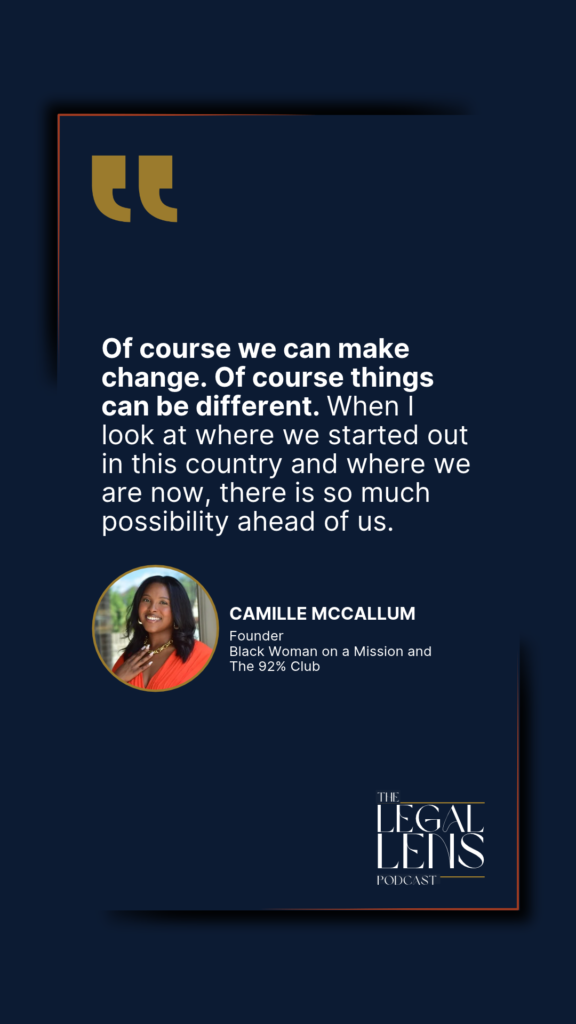
Although she ultimately moved away from Capitol Hill to pursue digital creation, her public policy background came full circle, fueling her mission to demystify government operations for her audience.
Black Women on a Mission: From Apparel to Advocacy
Founded in 2020, Black Women on a Mission originally started as a clothing brand. As the community grew, however, Camille recognized deeper systemic needs. The organization evolved, launching a scholarship program to address the “gap funding” that often forces college students to drop out after their freshman year.
Today, the organization boasts a robust collegiate ambassador program supporting 300 young women across 70 campuses nationwide — ranging from HBCUs to Ivy League institutions like Harvard. These ambassadors host campus events focused on leadership, financial literacy, and civic education.
According to Camille, students are combining voter registration with culturally relevant gatherings, such as natural hair workshops, to ensure their peers are registered and equipped with specific voting plans.
Systemic Barriers and the Youth Vote
While Gen Z and millennials are highly engaged, Camille noted that college students often face significant hurdles to ballot access. She highlighted systemic barriers, such as a polling location being removed from the North Carolina A&T campus, forcing students to travel 40 minutes to cast their vote.
Related Podcast: What Does Democracy Really Mean? A Conversation with Democracy Forward CEO Skye Perryman
Camille also stressed that students are facing direct policy threats to their futures, pointing to new federal rules attempting to eliminate student loan funding for liberal arts majors.
“Sometimes people think their vote doesn’t count. But when I look at the sweeping changes that have happened in our government over the last two years, I’m like, ‘Well, somebody’s votes definitely counted.’”
– Camille McCallum
Camille pointed out that these obstacles are often deliberately placed at both the local and federal levels, increasing the priority for students to request absentee ballots early. To date, Black Women on a Mission has successfully helped students request over 150 absentee ballots and develop countless individualized voting plans.
The 92% Club: Navigating Economic and Policy Shifts
Following the 2024 election, Camille launched the 92% Club — named in recognition of the 92% of Black women who voted Democrat. The initiative began as a series of monthly virtual meetups designed to give women a safe, two-way dialogue space outside of the traditional social media news cycle.
During these sessions, Camille brings in elected officials and policy experts to break down complex legislation, including stark realities like Project 2025 already being “about 90% implemented.” When asked what issues are currently top of mind for her community, Camille emphasized affordability and unemployment.
She shared her community’s concerns regarding the Department of Government Efficiency (DOGE), noting estimates that between 300,000 and 600,000 Black women have lost their jobs or been pushed out of the workforce due to recent government layoffs.
Additionally, Camille noted that medical professionals in her network are expressing deep frustration over policymakers unilaterally regulating health and medicine, leading some to consider leaving the profession entirely.
The Power of Digital Creators in the Modern Era
With the majority of Gen Z and millennials receiving their news via social media, Camille emphasized the critical role digital creators play in fighting mis- and disinformation.
She recently took this advocacy to Washington, attending the Congressional Black Caucus Legislative Conference in partnership with TikTok to educate policymakers on the creator economy.
Whether a creator focuses strictly on politics or weaves civic awareness into lifestyle and beauty content, maintaining an accurate, trusted voice is essential for keeping the electorate informed.
A Three-Step Voting Plan
As a precinct chair in her Dallas community, Camille is heavily focused on grassroots organizing for Texas’s potential as a swing state, rallying support for candidates like James Talarico and Jenna Hinojosa.
Related Article: The Legacy of the 1965 Voting Rights Act & Modern Workplace Voting Mandates
Camille frequently reminds her neighbors that “the person at the bottom of the ballot is the person closest to you.” She left listeners with a straightforward, three-step voting plan for the upcoming midterms:
- Check your voter registration status at iwillvote.com.
- Research your sample ballot at ballotpedia.com.
- Locate your exact polling place via your county election website.
Also, Camille advises voting early, and treating Election Day as the last day to vote, not the first.
“Never forget that a small group of committed citizens can change the world. Indeed, it’s the only thing that ever has.”
– Camille McCallum
Hear More from Experts Like Camille McCallum – Subscribe to the Legal Lens Podcast Now!
Whether dissecting civic engagement in the digital age or navigating complex workplace dynamics, I have dedicated my career to helping individuals and organizations resolve conflict through mediation and dispute resolution.
As the host of The Legal Lens radio show and podcast on KBLA Talk 1580, my mission is to empower you with objective, expert-driven insights born from years of practice at the intersection of law and society. We are here to “Bring Light to Law,” breaking down complex policies and everyday legal concepts into clear, actionable language.
Download and subscribe to The Legal Lens podcast today to hear more insights from leading experts like Camille McCallum.
To download and listen to the show with Camille McCallum on Apple or Spotify, click below:


To keep up with all things Legal Lens, follow me on Instagram at @iamangelareddockwright.
Follow Camille McCallum at @CamilleViviana, Black Women on a Mission at @BLKWomanOnAMission, and The 92% Club at @92PercentClub_.
Angela’s Other Work
Click here to learn about and order my book, The Workplace Transformed: 7 Crucial Lessons from the Global Pandemic.
Learn more about my work as an employment and Title IX mediator at Angela J. Reddock-Wright | Signature Resolution and on LinkedIn @Angela J. Reddock-Wright, Esq., AWI-CH.
Book Angela
For media or booking inquiries, please reach out to Kyle@kwsmdigital.com.
This communication is not legal advice. It is educational only. For legal advice, consult with an experienced employment or civil rights law attorney in your state or city.