

On The Legal Lens, we bring law to light by exploring the critical legal and policy issues impacting your daily life. This week, I had the distinct honor of welcoming Rev. Lennox Yearwood Jr., the President and CEO of the Hip Hop Caucus.
As we look at today’s political and social climate, understanding what is at stake requires us to hear from leaders who are actively navigating complex community and policy challenges on the ground. Rev. Yearwood is a minister, community activist, and U.S. Air Force veteran whom the Obama White House recognized as a “Champion of Change.”
In our powerful conversation, Rev. Yearwood broke down the critical intersections of climate justice, voting rights, and how culture can be leveraged to drive systemic legal change.
Listen to the full conversation with Rev. Lennox Yearwood Jr. below:
Navigating the Episode: Time Stamps
- 02:40: Honoring Lost Lives: The Story Behind the Hats
- 05:40: Growing Up in “Cancer Alley” and the Roots of Activism
- 09:10: The Birth of the Hip Hop Caucus
- 16:15: “Demonstration Without Litigation Leads to Frustration”
- 23:45: Environmental Racism and “Sacrifice Zones”
- 28:50: Protecting the Vote & The Respect My Vote Campaign
- 31:30: Using Film and Storytelling to Drive Change
Honoring Lost Lives: The Story Behind Rev. Lennox Yearwood Jr.’s Hats
If you have ever seen Rev. Yearwood in public, you have likely noticed his signature hats. During our interview, he wore a hat bearing the words “Be Good,” which he explained was in memory of Renee Good, a woman who was killed in Minneapolis by ICE.
Rev. Yearwood shared that over his 22 years doing this work, his team has provided him with over 1,000 different hats to honor individuals whose lives were tragically cut short, including Trayvon Martin and Sandra Bland, as well as to highlight pressing issues like voting rights and climate justice. These hats serve as a visual, everyday challenge to remember the human lives sacrificed within the movement and to carry their legacies forward.
Growing Up in “Cancer Alley” and the Roots of Activism
To understand Rev. Yearwood’s drive, one must look at his roots in Louisiana — specifically, an 85-mile stretch of land between New Orleans and Baton Rouge known as “Cancer Alley“.
“We have so many petrochemical facilities that we have the highest rates of cancer in the world… predominantly Black, Brown and Indigenous, unfortunately sometimes poor communities.”
— Rev. Lennox Yearwood Jr.
Rev. Yearwood explained that this region is heavily populated by petrochemical facilities that produce oil and gas used to make plastic. Transforming “Cancer Alley” into an “Opportunity Alley” away from the fossil fuel industry remains a central driving force in his life. Additionally, the devastating impact of Hurricane Katrina on his home state further catalyzed his deep involvement in environmental justice work.
The Birth of the Hip Hop Caucus
Rev. Yearwood’s title as “Rev” carried over from his time serving as a chaplain in the U.S. Air Force. During that period, he was active with Veterans for Peace and frequently attended anti-war rallies. However, he noticed a stark reality: the progressive movement was heavily siloed and segregated.
Environmental and peace rallies were predominantly attended by white advocates, while organizations fighting for Black lives, queer rights, or immigration operated in their own distinct lanes, despite often battling the exact same systemic entities.
The Hip Hop Caucus was born at the end of the 2004 election cycle to bridge this divide. Rev. Yearwood recognized that culture — through music, art, and theater — possessed a unique ability to bring diverse demographics together in ways that data and research often could not.
“Demonstration Without Litigation Leads to Frustration”
One of the most profound insights Rev. Yearwood shared centered on the intersection of grassroots activism and the legal system. While marching and demonstrating are vital, they must be paired with strategic legal action.
“Demonstration without litigation leads to frustration… without the law, particularly in America, you really cannot create the change that you need to create.”
— Rev. Lennox Yearwood Jr.
He provided a striking example from Cancer Alley, where activists were initially losing a battle against a petrochemical company attempting to build a new polluting facility. The breakthrough came through legal strategy: they discovered a law prohibiting the construction of such facilities on burial grounds. Because the company was attempting to build on a former plantation site where enslaved ancestors were interred, the law prevented them from digging up the bodies, thereby legally halting the construction of the plant.
Related Article: Attorney Qasim Rashid on Human Rights, Disaster Relief, and Protecting the Vote
Environmental Racism and “Sacrifice Zones”
We explored why climate justice in Black communities must be prioritized as a foundational civil rights issue alongside voting and employment equity. Rev. Yearwood introduced the chilling concept of “sacrifice zones” — geographic areas systematically targeted by corporations for hazardous facilities.
He explained that these companies engage in environmental racism by placing toxic plants in vulnerable communities that they believe lack the political will or legal resources to fight back. The result is that Black, Brown, Indigenous, and poor communities are forced to breathe dirty air and drink polluted water, leading to heightened rates of asthma, emphysema, and cancer that literally shorten their lifespans for the sake of corporate profit.
Protecting the Vote & the Respect My Vote Campaign
Beyond environmental advocacy, the Hip Hop Caucus has been a staunch defender of democracy. Their Respect My Vote campaign recently celebrated its 18th anniversary.
For Rev. Yearwood, the fight for voting rights is deeply personal. He shared that his mother — an immigrant from Trinidad who earned a PhD and dedicated her life to the civil rights movement — passed away on May 1st, right as the Supreme Court issued rulings that gutted foundational voting rights protections. One of her final directives to him was to ensure the community never stops fighting for its democracy.
Using Film and Storytelling to Drive Change
To adapt to the modern era, the Hip Hop Caucus is heavily investing in film and television production. Quoting Toni Cade Bambara, Rev. Yearwood noted that “the role of the artist is to make the revolution irresistible”.
The organization is leveraging streaming platforms to tell crucial stories, including the Netflix documentary Plastic Detox (which examines how microplastics harm fertility), a project titled #WhileBlack analyzing the impact of social media during the George Floyd protests, and City in the Forest, a documentary covering the tragic death of non-binary environmental activist Tortuguita at the Cop City protests in Atlanta.
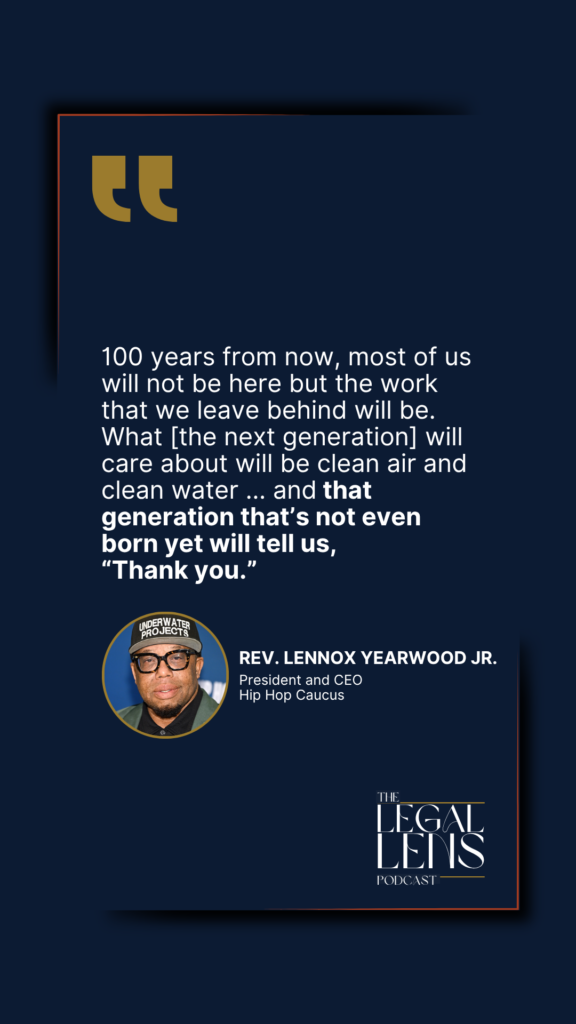
“Just know that 100 years from now in 2126 most of us who are listening to this show won’t be here. But the work that we will leave behind for the next generation will be.”
— Rev. Lennox Yearwood Jr.
Subscribe to the Legal Lens Podcast Now for More from Experts Like Rev. Yearwood!
As the host of the Legal Lens radio show and podcast, my mission is to empower you with objective, expert-driven insights born from years of practice at the intersection of law and society. I believe everyone can learn something new about the law and how it impacts the world we live in.
Download and subscribe to the Legal Lens podcast today to hear more insights from leading experts like Rev. Yearwood.
To download and listen to the show on Apple or Spotify, click below:


To learn about all things Legal Lens, follow me on Instagram @iamangelareddockwright.
Follow Rev. Lennox Yearwood Jr. and the Hip Hop Caucus on social media @hiphopcaucus and @RevYearwood.
Angela’s Other Work
Find out more about my work as an employment and Title IX mediator at Angela J. Reddock-Wright | Signature Resolution and on LinkedIn @Angela J. Reddock-Wright, Esq., AWI-CH.
Book Angela
For media or booking inquiries, please contact kyle@kwsmdigital.com.
This communication is not legal advice. It is educational only. For legal advice, consult with an experienced employment or civil rights law attorney in your state or city.