

 The intersection of law, policy, and representation has never been more critical. Whether I am analyzing high-profile workplace disputes on CNN, breaking down civil rights shifts for NBC, or providing legal commentary for People and CBS, my mission remains the same: bringing the law to light so you can move beyond the headlines and understand the forces shaping The United States.
In this watershed midterm election year, the American South has emerged as the ultimate testing ground for national policy. In the second Legal Lens episode of 2026, I sat down with a guest who is at the epicenter of this shift: Kendall Scudder, the Chair of the Texas Democratic Party. Kendall joined the show to pull back the curtain on the “Texas Framework”—a predictive model that he argues will define the national discussion on representation and civil rights for years to come.
For a deeper dive into these critical topics, I strongly encourage you to listen to our full discussion on The Legal Lens Podcast. You can find us on Apple Podcasts, Spotify, Simplecast, and everywhere you get your podcasts for free. You can also listen to the full episode in the player below:
Who is Kendall Scudder? A Legacy of Fighting for Others
To understand Scudder’s perspective on the current political climate, one must look at his roots. Growing up in a rural farming community in East Texas, his introduction to politics was born out of a perceived necessity for his family’s security.
“My moment of clarity came when I was a child… I grew up in a farming community in East Texas… but I had lesbian moms,” Scudder shared. He recounted that at age 12, when he felt legislative efforts in Texas threatened his home life, he began knocking on doors to advocate for his family.
Scudder eventually became the first in his family to attend college and went on to oversee half a trillion dollars in property value as the director of the appraisal district in Dallas County. This blend of grassroots experience and high-level administration informs his “bottom-up” philosophy. As he noted during the episode, “I’m a farm kid from East Texas… I just don’t take time off.”
Debunking the Myth: Is Texas a Republican Monolith?
A significant portion of our discussion focused on the misconception that Texas is a strictly Republican monolith. Scudder pointed to raw data to suggest that current GOP dominance may be a result of voter suppression rather than a lack of Democratic support. He highlighted that Texas is actually the second-biggest vote contributor to Democrats in the country, surpassed only by California.
“If the number of people who voted for Kamala Harris in ’24 were to show up and vote in this midterm, we’d run the table,” Scudder explained, characterizing Texas not as a “red state,” but as a “non-voting state.” He also observed a “California effect,” suggesting that while native Texans often trend more progressive, certain new residents moving to the state pull the political landscape further to the right.
Related Podcast Episode: Congresswoman Julie Johnson Joins the Legal Lens Podcast to Discuss the Government Shutdown, the Battle for Healthcare, and the Future of Redistricting in Texas and the U.S. Politics
The 2025 Redistricting: “Racial Pretense” and the Quorum Break
Our conversation took a deep dive into the 2025 redistricting efforts. In Texas, the state legislature is primarily responsible for redistricting, a process that typically occurs every 10 years following the census. However, Scudder provided a blunt timeline of how he believes recent maps were drawn to systematically impact Black representation.
“They are drawing it so that every Black member of Congress was drawn out of their district or their district was eliminated,” Scudder noted, emphasizing that Texas is a majority-minority state with more Black residents than any other state in the country.
In response to these maps, Texas Democrats took the dramatic step of “breaking quorum” by traveling to Chicago to block a legislative vote. Scudder mentioned that while a lower court initially ruled the maps were “clearly drawn on racial pretense,” the Supreme Court eventually allowed them to stand. Regarding the party’s stance moving forward, Scudder stated, “We’re here to throw punches… we’ve got nothing left to lose.”
Policy Division: A Rigged System?
Scudder’s analysis of current politics often reframes the “left vs. right” divide as a “top vs. bottom” struggle. He expressed deep concern for the economic hurdles facing the working class, illustrating the point with the rising cost of living.
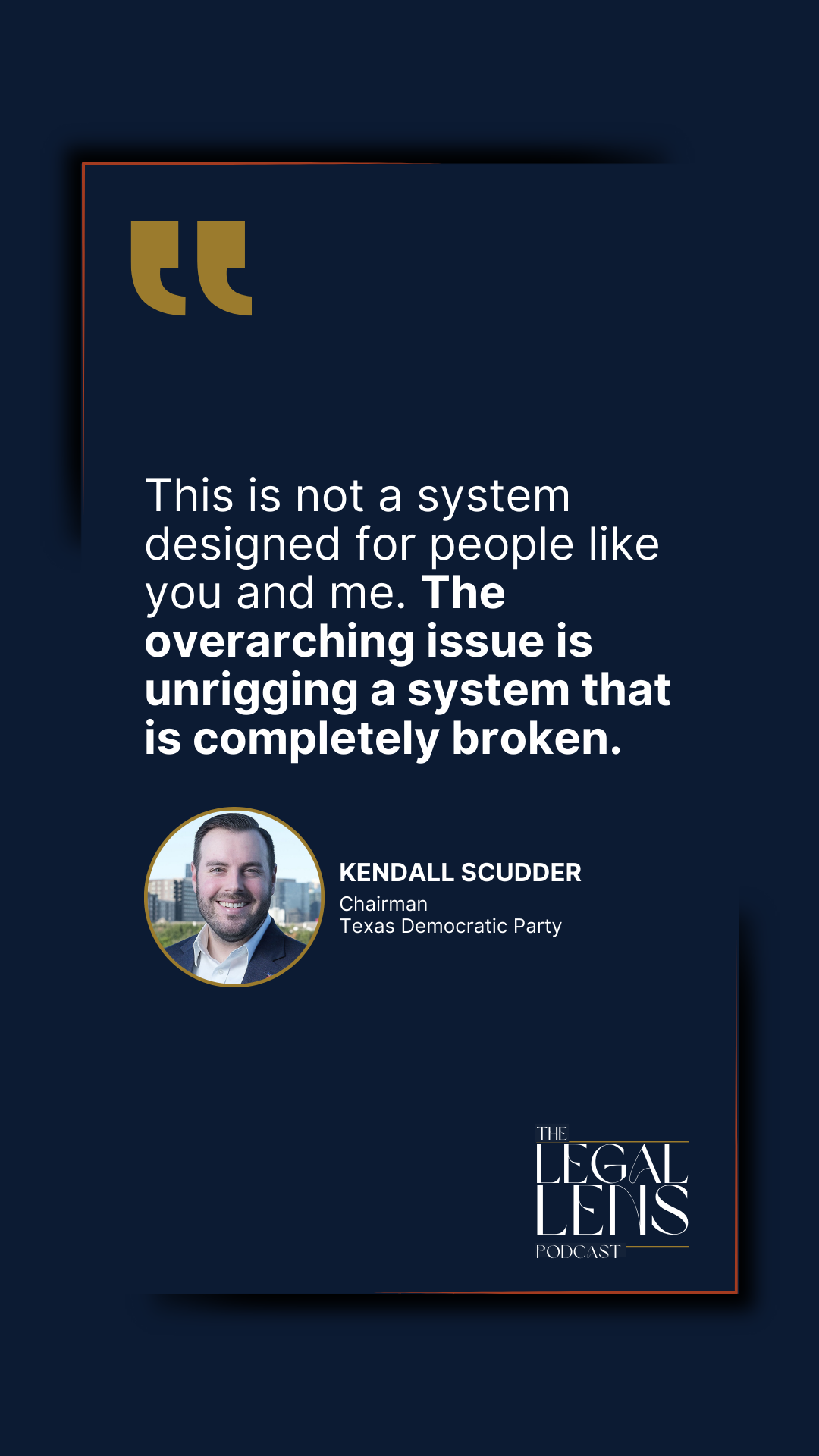
“If you are a minimum wage worker in Texas, you have to work an hour to buy one box of cereal,” Scudder lamented. His proposed solutions involve Democrats taking an “unapologetically bold” stance on working-class issues, such as expanding Social Security, ensuring preventative healthcare access, and increasing funding for public schools.
A Historic Milestone: Filling Every Seat
For the first time since 1974, the Texas Democratic Party has a candidate running for every single state and federal office on the ballot. Scudder explained this was a massive, intentional undertaking to ensure Republican candidates do not receive “free passes.”
He believes this “people power” model (utilizing neighborhood teachers and local leaders) is essential to reaching Texans who have felt ignored by the system. He highlighted leaders ranging from the outspoken Jasmine Crockett to consensus-driven figures like James Talarico as part of this drive for accountability.
Looking Toward the 2030 Census
The conversation concluded with a strategic outlook on the next decade. As populations shift toward the Sunbelt, Scudder argued that the path to the White House will soon be inextricably linked to Texas.
“The answer [to when Republicans will moderate] is when they lose Texas,” Scudder warned, suggesting that Texas must be “in play” for any party to capture the presidency after the next census. Despite the legal and economic hurdles, Scudder expressed hope, citing the grassroots support from people on fixed incomes as a signal that a broader movement is rising.
Related Podcast Episode: Attorney Yasmin Cader on the ACLU’s Fight for Democracy, Book Bans, and the Power of the People
Want to Learn More from Insightful Experts Like Kendall Scudder? Subscribe to the Legal Lens Podcast Now!
My conversation with Kendall Scudder offered insights that help shape the national dialogue during this time of great upheaval. Whether we are discussing justice and the rule of law or the nuances of trending cases, the goal remains the same: bringing the law to light so you can separate fact from spin.
I have dedicated my career to dissecting the legal issues that shape our public discourse and workplace dynamics. My mission as the host of the Legal Lens radio show and podcast is to empower you with the objective, expert-driven insights born from years of practice at the intersection of law and society.
Download and subscribe to the Legal Lens podcast today to hear more insights from leading experts like Kendall Scudder.
Follow the Legal Lens show on Instagram, Facebook, Apple Podcasts & Spotify here:




Learn more about my book – The Workplace Transformed: 7 Crucial Lessons from the Global Pandemic – here – https://angelareddock-wright.com/book/.
Learn more about my work as an employment and Title IX mediator here Angela J. Reddock-Wright | Signature Resolution and on LinkedIn@Angela J. Reddock-Wright, Esq., AWI-CH.
For media inquiries, please reach out to danny@kwsmdigital.com.
This communication is not legal advice. It is educational only. For legal advice, consult with an experienced employment or civil rights law attorney in your state or city.