

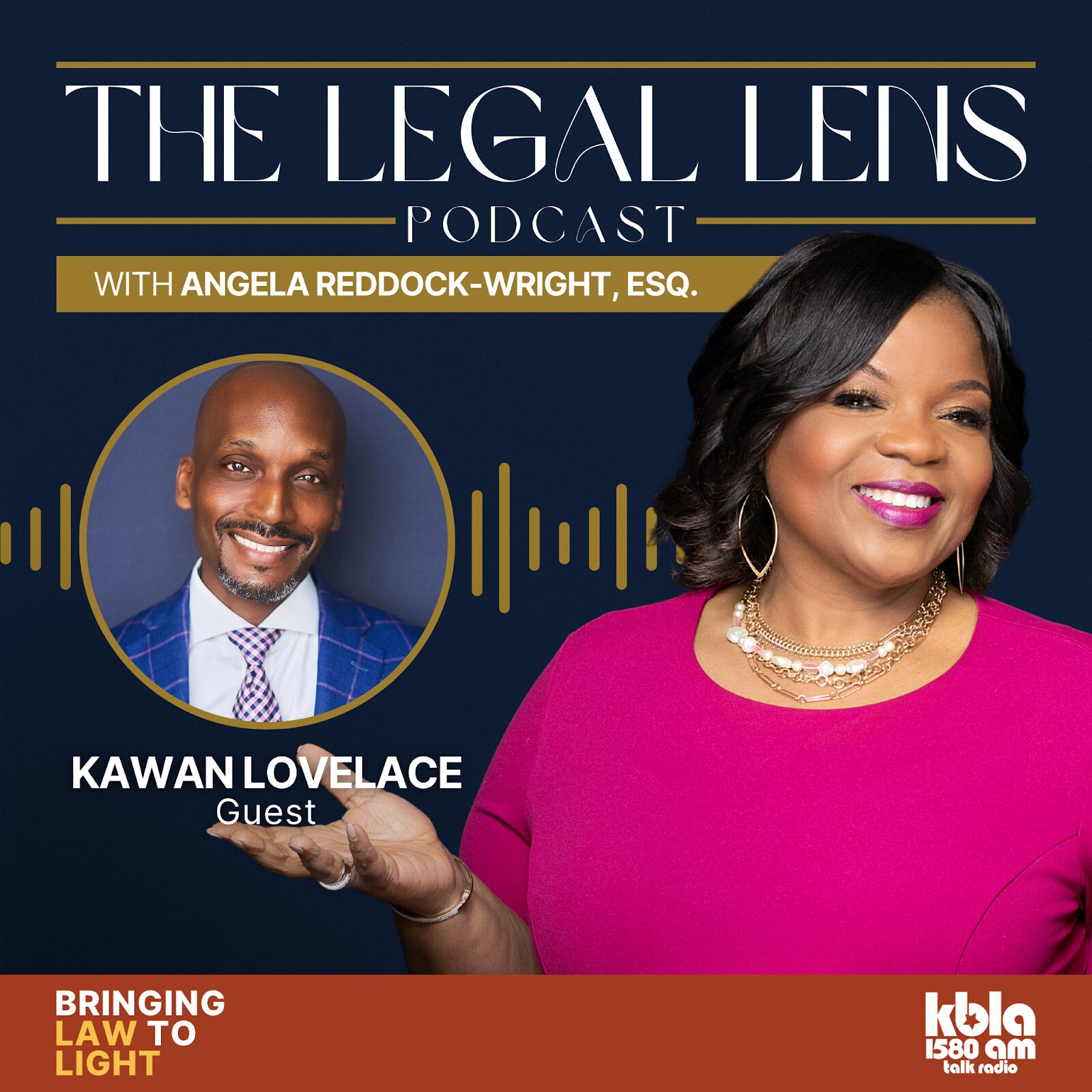
 We often hear about the criminal justice system from the outside looking in. But what happens when you sit down with someone who has seen the system from every conceivable angle, as an officer on the beat, a detective, a prosecutor, and now, a civil rights attorney fighting for justice? I was incredibly honored to welcome a first-time guest to The Legal Lens Podcast who brings exactly that perspective: Attorney Kawan Lovelace. Kawan Lovelace is a former 1996 Olympian, a former NYPD detective, and a former prosecutor who made the courageous decision to leave the system to hold it accountable.
Based in New York, his practice is now dedicated to representing victims of false arrest, police brutality, and malicious prosecution. In this riveting and deeply revealing conversation, Attorney Lovelace pulls back the curtain on police culture, explains why he walked away from the District Attorney’s office, and breaks down the staggering financial cost of police misconduct for taxpayers.
For a deeper dive into these critical topics, I strongly encourage you to listen to our full discussion on The Legal Lens Podcast. You can find us on Apple Podcasts, Spotify, Simplecast, and everywhere you get your podcasts for free. Alternatively, you can also listen to the full episode in the player below:
Attorney Kawan Lovelace on the “Blue Wall,” The Cost of Misconduct, and Why He Left the System to Fight It
As someone who has worn the badge and now sues the very department he used to serve, Attorney Lovelace offers an unprecedented look into the mechanics of policing and the urgent need for reform. Here are the timestamps and topics covered to help you better navigate this powerful episode:
- 4:00 – An Olympian’s Journey to the Precinct
- 7:00 – The “Justification” for the System & Why He Switched Sides
- 17:00 – The “Biggest Gang in the City”: Inside Police Culture
- 26:00 – The Billion-Dollar Cost of Misconduct
- 30:00 – The Shield of Qualified Immunity
- 33:00 – Hope and Action: Knowing Your Rights
Related Podcast Episode: Attorney Yasmin Cader on the ACLU’s Fight for Democracy, Book Bans, and the Power of the People
An Olympian’s Journey to the Precinct
Kawan Lovelace’s journey is anything but typical. Before he was fighting in the courtroom, he was fighting for gold as a triple jumper in the 1996 Atlanta Olympic Games.
He shared that the same tenacity required to become a world-class athlete was what carried him through law school later in life, at age 40. But his entry into law enforcement was born out of tragedy. Lovelace was part of the first NYPD academy class following 9/11, a day that he revealed impacted him personally as his wife worked in the Towers.
“9/11 touched me in a very personal way because, at the time, my wife worked in Tower Two, so it was just a really long day of hoping she was late to work. I remember sitting there and watching TV. We had no communication, and sometime around 7:30 in the evening, she came to the door and told us of the horrible ordeal she went through. We had a 2-year-old son at the time, and I just remember thinking for a large part of the day that I was going to have to explain to him that something had happened to his mother. It led me to want to do something to make New York a better place, I think in a very idealistic way, hence my endeavors at the police academy,” remembered Attorney Lovelace.
After graduating from the police academy, he was assigned to the Harlem 32nd Precinct, where he was a police officer and quickly moved to detective, narcotics, and gangs. He was eventually hurt while doing a search warrant, which afforded him the opportunity to retire.
“I was in law school for three years, and to be honest with you, it was one of the hardest things I’ve ever done, but it was well worth it. Then, I got a job at the prosecutor’s office in the Bronx. I wanted to go into a defense organization, but they weren’t too keen on picking up somebody who was a former police officer, which is understandable to a degree,” recalled Attorney Lovelace.
After retirement, he coached his son through high school, got him into college, and went to law school. However, his journey had just begun as he came to a sobering realization.
“It really made me question the role I was playing. Am I doing more harm than good on the grand scale by being a justification for a system I knew was inherently flawed and racist against Black and Brown people? That is what led me to leave the DA’s office and become a civil rights attorney,” remembered Attorney Lovelace.
Related Podcast Episode: Shakari Byerly on California Prop 50, the Power of the Black Vote, and the Fight Against Gerrymandering
The “Justification” for the System & Why He Switched Sides
One of the most profound moments of our conversation occurred when Attorney Lovelace described the exact moment he knew he had to leave the District Attorney’s office.
“In both contexts of being a police officer and then a prosecutor, I was trying to change the system from the inside. I was figuring out that my experience as an African American man in this country in New York would be beneficial in being able to help either officers or the prosecutor’s office to see things differently and be able to relate to people of color as they go through the system. What I quickly realized was that I was on one side of the court with prosecutors standing on the other side who happened to look like me – he was another man of color. The judge was a white man, and that is when I started to realize what I represented. Dressing up in my nice suit was a justification of the system,” mused Attorney Lovelace.
He described standing in court across from a defendant who looked like him, in front of a judge who looked nothing like them. He realized that his presence in that well-tailored suit wasn’t helping—it was being used to validate a broken system.
“This judge looked at this defendant as someone who was solely there because of the bad decisions that person made while totally missing the fact that this person had no choice in being born after a certain set of circumstances, and those circumstances were and still are dictated by our country’s history through things like not having access to a good education, being born into a lower socioeconomic status, not having mental health care access, and those aren’t factors that are always taken into consideration. We have this meritocracy predicated on this belief that you can become whatever you want on your own accord, and these outside factors don’t enter the picture. To say that bothered me would be an understatement,” explained Attorney Lovelace.
He realized that by being there, he was inadvertently validating the idea that the system works for everyone, ignoring the realities of redlining, lack of educational access, and socioeconomic barriers. That realization led him to become a civil rights attorney.
“I realized that as a prosecutor, this judge was looking at me as a person who made all the right decisions, and so therefore, I was a justification for the system. What I really had to do was decide on a case-by-case basis how I’m able to make some kind of difference,” said Attorney Lovelace.
Related Podcast Episode: Rev. Shavon Arline-Bradley on the NCNW’s 90-Year Fight for Black Women, Economic Justice, and the Power of the Black Church
Inside Police Culture
Attorney Kawan Lovelace was incredibly candid about the training, or lack thereof, regarding the law that officers receive. He shared a chilling anecdote from his first day at the police academy.
“It’s impossible to address some of these issues without discussing the mentality of police officers, particularly how they’re trained in the academy and eventually assigned to a precinct. I remember my first day at the police academy and one of the instructors saying, ‘You just joined the biggest gang in the city. You’re no longer black or white; you are blue now.’ That creates an inherently adversarial relationship to the community we are, quote-unquote, supposed to serve,” reflected Attorney Lovelace.
He explained that this mentality creates an adversarial “Us vs. Them” relationship with the community. Officers are trained to patrol in constant fear, viewing the citizens they are sworn to protect not as human beings, but as threats, “perps,” or “scales.”
This dehumanization, he argues, is what makes excessive force so prevalent. It allows officers to justify using force over and above what a situation calls for because they have ceased to view the person on the other side as a community member or a family member.
“I made detective rather quickly, and I thought I actually knew the law. But you learn it by making arrests and from what you’re taught by your supervisors when you’re on the street. But it wasn’t until I was in law school and sitting in my current procedure class that I realized I didn’t know the law at all and that what I had been trained on was wrong. So it became a conundrum. How was I supposed to enforce the law if there was no prerequisite for me to know the law?” asked Attorney Lovelace.
Related Podcast Episode: Congresswoman Julie Johnson Joins the Legal Lens Podcast to Discuss the Government Shutdown, the Battle for Healthcare, and the Future of Redistricting in Texas and the U.S. Politics
The Billion-Dollar Cost of Misconduct
We also discussed the staggering financial implications of police misconduct. Lovelace noted that in 2024 alone, New York City paid out nearly $2 billion in settlements, with the NYPD accounting for over $300 million of that for tort claims and civil rights violations.
The tragedy, as Lovelace pointed out, is that this money comes from the city’s general fund, meaning tax dollars, rather than the police budget.
“The comptroller himself said that instead of taking it out of the general funds, if they actually took out police budgets, it would have more of an effect on curbing the actions that are leading to the settlements. This is one of the ways in which civil rights attorneys can bring light to the misconduct that is rampant within agencies like the NYPD because, without this, we have almost no record of it,” said Attorney Lovelace.
This is why Lovelace fights for financial settlements for his clients: in a capitalist society, money talks. Large verdicts are one of the few ways to force the system to pay attention to its own failures.
“The lawsuits are really important because they bring misconduct to light and show a disregard for the law and the Constitution, so you get enough of those and, at some point, you hope it may result in some kind of consent decree from the court, as they now have enough evidence to say this is law-breaking. The reality of our situation is that the misconduct has reached such a level that now we have to step in,” added Attorney Lovelace.
Related Podcast Episode: A New Voice for the “Purple District”: Assemblymember Rhodesia Ranson on CA Prop 50 and Saving Californian Jobs
The Shield of Qualified Immunity
A major theme of our discussion was “Bad Apple” rhetoric and Qualified Immunity, a legal doctrine that shields government officials, including police officers, from being held personally liable for constitutional violations.
We examined this concept through the lens of the tragic murder of George Floyd.
“Why do we invest police officers with the power to take life with zero accountability for how they do that?” asked Lawyer Lovelace.
He urges listeners to push lawmakers, both locally and federally, to end qualified immunity. Until officers face personal liability for their actions, he believes the culture of impunity will remain.
Related Podcast Episode: Kara Gotsch of the Sentencing Project: Second Chances, the Truth About Mass Incarceration, and Threats to Criminal Justice & Sentencing Reform
Hope and Action: Knowing Your Rights
Despite the heavy subject matter, Attorney Lovelace left us with a message of empowerment. He emphasized the importance of knowing your rights and the power of the video camera.
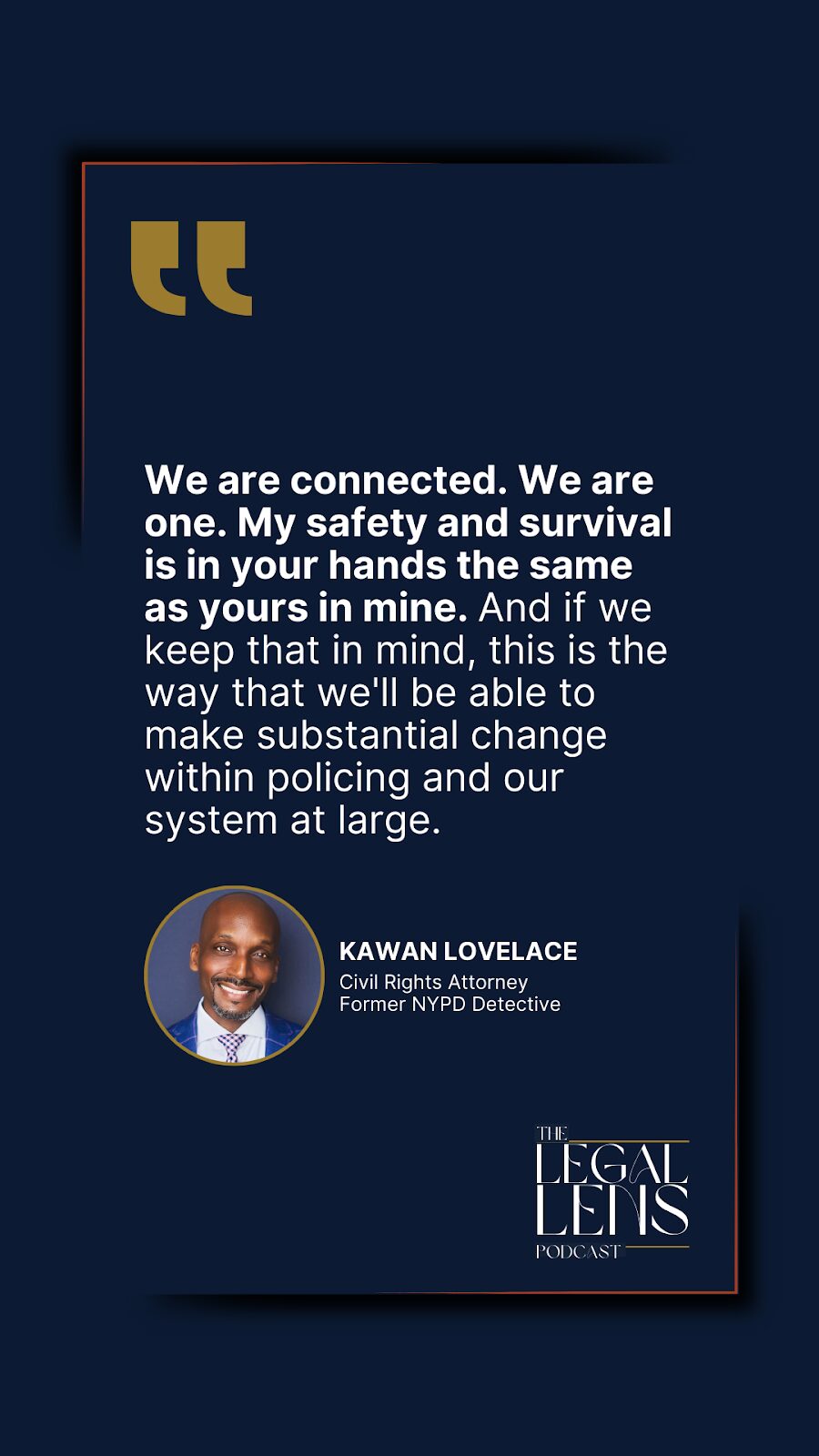
“My safety and survival are in your hands, the same as yours are in mine, and if we keep that in mind, that is the way that we will be able to make substantial change within policing and our system at large,” offered Attorney Lovelace.
He advises that if you are stopped, you can ask, “Am I free to leave?” If the answer is no, you know you are in a custodial situation.
He noted that simply using correct legal terminology can sometimes de-escalate a situation because officers realize they are dealing with someone who is informed.
Related Podcast Episode: Alphonso David on the Global Black Economic Forum, Protecting Democracy and Civil Rights, and Why Principles Matter in Inconvenient Times
Do You Want to Hear More Powerful Insights from Experts and Activists Like Attorney Kawan Lovelace? Subscribe to and Download the Legal Lens Podcast Today!
Our conversation with Attorney Kawan Lovelace provided a rare and necessary look behind the “Blue Wall.” His journey from the inside of the precinct to the frontlines of civil rights litigation is a testament to the power of conscience and the need for systemic reform.
Listen to this full episode of The Legal Lens Podcast to hear Attorney Kawan Lovelace’s complete perspective on Simplecast, Apple Podcasts, or Spotify, and subscribe to never miss a critical conversation.


 Also, to learn about all things Legal Lens, follow me on Instagram @iamangelareddockwright.
For media inquiries, please reach out to josh@kwsmdigital.com.
This communication is not legal advice. It is educational only. For legal advice, consult with an experienced employment law attorney in your state or city.