

I was profoundly honored to welcome two phenomenal thought leaders to The Legal Lens on KBLA Talk 1580 this week: Dr. Nina Banks and Dr. Rhonda Vonshay Sharpe. Together, they co-edited the recently published book Black Women in the U.S. Economy: The Hardest-Working Woman.
In this episode, we move beyond basic labor statistics to explore feminist economics, the historical devaluation of unpaid community labor, the push to disaggregate economic data, and the systemic barriers that criminalize survival for marginalized women.
Listen to the full conversation with Dr. Nina Banks and Dr. Rhonda Vonshay Sharpe below:
Navigating the Episode: Time Stamps
- 03:55: Meet the Economists & Excavating Black Economic History
- 06:10: Disaggregating Data: Making the Invisible Visible
- 14:46: Debunking Labor Market Myths and Tropes
- 22:28: “The Hardest Working Woman”
- 25:12: The Value of Unpaid Work and Community Advocacy
- 30:59: Criminalizing Survival: Poverty and Incarceration
- 34:48: The Book’s Impact and a Special Listener Discount
Excavating History and Making the Invisible Visible
The conversation began by exploring the distinct “whys” that drive both guests.
Dr. Nina Banks, a professor of economics and chair of the Department of Critical Black Studies at Bucknell University, shared her dedication to feminist economics and women’s economic history. She detailed her extensive archival research to excavate the intellectual thought of Sadie T.M. Alexander, the first African-American economist, who graduated in 1921 but was forced to become a lawyer because no one would hire a Black woman as an economist.
In 2003, while conducting research at the University of Pennsylvania archives, Dr. Banks discovered a collection of Alexander’s speeches, which she ultimately published in her book, Democracy, Race, & Justice: The Speeches and Writings of Sadie T. M. Alexander.
Dr. Rhonda Vonshay Sharpe founded the Women’s Institute for Science, Equity, and Race (WISER). Trained primarily as a mathematician, she explained that her mission is to disaggregate data so that specific demographic groups are no longer rendered invisible by generalized statistics or dismissed due to sample size.
“My ‘why’ has been making the visible visible through disaggregating data so that we can get at the nuances and the outcomes.”
– Dr. Rhonda Vonshay Sharpe
Debunking Labor Market Tropes
Dr. Sharpe highlighted the dangers of presenting economic figures without proper context, pointing to recent inaccurate narratives claiming that 300,000 Black women had suddenly left the workforce.
She emphasized that such decontextualized statistics often feed into harmful, historic tropes that portray Black mothers as lazy or unwilling to work, rather than acknowledging the structural constraints or alternative economic paths they must navigate.
Why ‘The Hardest-Working Woman’?
The book’s title, Black Women in the U.S. Economy: The Hardest-Working Woman, was highly intentional. Dr. Sharpe noted that the singular “woman” deliberately plays on James Brown’s moniker as the ‘hardest-working man in show business’ while also paying homage to Sojourner Truth’s famous “Ain’t I a Woman?” speech.
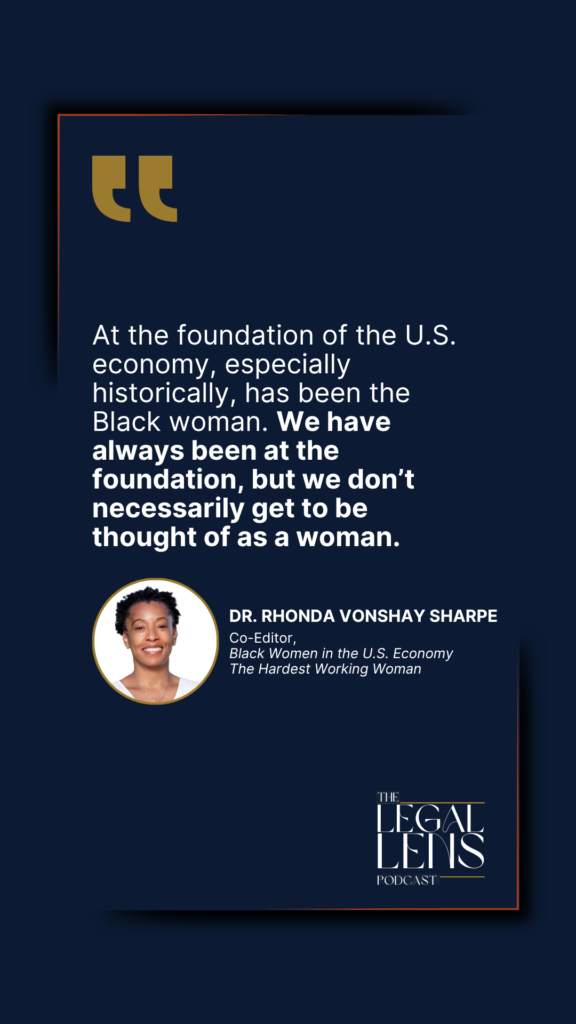
Dr. Sharpe explained that the title challenges readers to consider whether Black women are historically afforded the same protections and societal grace as other women, despite serving as the foundational caregivers, domestic workers, and economic engines of the country.
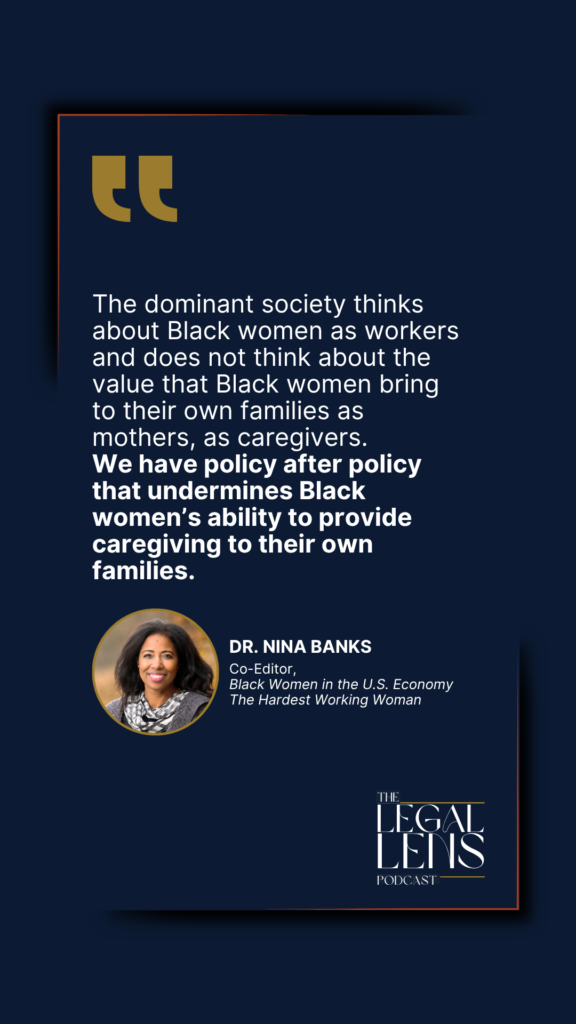
“We see this throughout US history, where the dominant society thinks about Black women as workers and does not think about the value that Black women bring to their own families as mothers, as caregivers… And so we have policy after policy that undermines Black women’s ability to provide caregiving to their own families.”
– Dr. Nina Banks
Structuring the Narrative: From Market Forces to Public Policy
Dr. Sharpe and Dr. Banks explained that their book is an intentional update to Julianne Malveaux and Margaret Simms’ groundbreaking 1986 volume, Slipping Through the Cracks: The Status of Black Women.
With a foreword by Barbara Jones — a 1960s civil rights activist, the oldest living Black woman economist, and the first to write a dissertation on Black women — the new book is divided into distinct analytical sections to view Black women in their totality:
- Market Economy & Education: Features chapters by Susan McAvoy on educational investment, Valerie Wilson of the Economic Policy Institute on the labor market, and LaToya Council (Lehigh University) and Kris Marsh (University of Maryland) on wealth and mobility.
- Family & Community Relations: Introduced by Margaret Simms, this section covers social reproduction, child caregiving during the pandemic, and unpaid community work.
- Politics & Public Policy: Introduced by Julianne Malveaux, this section dives into immigration, entrepreneurship, incarceration, and political organizing.
Redefining Unpaid Labor and Community Advocacy
Dr. Banks expanded on her chapter regarding “social reproduction” and unpaid work. While traditional feminist economics often focuses on the division of household chores between men and women, Dr. Banks argued that an intersectional analysis must also account for the collective, unpaid labor Black women perform on behalf of their communities.
She cited historical examples of Black women mobilizing to fill gaps left by racial exclusion and systemic neglect, such as the Alpha Kappa Alpha Sorority’s Mississippi Health Project during the Great Depression and modern initiatives like the Midtown Mamas in St. Louis fighting for food justice.
Dr. Banks explained that, because “geography now does the work of Jim Crow,” this community advocacy must be formally theorized and recognized as vital economic work.
Criminalizing Survival
Dr. Sharpe discussed her chapter, “Criminalizing Survival,” which explores how the incarceration of Black women is deeply tied to poverty. While much of the societal focus remains on the “war on drugs” and its impact on Black men, Dr. Sharpe noted an uptick in Black women being prosecuted for fraud at the state and federal levels.
She clarified that this is not white-collar crime; rather, it often involves single mothers who must pick up unreported, cash-based “side hustles” like braiding hair just to pay rent and afford childcare when restrictive public assistance policies fail to provide a living wage or support higher education.
Specifically, Dr. Sharpe pointed to the Personal Responsibility Opportunity Work Act, which drastically limited college credit assistance to a maximum of 12 months, stripping mothers of the ability to upskill for higher wages.
Dr. Sharpe noted that this structural trap forces women into impossible choices, ultimately criminalizing their basic survival strategies in ways that create devastating ripple effects — the majority of these incarcerated women are in their prime years (20 to 30) and 60% are mothers, meaning these prosecutions regularly force their children into the foster care system.
Get the Book at a Special Discount
Black Women in the U.S. Economy: The Hardest-Working Woman is for policymakers, students, and anyone looking to understand the full, nuanced reality of Black women in America.
Listeners of The Legal Lens can purchase the book on the Routledge website and use the exclusive promo code 26ESA2 for a 20% discount.
Hear More from Experts Like Dr. Nina Banks and Dr. Rhonda Vonshay Sharpe by Subscribing to the Legal Lens Podcast!
Whether dissecting economic policy or navigating complex workplace dynamics, I have dedicated my career to helping individuals and organizations resolve conflict through mediation and dispute resolution.
My mission as the host of the Legal Lens radio show and podcast on KBLA Talk 1580 is to empower you with objective, expert-driven insights born from years of practice at the intersection of law and society. We are here to “Bring Light to Law,” breaking down complex policies and everyday legal concepts into clear, actionable language.
Download and subscribe to the Legal Lens podcast today to hear more insights from leading experts like Dr. Nina Banks and Dr. Rhonda Vonshay Sharpe.
To download and listen to the show with Dr. Nina Banks and Dr. Rhonda Vonshay Sharpe on Apple or Spotify, click below:


Keep up with all things Legal Lens by following me on Instagram @iamangelareddockwright.
Angela’s Other Work
Click here to learn about and order my book, The Workplace Transformed: 7 Crucial Lessons from the Global Pandemic.
Learn more about my work as an employment and Title IX mediator at Angela J. Reddock-Wright | Signature Resolution and on LinkedIn @Angela J. Reddock-Wright, Esq., AWI-CH.
Book Angela
For media or booking inquiries, please contact kyle@kwsmdigital.com.
This communication is not legal advice. It is educational only. For legal advice, consult with an experienced employment or civil rights law attorney in your state or city.