

The legal parameters of generational wealth transfer are often viewed as a concern strictly for the ultra-wealthy, but the reality is that every individual with a bank account, a vehicle, or a home has an estate that requires structural protection. State laws and court systems intervene when families fail to establish formal legal directives, frequently leading to unnecessary administrative burdens and prolonged family disputes.
During the latest episode of The Legal Lens, I was thrilled to welcome Attorney Jehan Crump-Gibson to discuss these very issues. Crump-Gibson is the founder and managing partner of the Great Lakes Legal Group in Michigan, where she serves entrepreneurs, families, and businesses in commercial transactions, government affairs, and probate and estate planning.
Together, we explore the critical importance of estate planning for Black and Brown families, the impact of recent tax legislation, and the foundational tools every adult needs to protect their assets and ensure a seamless transition for their loved ones.
Navigating the Episode: Time Stamps
- 00:03:13: Jehan’s Personal “Why”: Seeing the Need in Law School
- 00:06:20: The “One Big Beautiful Act“: Estate Tax Thresholds
- 00:11:45: Estate Planning 101: Wills and Trusts, and Powers of Attorney
- 00:20:40: The Danger of Relying on Beneficiary Designations
- 00:27:55: Protecting Minors and Dependents with a Special Needs Trust
- 00:33:20: The Risks of Using AI and DIY Forms for Estate Planning
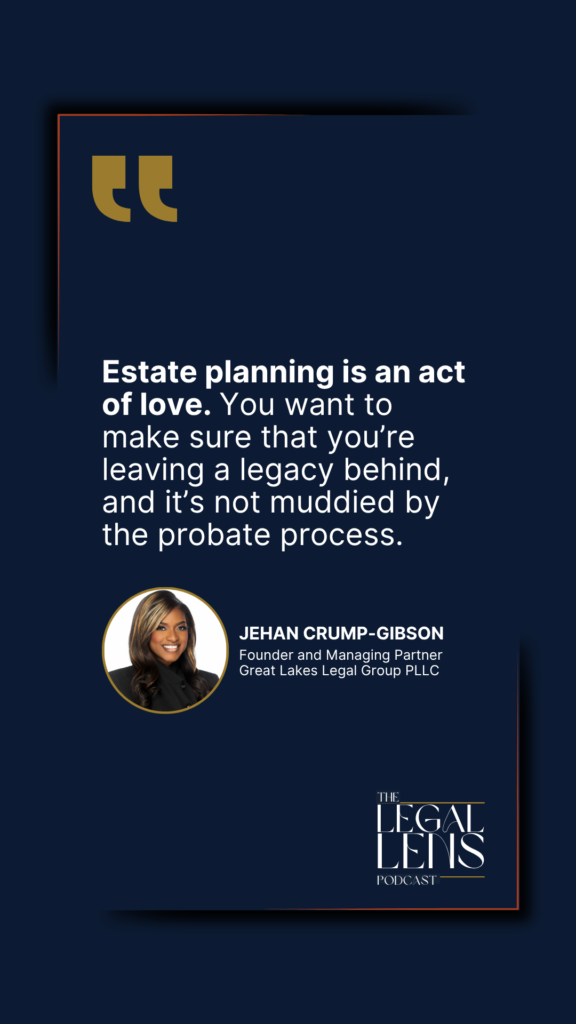
- 00:36:33: Closing: Estate Planning as an Act of Love
Watch the interview with Jehan Crump-Gibson on YouTube.
Jehan’s Personal “Why”: Seeing the Need in Law School
Crump-Gibson explains that her initial interest in estate planning was sparked during a law school clerkship with a corporate bank’s legal department. Seeing real families struggle to navigate the administrative hurdles of managing accounts after a loved one’s passing inspired her to focus her career on probate law.
After spending over 17 years in the trenches of the probate court system, Crump-Gibson witnessed firsthand how mandated legal processes could create severe financial burdens and fracture familial relationships. While many communities do not regularly discuss wills and trusts around the dinner table, Crump-Gibson’s recognition that these disputes are easily preventable became her primary motivation to educate the public.
“There are simple steps that everybody, no matter what you have, what your family looks like, can take to make sure that they don’t end up in probate court. I’m tired of seeing our people get tied up in probate court and the impact that it has on them.”
— Jehan Crump-Gibson
The “One Big Beautiful Act”: Estate Tax Thresholds
Our conversation shifted to recent federal legislation and its practical implications for everyday citizens. Specifically, Crump-Gibson analyzed the One Big Beautiful Act, which established a permanent federal estate tax threshold of $15 million for an individual and $30 million for a married couple.
While the average person does not possess an estate approaching that financial threshold, Crump-Gibson emphasizes that this legislation actually highlights a critical reality: everyday people still desperately need to plan. She notes that estates valued under $15 million are not given a “fast track” — they must go through the exact same legal probate processes as multi-million-dollar estates.
“Even if you hear this and go, ‘Oh, the big beautiful bill didn’t do anything that impacts me,’ it actually highlighted the importance of why the everyday person still needs to do planning, because you don’t have $15 million to draw from and waste.”
— Jehan Crump-Gibson
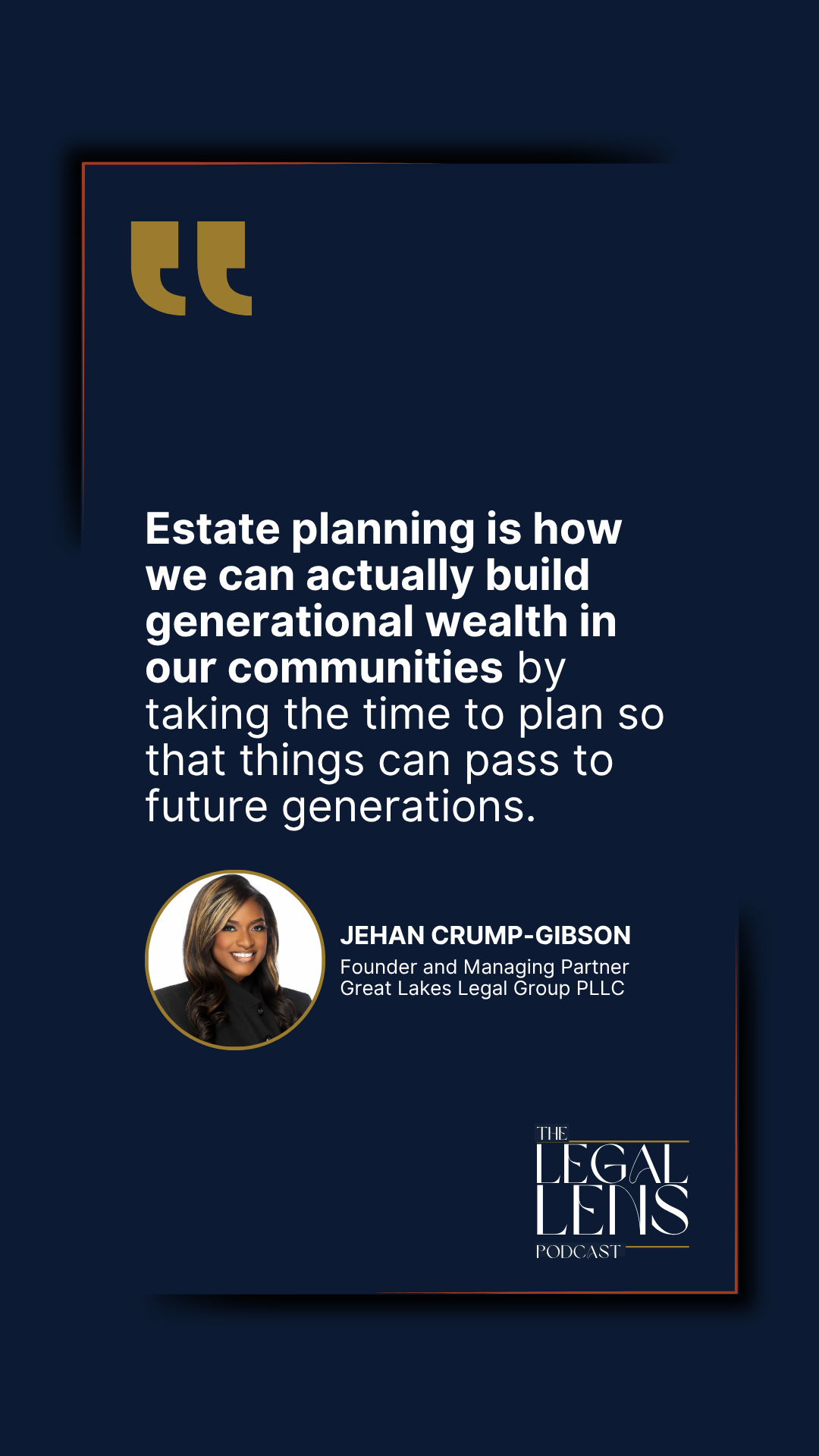
She stresses that proper planning is arguably more essential for modest estates, ensuring that assets are maximized for the beneficiaries rather than being drained by prolonged court costs and administrative legal fees.
Estate Planning 101: Wills, Trusts, and Powers of Attorney
To clarify the legal mechanisms involved in proper asset disposition, Crump-Gibson provided a structural breakdown of a complete estate plan. She notes that an “estate” is simply whatever assets a person currently holds — even if it is just a primary vehicle and a basic checking account.
According to Crump-Gibson, three essential tools for a comprehensive plan include:
1. Powers of Attorney
Legal documents that designate a trusted individual to make financial and medical decisions if an individual becomes incapacitated. Crump-Gibson advises that every single person 18 and older should have these documents in place, even young adults heading off to college.
Furthermore, healthcare powers of attorney (which may also encompass living wills or patient advocate designations) dictate your preferences regarding life support, sparing family members from arguing over critical medical decisions during a crisis.
2. Last Will and Testament
An instruction sheet detailing where assets should go upon passing. However, Crump-Gibson explicitly warns that a will does not avoid probate court. It merely provides the court with instructions on how to distribute the assets after the probate process concludes.
3. Trust
A distinct legal vehicle used to manage assets directly, effectively avoiding probate entirely. She compares a trust to a “flower vase,” explaining that as long as your assets (the flowers) are legally placed inside the trust (the vase), they can pass directly to your beneficiaries without any state or court intervention.
Related Podcast Episode: Lourdes Castro Ramírez on The State of Housing in Los Angeles & Beyond
The Danger of Relying on Beneficiary Designations
A common misconception in wealth transfer is that a family can successfully bypass the legal system simply by listing an older, responsible child as the sole beneficiary or joint owner on bank accounts, life insurance policies, and property deeds, with informal verbal instructions to split the money evenly among siblings later.
Crump-Gibson warns heavily against this strategy when avoiding probate. She asserts that a named beneficiary on a transfer-on-death (TOD) or payable-on-death (POD) account is under no legal obligation to share those funds with their siblings, regardless of any verbal promises made prior to a parent’s passing.
Furthermore, she explains that leaving a physical home without a trust can lead to devastating consequences. If a parent passes away without formal planning, the home must go through probate. Crump-Gibson notes that this frequently results in the legal eviction of a sibling who may have lived with and cared for the deceased parent for decades.
Despite their caregiving efforts, that sibling does not automatically gain legal priority over the property. If they lack the financial standing to assume the property’s taxes and mortgage costs, the other siblings have the legal right to force a sale of the house.
“If you don’t plan, then state law will say what happens, and it won’t matter that your son has not come home or checked on you in 15 years. He’s going to have equal standing as his other siblings.”
— Jehan Crump-Gibson
Protecting Minors and Dependents with a Special Needs Trust
Crump-Gibson emphasizes that individuals with minor children absolutely require a trust.
She notes that financial institutions will not issue large payouts directly to anyone under the age of majority. If a 7-year-old or 17-year-old is named as a direct beneficiary on a life insurance policy, the surviving family members will be forced into probate court to establish legal conservatorship over the funds before a check is ever cut.
Furthermore, she insists that parents of minor children must legally designate physical guardians. Without this formal designation, a family may end up in contentious “grandma versus auntie wars” in probate court, arguing over who is best suited to raise the children.
Additionally, for families with adult children living with disabilities, Crump-Gibson highlighted the absolute necessity of establishing a special needs trust. She explains that leaving a direct inheritance to an adult dependent who receives government benefits — such as Medicaid — can immediately disqualify them from receiving essential health and housing assistance by artificially inflating their income.
A properly structured trust allows the funds to supplement their care without jeopardizing their state or federal benefits.
The Risks of Using AI and DIY Forms for Estate Planning
With the rapid rise of artificial intelligence and online legal forms, many individuals are attempting to draft their own estate plans to save money. Crump-Gibson cautions strongly against this approach, arguing that an AI’s output is only as accurate and legally sound as the user’s input.
She notes that a layperson simply does not know the correct legal questions to ask, often resulting in boilerplate documents that miss critical, state-specific provisions.
According to Crump-Gibson, if an estate planning document is silent on a key issue, the only place to resolve that ambiguity is in a courtroom, which defeats the purpose of creating the document in the first place. She urges everyone to consult with a qualified attorney to ensure their documents are tailored exactly to their family’s unique dynamics.
Related Article: AI & Employment Law Update: Harper v. Sirius XM Radio, LLC
Estate Planning as an Act of Love
Crump-Gibson concluded our conversation by reframing how we view the legal preparation for the end of life. She encourages families to move past the intimidation, fear, and myths surrounding the legal process, and to instead view it through the lens of legacy building.
Hear More from Experts Like Jehan Crump-Gibson by Subscribing to the Legal Lens Podcast Today!
I have devoted my career to assisting individuals in resolving their legal disputes through mediation and dispute resolution processes. Additionally, I focus on analyzing the legal issues that influence public discourse and workplace dynamics, both as a radio and podcast show host and as a legal analyst in the news.
My mission as the host of the Legal Lens radio show and podcast is to empower you with objective, expert-driven insights born from years of practice at the intersection of law and society, bringing light to the complex legal concepts that impact our daily lives.
Click below to download and subscribe to The Legal Lens podcast for more insights from leading experts like Jehan Crump-Gibson:


To learn about all things Legal Lens, follow me on Instagram @iamangelareddockwright.
You can find Jehan Crump-Gibson online at jehancrumpgibson.com, or follow her firm on Facebook, Instagram, and LinkedIn at @GLLegalGroup.
Connect with & Learn More About Angela Reddock-Wright
Learn more about my book, The Workplace Transformed: 7 Crucial Lessons from the Global Pandemic here, and my work as an employment and Title IX mediator at Signature Resolution.
Connect with me on LinkedIn here, and for media or booking inquiries, please contact kyle@kwsmdigital.com.
This communication is not legal advice. It is educational only. For legal advice, consult with an experienced employment or civil rights law attorney in your state or city.