

Thomas Saenz, the President and General Counsel of the Mexican American Legal Defense and Educational Fund (MALDEF), has spent nearly three decades on the front lines of civil rights law. His legal work focuses on defending the rule of law and protecting the constitutional rights of Latino communities across the United States.
As a seasoned employment law mediator, conflict resolution strategist, and the host of The Legal Lens podcast, I have dedicated my career to navigating the complex intersections of law, civil rights, and public discourse. From my vantage point as a thought leader and author of The Workplace Transformed, I help individuals and organizations find clarity in an era of shifting legal landscapes.
During the latest episode of The Legal Lens podcast, Saenz discusses the systemic challenges facing civil rights, voting access, and immigration protections. Our conversation explores the history of MALDEF, the mechanics of fighting racial profiling, and the current state of voting rights in federal courts today.
Navigating the Episode: Time Stamps
- 02:24: Tom Saenz’s Personal “Why”: A Path to Civil Rights Law
- 05:24: The 1968 Founding of MALDEF and the NAACP LDF Connection
- 11:23: Unprecedented Challenges: Deconstructing the Threats to the Rule of Law
- 16:07: Fighting Racial Profiling: ICE Surges and the Federal Tort Claims Act
- 21:35: Holding the Private Sector Accountable for Immigration Discrimination
- 24:52: The Perilous State of Voting Rights: Shelby, Brnovich, and Callais
- 30:30: Defending Tuition Equity for Undocumented Students
Meet Thomas Saenz
Thomas (Tom) Saenz is a nationally recognized civil rights attorney who has dedicated his career to advancing the rights of the Latino community.
Before stepping into his current role as President and General Counsel of MALDEF in 2009, he served as the organization’s head of litigation.
His impressive civic resume also includes a four-year stint serving under former Los Angeles Mayor Antonio Villaraigosa, as well as serving on the Los Angeles County Board of Education and the board of the California Community Foundation.
A Legacy of Public Service and Resilience
Passionate advocates are most often driven by their personal history. For Tom, who grew up in the Los Angeles suburb of Alhambra and became the first lawyer in his family, that drive was instilled by his parents. Though his parents were born in the United States, they came of age during a time when educational opportunities for Mexican Americans were severely restricted. As a result, neither of his parents had the opportunity to earn a bachelor’s degree.
However, they made it unequivocally clear to Tom and his brother that a four-year college education was an absolute expectation. They also provided Tom’s first education on the realities of discrimination against communities of color, lessons he would later experience firsthand in middle and high school. This legacy of resilience propelled both brothers into lifelong public service; his brother served 30 years in the U.S. Army, while Tom pursued the law.
“I went to law school to do civil rights work. I never wanted to work in a big firm… I wanted to do the kind of work that I’ve had the honor and privilege of doing now for over 29 years at MALDEF. My life has been MALDEF, and that was my goal.” — Tom Saenz
MALDEF’s Mission & History
Founded in 1968, MALDEF is a national legal civil rights organization established to protect and promote the civil rights of all Latinos living in the United States. Its inception is deeply tied to another cornerstone of American civil rights history.
The story of MALDEF begins with lead founder Pete Tijerina, a lawyer from Texas. Saenz explains that Tijerina was inspired to create the organization after representing a Latina client and witnessing the systemic exclusion of Latinos from South Texas juries. Because he could not overcome this structural bias, he was forced to settle his client’s case.
Realizing the need for organized legal defense, Tijerina looked to the NAACP Legal Defense Fund (LDF), which had secured the Brown v. Board of Education victory, as a model. LDF’s then-Director Counsel, Jack Greenberg, personally introduced MALDEF’s founders to the Ford Foundation, securing the vital funding needed to open their doors in San Antonio and Los Angeles.
“We very much view LDF as not just an ongoing partner, which we are, but as a godmother, if you will, of MALDEF through the role that its director counsel, Jack Greenberg, played in enabling our founders to get the resources to get started.” —Tom Saenz
Unprecedented Challenges: Deconstructing the Threats to the Rule of Law
Saenz offers a structured assessment of the current political and social climate, noting that the foundation of the rule of law faces daily challenges from various levels of government and the courts.
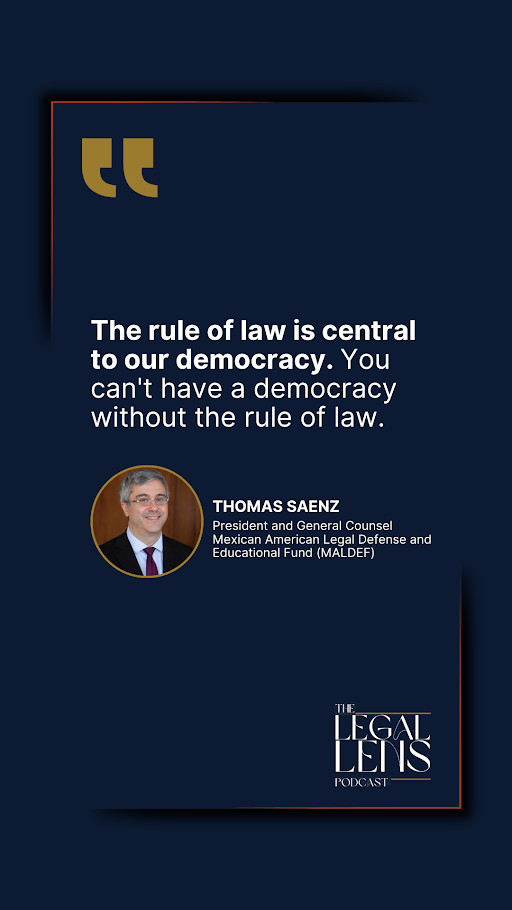
“Rule of law is the basic principle that in the United States, the same laws apply to everyone. There’s not one set of laws for people who are one race versus another. There’s not one set of laws for the wealthy versus those who don’t have the resources… Our rule of law means equity in the application of our laws.” — Tom Saenz
Saenz warns of the systemic risks that arise when the justice system departs from long-established legal precedents. He points to the expanding scope of executive power, facilitated by judicial appointees who align with specific political ideologies, which he states can result in direct violations of civil rights for marginalized groups, including Latino, Black, LGBTQ, and Muslim communities.
Related Article: Attorney Nse Ufot on Humanizing Immigration, Southern Politics, the Success of the New Georgia Project, and More
Fighting Racial Profiling: ICE Surges and the Federal Tort Claims Act
According to Saenz, immigration enforcement tactics frequently rely on unlawful racial profiling. MALDEF has consistently worked on the front lines to challenge targeted enforcement sweeps in cities such as Los Angeles, Chicago, and Minneapolis.
However, Saenz highlights a significant legal hurdle: obtaining advance injunctions to stop law enforcement misconduct before it happens remains difficult due to restrictive Supreme Court precedents, such as the Lyons case. Furthermore, he notes that decisions from the Supreme Court’s shadow docket, such as the Vasquez decision, where Justice Kavanaugh issued an opinion lifting an injunction against ICE in Los Angeles, have led federal agents to return to contested practices.
To counter this, MALDEF has shifted toward filing lawsuits under the Federal Tort Claims Act (FTCA). By suing the federal government for monetary damages after citizens and immigrants are subjected to racial profiling, the organization aims to establish a clear financial deterrent against future abuses.
“When you target a specific group of workers, largely defined by race, day laborers, for example, when you target people based on their language, when you target people based on their appearance, that’s all forms of racial profiling. These FTCA cases that we’re bringing are designed to deter that conduct.” — Tom Saenz
The Power of Cross-Cultural Coalition Building
The fight against systemic disenfranchisement is too large for any single organization to tackle alone. Following the devastating Shelby County decision in 2013, MALDEF and the NAACP LDF co-founded a national voting rights working group. Today, this coalition comprises 12 distinct civil rights organizations — including Asian Americans Advancing Justice, LatinoJustice PRLDEF, the Brennan Center, and the ACLU.
Tom explained that the goal of the coalition is to address increasing challenges in the voting rights arena more efficiently. By coordinating their litigation strategies and sharing resources, these advocacy groups are mounting a unified, cross-cultural defense to ensure that the voting rights of all voters of color are protected in federal court.
The State of Voting Rights: Shelby, Brnovich, and Callais
Saenz describes voting rights in America as being in a weakened state following a trio of Supreme Court decisions. He systematically breaks down the judicial shifts affecting the Voting Rights Act:
- The Shelby County Decision (2013): Eliminated the Section 5 pre-clearance requirement, which previously forced jurisdictions with histories of racial discrimination to submit voting changes for federal review.
- The Brnovich Case: Heightened the requirements needed to challenge “vote denial” tactics, such as restrictive voter ID laws and proof-of-citizenship mandates.
- The Callais v. Louisiana Decision: A ruling that made it more difficult to challenge “vote dilution” (gerrymandering that divides minority voting blocs). Saenz notes that this decision prioritized political party interests in maintaining power over a voter’s right to be free from racial discrimination.
Despite these judicial shifts, Saenz stresses that the primary solution is consistent participation at the ballot box. He issues a specific call to action for the Latino community, which currently maintains the largest gap between eligible voters and actual votes cast in the country.
“We really need to see folks voting in defiance, if you will, of these attempts to prevent and deter participation by Black and Latino voters. You may try to stop us from voting, but in the end you cannot, and we are going to have a government that serves the interests of all voters.” — Tom Saenz
Related Podcast Episode: Voting Rights at Stake: Understanding the SCOTUS Decision in Louisiana v. Callais with Dr. T. Anansi Wilson
Defending Tuition Equity for Undocumented Students
The conversation concludes with a discussion of MALDEF ongoing work defending tuition equity. In multiple states, the federal government has begun challenging state laws that have allowed undocumented students to pay resident (in-state) tuition over the past 25 years.
Saenz highlights a specific pattern regarding how these cases are handled, stating that the federal government has worked alongside state attorneys general to file consent decrees on the same day lawsuits are initiated. According to Saenz, these swift arrangements quickly dismantle state laws, in places like Texas, Oklahoma, and Kentucky, based on a 1996 federal statute that prior administrations had not utilized to challenge tuition equity.
“This is an extraordinary example of this administration’s disrespect for the law. The way to address this issue, if they want these laws gone, is to work to repeal them in state legislatures, not to have a collusive deal in federal court.” — Tom Saenz
Related Video: Who Gets Counted? The Fight Over The Census & The 14th Amendment
Hear More from Experts Like Tom Saenz – Subscribe to the Legal Lens Podcast Today!
I have dedicated my career to helping litigants resolve their legal disputes through mediation and other dispute resolution processes, and to dissecting the legal issues that shape our public discourse and workplace dynamics, whether as a radio and podcast show host or as a legal analyst in the news.
My mission as the host of the Legal Lens radio show and podcast is to empower you with objective, expert-driven insights born from years of practice at the intersection of law and society. We are here to “Bring Light to Law” and break down complex concepts into clear, everyday language.
Download and subscribe to the Legal Lens podcast today to hear more insights from leading experts like Tom Saenz.
To download and listen to the show with Tom Saenz on Apple or Spotify, click below:


To learn about all things Legal Lens, follow me on Instagram @iamangelareddockwright.
You can follow Tom Saenz and learn more about MALDEF’s ongoing cases at maldef.org or across their major social media channels.
Angela’s Other Work
Learn more about my book – The Workplace Transformed: 7 Crucial Lessons from the Global Pandemic – here.
Learn more about my work as an employment and Title IX mediator at Angela J. Reddock-Wright | Signature Resolution and on LinkedIn @Angela J. Reddock-Wright, Esq., AWI-CH.
Book Angela
For media or booking inquiries, please reach out to Kyle@kwsmdigital.com.
This communication is not legal advice. It is educational only. For legal advice, consult with an experienced employment or civil rights law attorney in your state or city.