

Alec Karakatsanis, the founder and executive director of the Civil Rights Corps, has spent the last decade challenging systemic inequalities. His legal work details how profit-driven policies often criminalize poverty and disproportionately harm marginalized communities.
As a seasoned employment law mediator, conflict resolution strategist, and the host of The Legal Lens podcast, I have dedicated my career to navigating the complex intersections of law, civil rights, and public discourse. From my vantage point as a thought leader and author of The Workplace Transformed, I help individuals and organizations find clarity in an era of shifting legal landscapes.
During the latest episode of The Legal Lens podcast, Karakatsanis unpacks mass incarceration, bail reform, and media manipulation. Our conversation explores the landmark constitutional challenges that are currently seeking to dismantle cash bail systems across the country, as well as actionable ways citizens can push back against fear-mongering and demand community-focused solutions.
Navigating the Episode: Time Stamps
- 00:00 – Introduction to Alec Karakatsanis and the Civil Rights Corps
- 02:26 – Alec’s Background: From Public Defender to Civil Rights Champion
- 05:27 – Defining the Punishment Bureaucracy vs. The Criminal Justice System
- 08:08 – 10 Years of the Civil Rights Corps: Landmark Victories
- 15:48 – The Right to Hug Campaign: Fighting the Jail Telecom Monopoly
- 18:42 – The State of Bail Reform in the U.S. and Harris County, Texas
- 26:11 – Introducing the Copaganda Book and Media Manipulation
- 31:14 – Eyewitness to Washington DC and a Radical Note of Hope
Introduction to Alec Karakatsanis and the Civil Rights Corps
The Civil Rights Corps is a non-profit organization focused on challenging the systemic injustices embedded within the American legal framework.
During the introduction of the podcast, Karakatsanis outlines the foundational goals of the organization, which he established to combat the criminalization of poverty. His organization operates nationwide, partnering not only with lawyers but also with academic researchers and artists.
According to Karakatsanis, the fundamental issue is that no human being should be separated from their family or community solely because they lack the financial resources to pay government fines or fees. By focusing on pretrial detention and the extortionate practices of the criminal courts, his organization seeks to vindicate common-sense constitutional principles that protect the most vulnerable members of society.
“I started representing people who could not afford an attorney who were accused of crimes, and I was just really alarmed initially and then outraged. I became determined to spend my life defending people who the government was trying to put in cages.” – Alec Karakatsanis
Related Article: Hasan Kwame Jeffries on Celebrating Black History, the Legacy of Civil Rights, Dr. King, and the Modern Struggle for Freedom
Alec’s Background: From Public Defender to Civil Rights Champion
Karakatsanis’ journey into civil rights law began with a focus on education. A graduate of Yale College and Harvard Law School, he initially intended to pursue school desegregation work. However, his academic and practical experiences shifted his trajectory.
While representing individuals as a public defender in Alabama and later in Washington, D.C., he witnessed firsthand the devastating toll the legal system took on low-income families. Karakatsanis notes that his time as a public defender exposed him to the reality that the courts were highly effective at maintaining economic and racial inequality.
Equipped with a grant from Harvard Law School, he eventually transitioned away from public defense to travel the country. His objective was to design novel, constitutional challenges against local governments that jailed people simply for owing debt, a practice he viewed as an unconstitutional criminalization of poverty.
“As I was in law school, I began to learn more and more about the injustices in the criminal punishment bureaucracy. It was that system that began to define the early parts of my legal career as a public defender.” – Alec Karakatsanis
Defining the Punishment Bureaucracy vs. The Criminal Justice System
A key tenet of Karakatsanis’ ideology is the deliberate rejection of the term “criminal justice system.” Instead, he labels the institution a punishment bureaucracy, arguing that its primary function is not to produce justice or public safety, but rather to exert control. He posits that when the framework is viewed through the lens of control, the system is actually functioning exactly as intended by preserving specific distributions of wealth and power.
He cites his investigation into Ferguson, Missouri, following the death of Michael Brown as a prime example of this bureaucracy at work. According to the lawsuit his team filed, the city of Ferguson averaged 3.6 arrest warrants for every household, the vast majority of which were for unpaid debts and disproportionately targeted Black families. Karakatsanis argues that treating citizens as revenue sources fundamentally corrupts the legal process.
“I call it the punishment bureaucracy because I do not want to give anybody the impression that either the purpose or the effect of what it is doing is justice. The purpose of it is control, and the purpose of it is maintaining certain distributions of wealth and power in our society.” – Alec Karakatsanis
10 Years of the Civil Rights Corps: Landmark Victories
This year marks the 10-year anniversary of the Civil Rights Corps. Karakatsanis highlights the organization’s growth from a small initiative into a formidable legal force with approximately 25 staff members working across the country. Over the past decade, the organization has secured the release of hundreds of thousands of individuals from jail and brought tens of millions of dollars back into the hands of marginalized communities by challenging extortionate court fees.
One of their most significant victories occurred in California. Through cases like Humphrey and the more recent Kowalczyk decision in the California Supreme Court, the organization successfully established the legal principle that individuals charged with misdemeanors or non-violent felonies cannot be held in jail simply because they cannot afford bail. Karakatsanis stresses that while these legal wins are monumental, the organization must continually defend them against political pushback and law enforcement lobbying efforts.
“We have won these kinds of cases in dozens of states, and we are currently litigating these cases all over the United States. We are vindicating some of the most basic and common sense legal principles in our constitutional tradition.” – Alec Karakatsanis
Related Article: Professor Jared Clemons on the Role of Education in Solving Racial Inequality
The Right to Hug Campaign: Connecting Jailed Parents, Children & Family Members
Karakatsanis details the launch of the “Right to Hug” campaign, an initiative aimed at exposing and dismantling the monetization of human connection within jails. He explains that facilities across the country have systematically eliminated free, in-person visitation rights for incarcerated individuals. Consequently, millions of children are barred from physically interacting with their parents.
He asserts that this policy shift is entirely profit-driven. Private equity companies that own prison telecommunications monopolies incentivize local sheriffs to ban physical visits. This forces families to pay exorbitant rates for phone and video calls.
The campaign is currently representing children nationwide, advocating for their constitutional right to maintain physical contact with their parents, and demonstrating how forced isolation ultimately decreases public safety and harms childhood development.
“There is a multi-billion-dollar prison and jail telecommunications industry which is owned by private equity companies. They figured out that if you get sheriffs to stop letting families visit each other for free, they will have to spend a lot more money on these monopoly phone calls and video calls.” – Alec Karakatsanis
The State of Bail Reform in the U.S. – Harris County, Texas as an Example
The conversation then shifts to the broader state of bail reform. Karakatsanis points out that the United States and the Philippines are the only two countries in the world that rely on a for-profit commercial money bail industry. He explains that this system allows private companies to extract billions of dollars from individuals who are legally presumed innocent, creating a two-tiered system of justice based entirely on wealth.
He uses his organization’s landmark lawsuit in Harris County, Texas, to illustrate this disparity. Prior to the lawsuit, the county detained approximately 20,000 individuals annually on misdemeanor charges simply because they could not afford bail. Facing prolonged detention, 84% of these individuals pleaded guilty within three days just to secure their release.
After securing a preliminary injunction and a landmark consent decree, the conviction rate dropped dramatically, as prosecutors were forced to actually prove their cases rather than rely on coerced pleas.
“If you are rich enough to buy your way out of pretrial custody, you are more likely than not in Harris County, Texas, to never get convicted at all. However, the poorest people are pleading guilty just to get out of jail, and that detention of the poorest people actually increases future crime.” – Alec Karakatsanis
Related Article: Attorney Yasmin Cader on the ACLU’s Fight for Democracy, Book Bans, and the Power of the People
Insights to Alec’s New Book
In addition to his legal work, Karakatsanis authored the Copaganda book, which examines how the media and law enforcement manipulate public perception regarding crime. He observes that whenever communities propose investing in education, healthcare, or housing to reduce crime organically, media narratives often shift to amplify fear, thereby protecting the status quo of high police and prison budgets.
He argues that small groups profit immensely from a frightened public, as fear makes society more willing to surrender civil liberties and accept authoritarian practices. The book provides a practical guide to help readers critically analyze news media and offers actionable advice on how to engage local officials.
Karakatsanis also notes that all royalties from the book are donated to the Stop LAPD Spying Coalition, and free copies are distributed to students and incarcerated individuals.
“The inspiration for the book was going around the country and doing all of this amazing civil rights work, meeting amazing people who are working on beautiful solutions to make their communities safer, and then basically watching the media lie about it all the time.” – Alec Karakatsanis
Eyewitness to Washington DC and a Radical Note of Hope
The episode concludes with a sobering reflection on how systemic abuses become normalized. Karakatsanis recounts his early days working in Washington, D.C., where he observed young children (often eight or nine years old) completely shackled in the courtroom.
He points out that this illegal and traumatizing practice, which disproportionately targeted children of color, had gone unchallenged for years simply because the local legal community had become desensitized to it.
Despite witnessing such profound injustices, Karakatsanis remains optimistic. He notes that marginalized communities have been successfully fighting these systems for decades. He urges listeners to reject complacency, to educate themselves, and to actively organize within their communities to dismantle oppressive structures and demand accountability from local governments.
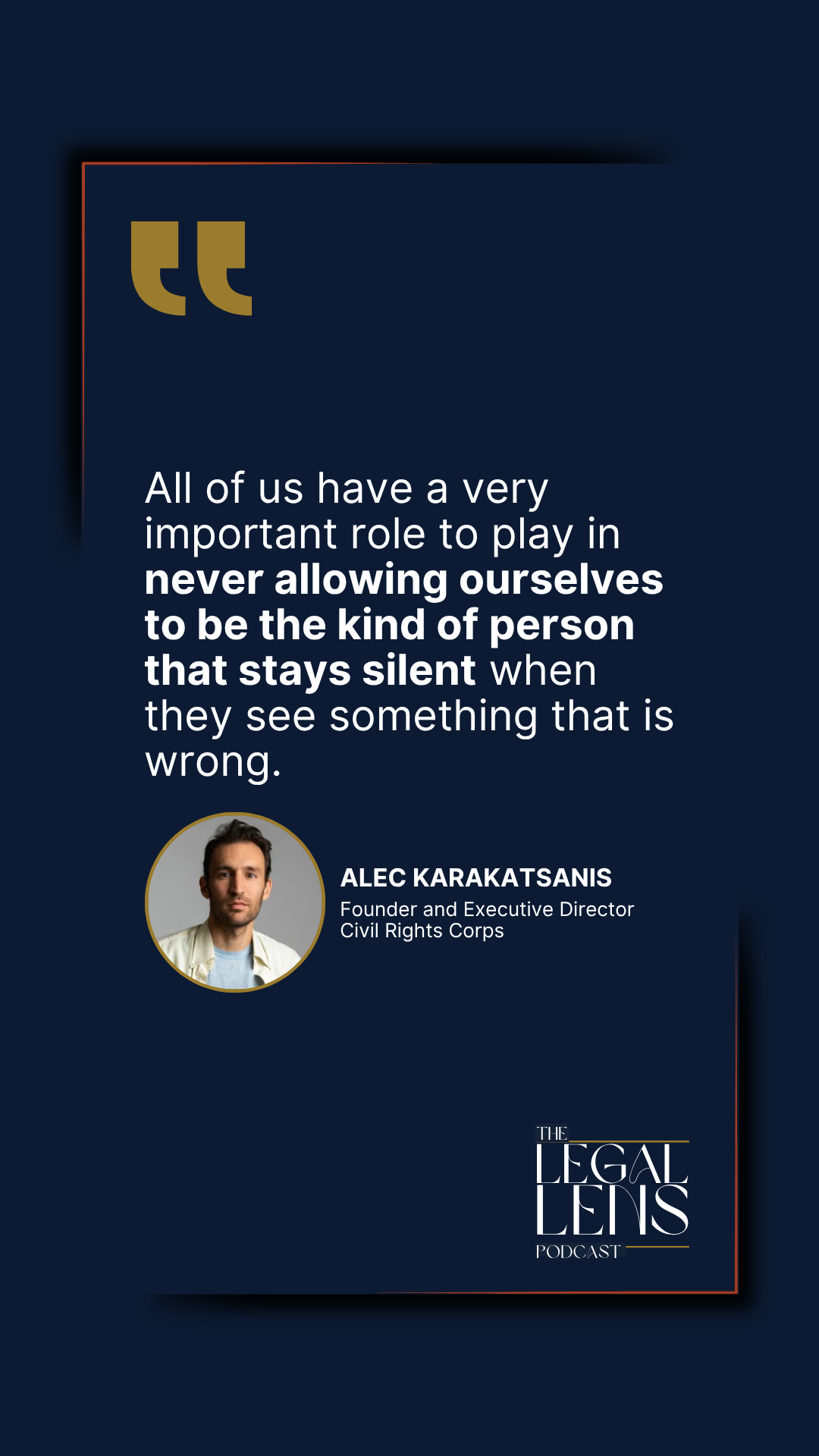
“We must never allow ourselves to be the kind of person that stays silent when they see something that is wrong, and we must never allow ourselves to become desensitized to things that should shock us to the core. If we all do that, and we do that together, then we can push back against anything.” – Alec Karakatsanis
Want to Hear More from Experts Like Alec Karakatsanis? Subscribe to the Legal Lens Podcast Today!
I have dedicated my career to helping litigants resolve their legal disputes through the mediation and dispute resolution process, and by helping dissect the legal issues that shape our public discourse and workplace dynamics, whether it be as a radio and podcast show host, or as a legal analyst in the news. My mission as the host of the Legal Lens radio show and podcast is to empower you with objective, expert-driven insights born from years of practice at the intersection of law and society.
Download and subscribe to the Legal Lens podcast today to hear more insights from leading experts like Alec Karakatsanis.
To download and listen to the show with Alec Karakatsanis on Apple or Spotify, click below:


To learn about all things Legal Lens, follow me on Instagram @iamangelareddockwright.
Follow Alec Karakatsanis on social media at @EqualityAlec and learn more about his work at civilrightscorps.org
Angela’s Other Work
Learn more about my book – The Workplace Transformed: 7 Crucial Lessons from the Global Pandemic – here.
Learn more about my work as an employment and Title IX mediator at Angela J. Reddock-Wright | Signature Resolution and on LinkedIn @Angela J. Reddock-Wright, Esq., AWI-CH.
Book Angela
For media or booking inquiries, please reach out to danny@kwsmdigital.com.
This communication is not legal advice. It is educational only. For legal advice, consult with an experienced employment or civil rights law attorney in your state or city.