

Navigating the complexities of state legislation can feel daunting when the system appears disconnected from everyday community struggles. I have dedicated my career to dissecting critical legal issues, providing the objective, expert-driven insights you need to understand your local government. As the host of the Legal Lens radio and podcast show, my goal is to bridge the gap between legislative action and community impact.
I was honored to welcome California Assemblywoman Sade Elhawary to the program to discuss her deeply personal journey from an educator in South Central Los Angeles to a prominent state legislator. We explored her targeted policy agenda, the ongoing fight for systemic reform, and the harsh realities of passing progressive laws in Sacramento. Our conversation sheds light on the dedication required to deliver tangible results for working-class families.
Navigating the Episode: Time Stamps
- 03:30 – From Grassroots Organizer to the State Assembly
- 06:38 – The Demographics and Reality of the 57th Assembly District
- 08:41 – The Learning Curve of a First-Year Legislator
- 11:53 – Defending the Integrity of California Elections
- 17:53 – Defining Priorities: Wellness Equity and Restorative Justice
- 20:03 – The Impact of the THRIVE Act and Support from San Quentin
- 29:38 – The Diversion Bill and the Reality of Political Compromise
- 34:03 – A Note of Hope for the Future
From Grassroots Organizer to the State Assembly
The path to political office is rarely a straight line, especially for those whose origins lie in ground-level community advocacy. Before taking her seat in the state legislature, Sade Elhawary was deeply entrenched in the daily lives of Los Angeles residents as an educator, a grassroots organizer with the Community Coalition, and a foster mother.
Her perspective on public policy is profoundly shaped by the divergent paths taken by members of her own family. While she pursued higher education at UCLA and Harvard, her sister faced significant hardships, dropping out of school in the ninth grade and navigating the perilous realities of the streets before eventually returning to graduate from UCLA a decade later.
This stark contrast fueled her initial activism. Her transition from a behind-the-scenes organizer to a public figure was entirely unplanned, catalyzed by a moment of acute local crisis surrounding leaked recordings at the Los Angeles City Council. She created T-shirts bearing the phrase “I’m with the Blacks” to demand accountability, planning only to distribute them to her peers.
“I just wanted to be the T-shirts girl, and instead I became someone who folks… thrust into the spotlight. Folks wanted me in different rooms and at different tables, and really made space for younger Black voices to be a part of that conversation.” — Sade Elhawary.
This impromptu thrust into leadership demonstrated the need for authentic, grounded voices in government. It prompted community members to urge her to run for office, realizing that a representative with a deep understanding of both Black and Latino communities was essential for the district’s future.
The Demographics and Reality of the 57th Assembly District
The 57th Assembly District is a vibrant, diverse, and economically challenged section of Los Angeles. It encompasses Downtown LA, Skid Row, South Central, and Exposition Park. While the district is set to receive global attention by hosting the Fan Fest for the World Cup, the day-to-day reality for its residents is marked by significant economic hurdles.
California Assemblywoman Sade Elhawary provided a sobering overview of the economic landscape her constituents navigate daily. The disparity between the influx of global capital for sporting events and the struggles of the local working class is a central tension in her policy formulation.
“About 85% of our folks I represent are Black or Latino… 85% of our community makes under $55,000 a year is our median income, so, our folks are very much in a space where we are barely getting by.” — Sade Elhawary.
Her legislative philosophy is anchored in the belief that government intervention must elevate communities beyond mere survival. The goal is to establish frameworks that allow working-class families to build generational wealth, secure stable housing, and access critical social services. The 57th Assembly District serves as a microcosm for the broader challenges facing urban California, making the policies crafted here a potential blueprint for state-wide economic reform.
Related Article: Dr. T. Anansi Wilson: Voting Rights at Stake – The Recent SCOTUS Decision in Louisiana v. Callais
How Does California Assemblywoman Sade Elhawary Approach the Learning Curve of a First-Year Legislator?
Elhawary navigates the complex legislative environment by leaning heavily on her background as a community organizer to build necessary coalitions while challenging entrenched political norms. Entering the California Assemblywoman role without prior experience as a school board member, mayor, or legislative staffer brings a unique set of challenges and advantages. She admitted to initially battling imposter syndrome, questioning how her background translated to the rigid structures of the state capital.
However, the absence of traditional political conditioning allowed her to approach the legislative calendar (with its strict deadlines for policy committees, floor votes, and budget approvals) with fresh eyes. In her second year of the two-year session, she balances the desire to disrupt the status quo with the pragmatic need to govern effectively.
“I am one of the few people who have done neither of those things, and it means that I’m coming in also with a sense of being bright-eyed and bushy-tailed, but it also means that I’m not restricted by the rules of what I believe I’m supposed to do because of this is how it has always worked.” — Sade Elhawary.
This approach means she occasionally gets into “good trouble,” meaning pushing boundaries to advance her bills. Simultaneously, she recognizes the critical importance of scaling back when necessary to foster bipartisan relationships and secure the votes required to move legislation out of her assigned committees, which range from labor to elections.
Defending the Integrity of California Elections
As national scrutiny surrounding election integrity continues to dominate headlines, California’s voting processes are frequently targeted by partisan critics. During the June primary elections, the extended time required to accurately count ballots in California became a topic of intense national debate. Sitting on the elections committee, the Assemblywoman offered a robust defense of the state’s methodology.
As described by Assemblymember Elhawary, California’s system is intentionally designed to maximize voter participation by removing historical barriers to entry. This includes universally mailing ballots, accepting postmarked ballots up to election day, and providing numerous secure drop boxes. While this comprehensive approach extends the tabulation timeline, it is a deliberate trade-off prioritizing accuracy and enfranchisement over immediate gratification.
“I think the more barriers we create, the more we’re taking away from folks’ actual, like, ability to engage civically, and we want people’s voices in this process… You can, literally, there’s cameras there, and you can see everything going on.” — Sade Elhawary.
She vehemently pushed back against unsubstantiated claims of fraud, noting that the entire counting process is highly transparent and observable. In a state with immense population density, treating the democratic process with rigorous patience is vital to ensuring that every marginalized and working-class voice is fully accounted for.
Related Article: Civil Rights Attorneys Stephen King & Carmen-Nicole Cox on the SCOTUS Louisiana v. Callais Decision & How It Reshapes the Voting Rights Act
Defining Priorities: Wellness Equity and Restorative Justice
In the California State Assembly, legislators are capped at introducing 35 bills per two-year session. This limitation forces elected officials to be highly strategic about where they dedicate their political capital. Rather than adopting a scattershot approach, Sade Elhawary chose to focus intensely on two primary areas where her district lacked vocal champions: wellness equity and restorative justice.
Her commitment to restorative justice stems directly from her early career focus on dismantling the school-to-prison pipeline. Her goal is to shift the state’s paradigm from punitive mass incarceration toward comprehensive prevention, intervention, and post-incarceration re-entry programs.
Simultaneously, her focus on wellness equity addresses the severe lack of resources available to unhoused populations and low-income families. This includes fighting for tangible environmental improvements, such as clean air and water for neighborhoods bifurcated by massive freeways, and actively working to destigmatize mental health care in communities of color.
“I wanted to take all of that information and really hone in on where would our community benefit most. Where don’t we have champions already in the state legislature? … On the wellness side, it was how do we ensure that com- our community has access to mental health and substance abuse treatment…” — Sade Elhawary.
By narrowing her legislative focus, she maximizes her ability to build specialized coalitions and drive meaningful, systemic changes that directly address the root causes of poverty and institutional marginalization within her district.
What is the THRIVE Act, and How Does it Address Systemic Community Trauma?
The THRIVE Act is a groundbreaking piece of legislation designed to provide free, immediate, and sustained mental health services to young people under the age of 25 who have survived or witnessed gun violence. The origins of this bill are rooted in profound community tragedy, specifically a shooting at a two-year-old’s birthday party in Stockton. The primary objective is to intervene in the psychological aftermath of such violence, providing youth with the tools to process trauma rather than resorting to the devastating cycle of retaliation that currently drives much of the juvenile justice system.
The impact of the THRIVE Act extends far beyond the immediate victims. In a stunning display of cross-demographic support, currently incarcerated individuals recognized the bill’s transformative potential. These men, many of whom have served decades for crimes committed in their youth, reached out to her office directly.
“Can you come to San Quentin and talk to us about it? Can we help you make sure it passes? What can we do? Because this is exactly what we needed, right, when we were under 25, and we committed our first crimes because we had seen something… and felt like the only way we could respond was retaliation.” — Sade Elhawary.
By establishing a pilot program in highly impacted counties like Los Angeles and San Bernardino, the THRIVE Act seeks to leverage existing programs to avoid burdening the general fund. It represents a paradigm shift in public safety, proving that true security is achieved through proactive psychological support rather than reactive, hardcore punishment.
Related Article: Movement Lawyer Elizabeth “Paige” White on the Front Lines of Criminal and Civil Rights Law
The Diversion Bill and the Reality of Political Compromise
The legislative process is rarely without its setbacks, a reality clearly illustrated by the trajectory of the Safer Communities Through Opportunities Act. This diversion bill aimed to fundamentally alter how the state handles low-level, non-serious, non-violent felonies. Instead of immediately sentencing individuals to prison for crimes fundamentally rooted in poverty (such as stealing diapers or basic necessities) the bill proposed a framework for accountability through mandatory services and job training programs.
Despite immense effort, the bill faced a severe hurdle on the Assembly floor. After passing initial votes and moving through the Senate with amendments, it required a final “concurrence vote” back in the Assembly just days before the legislative deadline. Facing intense, last-minute lobbying from police chiefs and district attorneys, several colleagues withdrew their support, causing the bill to fail with 35 out of the required 41 votes.
“I walked onto the floor with enough votes, and people were starting to get hit up by the opposition, police chiefs and the DAs… And they literally peeled off within 10 minutes of taking up the bill.” — Sade Elhawary.
This defeat highlights the grueling nature of lawmaking. To eventually pass such progressive reforms, California Assemblywoman Elhawary detailed the necessity of returning to the drawing board to make strategic concessions. She drew a parallel to another bill aimed at ending endless probation for youth, where she had to compromise to guarantee protections for foster youth specifically. Understanding why moderate colleagues vote “no” is a crucial step in refining legislation so it can ultimately survive both the legislature and the Governor’s desk.
A Note of Hope for the Future
Despite the uphill battles, the aggressive opposition, and the complexities of the state budget cycle, Sade Elhawary remains deeply optimistic about the future of California policy. The presence of a dedicated, diverse cohort of progressive leaders in Sacramento provides a strong foundation for continued advocacy.
She credits the collective power of her colleagues, including Isaac Bryan, Tina McKinnon, and Lola Smallwood-Cuevas, for maintaining the momentum required to fight for marginalized communities. Her message to the public is not one of defeat, but an urgent call to action.
“We are on the front lines, and we are doing everything we can. And so continue to work with us, continue to push us, continue to ask us real questions, but know that we are fighters for our people.” — Sade Elhawary.
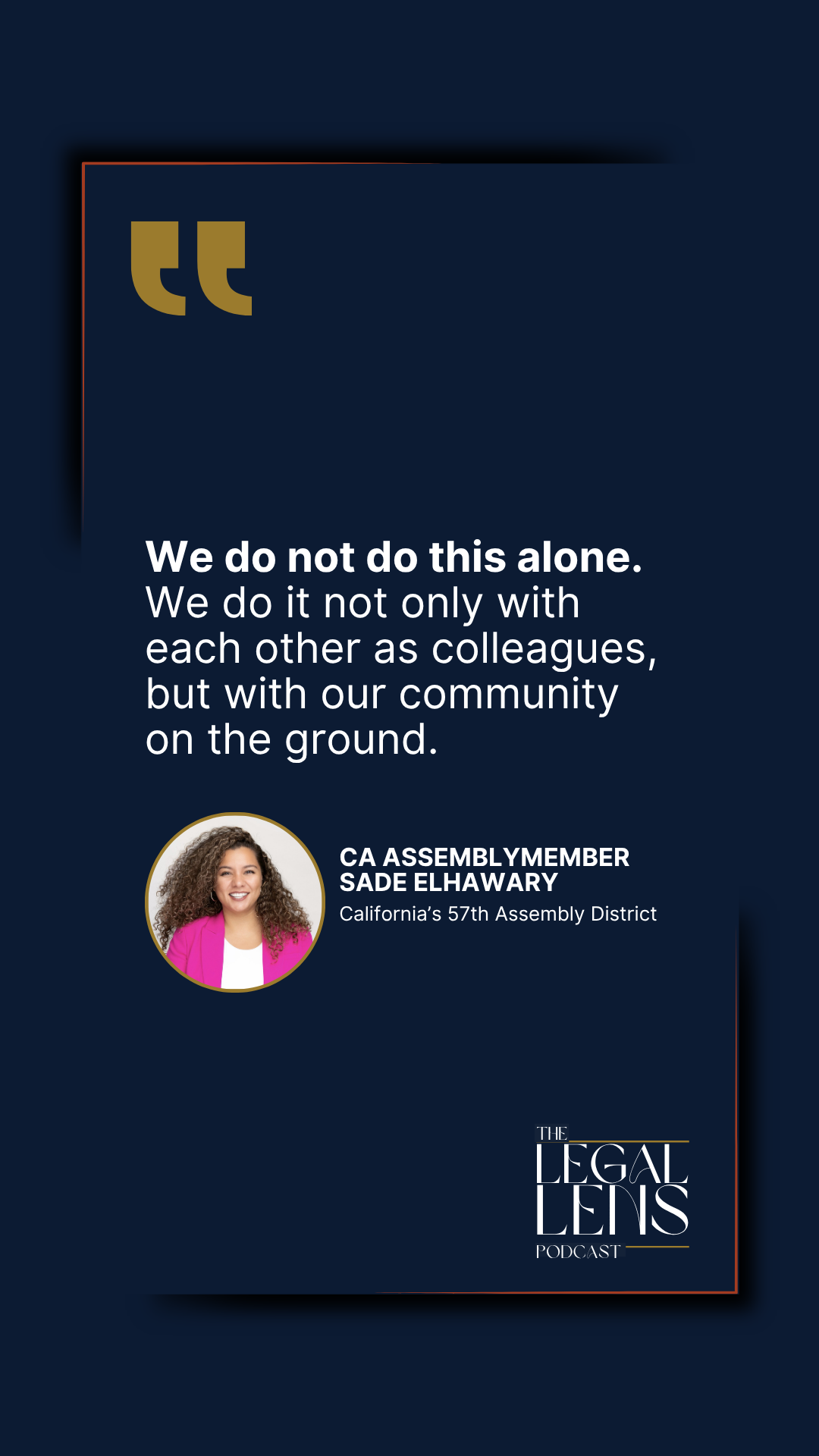
True change requires a persistent partnership between elected officials and the public. By staying engaged, joining coalitions, and demanding accountability, citizens hold the power to shape a government that genuinely reflects and serves the needs of its people.
Want to Hear More from Experts Like Assemblywoman Sade Elhawary? Subscribe to the Legal Lens Podcast Today!
I have dedicated my career to helping litigants resolve their legal disputes through the mediation and dispute resolution process, and by helping dissect the legal issues that shape our public discourse and workplace dynamics, whether it be as a radio and podcast show host, or as a legal analyst in the news. My mission as the host of the Legal Lens radio show and podcast is to empower you with objective, expert-driven insights born from years of practice at the intersection of law and society.
Download and subscribe to the Legal Lens podcast today to hear more insights from leading experts like California Assemblywoman Sade Elhawary.
To download and listen to the show with Sade Elhawary on Apple or Spotify, click below:


To learn about all things Legal Lens, follow me on Instagram @iamangelareddockwright.
Follow Assemblywoman Sade Elhawary on her Instagram at @SadeElhawary to stay connected with her assembly office updates.
Angela’s Other Work
Learn more about my book – The Workplace Transformed: 7 Crucial Lessons from the Global Pandemic – here.
Learn more about my work as an employment and Title IX mediator at Angela J. Reddock-Wright | Signature Resolution and on LinkedIn @Angela J. Reddock-Wright, Esq., AWI-CH.
Book Angela
For media or booking inquiries, please reach out to danny@kwsmdigital.com.
This communication is not legal advice. It is educational only. For legal advice, consult with an experienced employment or civil rights law attorney in your state or city.