

The recent United States Supreme Court ruling in the Louisiana v. Callais case has prompted widespread legal debate regarding the future of voter rights and electoral representation. Many citizens and legal professionals are analyzing how this decision reinterprets established voting protections. This ruling specifically addresses Section 2 of the Voting Rights Act, altering the standards used to evaluate district maps.
To understand the broader implications of these legal shifts, it’s essential to examine the specific arguments currently shaping election law. I sat down with Attorney Stephen King and Attorney Carmen-Nicole Cox to dissect the legal framework of this landmark case. Together, we analyzed the potential consequences for voters nationwide and the procedural strategies being deployed by community organizations.
Navigate the Episode: Timestamps
- 00:00:00 – Introduction to the Louisiana v. Callais ruling.
- 00:03:53 – Attorney Stephen King’s background and transition to civil rights law.
- 00:05:12 – Attorney Carmen-Nicole Cox’s entry into policy and justice reform.
- 00:07:20 – Breaking down the ruling and the legal standards for specialized electoral maps.
- 00:12:48 – The legislative history of the Voting Rights Act and the scope of Section 2.
- 00:17:26 – Analyzing how federal rulings influence California ballot initiatives.
- 00:25:23 – The intersection of voting laws and the young adult demographic.
- 00:29:21 – Mobilization and community education strategies post-ruling.
What Motivates Legal Advocates Like Attorneys Stephen King and Carmen-Nicole Cox?
Before diving into complex constitutional analyses on the Legal Lens podcast, I always go behind the lens to understand the professional and personal drivers of my guests. The practice of civil rights litigation requires attorneys to navigate complex institutional frameworks and historical precedents. For Attorney King, the 50th President of the California Association of Black Lawyers (CABL) and founder of King’s Justice Law, his entry into the legal field was shaped by early experiences with geopolitical instability. Escaping a conflict zone informed his fundamental focus on the rule of law and the preservation of individual liberties within the United States.
“At the age of ten, I was involved in a war, a coup d’état, military takeover in Monrovia, Liberia. And so I had to escape a country for my freedom and for my safety, and I had to start all over. And so when I got here, individual rights, civil rights, those are important things to me… my passion has always been fighting for the underdog.” – Attorney Stephen King
For Attorney Cox, President of the Cox Firm for Law and Policy and the 2026 CABL Lawyer of the Year, the catalyst for her legal career was a profound personal experience with the carceral system. As an adjunct professor who teaches a course on “Race, Mass Incarceration, and Justice Reform,” she approaches the law as an active mechanism for shaping systemic outcomes. Her motivation aligns closely with my own professional focus when exploring the intersecting realms of law and society: using objective legal analysis as a tool for public education.
“In my third year of law school, my father died… we got a notice less than three weeks before he was supposed to come home, that they had found him dead on a prison cell floor. At that time, I was already in law school, and so I realized that not only could I do this kind of work around civil laws, but that I could actually do work that would impact the way people experience our carceral system. So I identify as a liberation attorney because liberation looks like health, wealth, and prosperity.” – Attorney Carmen Nicole Cox
What Are the Core Legal Facts of the Louisiana v. Callais Case?
The Louisiana v. Callais case is a 6-3 Supreme Court ruling that establishes new legal thresholds for the creation of majority-minority districts. During our discussion, Attorney Cox laid out the specific mechanics of this ruling, noting that it provides the legal parameters to challenge existing maps that were originally drawn to consolidate the voting power of non-white residents.
Historically, when a federal court determined that a state’s electoral map diluted the minority vote, the court could mandate the creation of specific districts to correct that imbalance. However, the Louisiana v. Callais ruling determined that relying primarily on race to draw these corrective districts is unlawful. The court established that unless plaintiffs can explicitly prove discriminatory intent by lawmakers, utilizing race-conscious mapping to correct alleged imbalances violates current constitutional interpretations.
“The court said, ‘You can almost never do that. Where you did that here, you shouldn’t have done it because you took race into consideration.’ And then they said, ‘Yeah, it looks like racism, it smells like racism, it tastes like racism,’ all the signs of racism. But they said it wasn’t racism. They said they’re just trying to protect people who are already in those seats. And as long as the government can come up with any non-racist reason, then you can’t prove that race is a good reason to draw these majority-minority districts.” – Attorney Carmen-Nicole Cox
Related Article: Dr. T. Anansi Wilson: Voting Rights at Stake – The Recent SCOTUS Decision in Louisiana v. Callais
The Legal Concept of “Cracking” a District
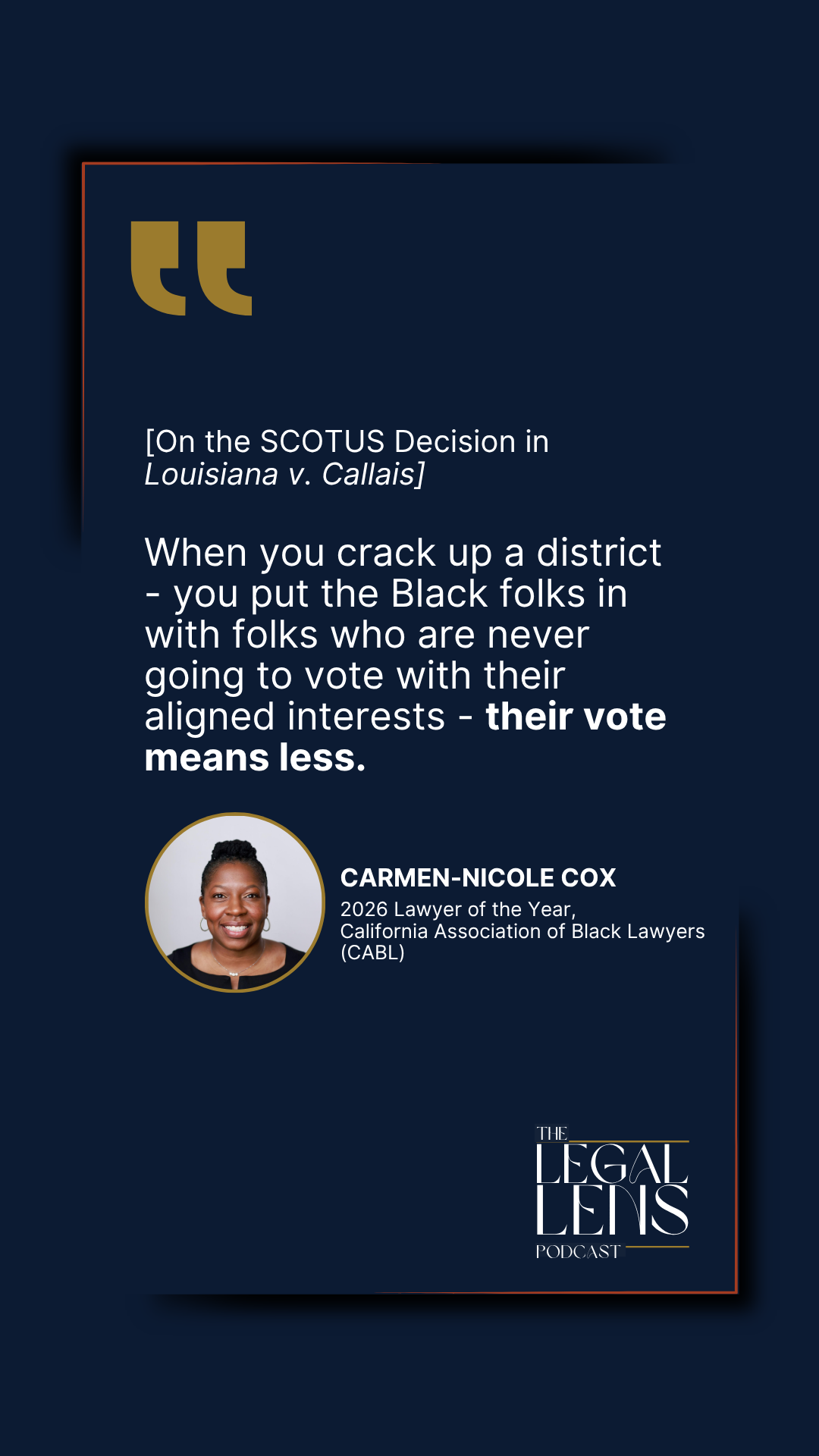
To illustrate how these legal theories apply to physical maps, Attorney Cox highlighted the dissent written by Justice Elena Kagan. The dissent utilized a geometric analogy: imagine a rectangular state containing a circular county in the middle where Black residents form the demographic majority. If that circular boundary is maintained, those residents hold the collective voting power to elect a representative of their choosing.
However, if that circle is “cracked” (legally divided into smaller pieces and absorbed by the surrounding, predominantly white districts), the voting block is statistically marginalized. By restricting the legal justifications for the protective boundaries of these specialized districts, advocates argue that the court is allowing systemic cracking to proceed without federal intervention.
How Does This Supreme Court Decision Reinterpret the Voting Rights Act?
This Supreme Court decision fundamentally shifts how Section 2 of the Voting Rights Act is applied in modern litigation by changing the burden of proof required from plaintiffs. To fully comprehend this legal transition, our guests reviewed the historical enforcement of the Voting Rights Act of 1965. Originally designed to enforce the 15th Amendment following decades of localized voting restrictions (such as poll taxes and literacy tests), the Act historically relied on two main enforcement pillars: Section 5 and Section 2.
Section 5 previously required states with documented histories of voting disparities to obtain federal “pre-clearance” before changing their election laws. The Supreme Court effectively nullified that requirement in 2013, citing changes in the modern racial landscape. This left Section 2 as the primary statutory tool, which broadly prohibited laws that resulted in an unfair burden on non-white voters.
For decades, the legal standard dictated that plaintiffs only had to prove that an electoral map had a “discriminatory result” to warrant judicial intervention. The Louisiana v. Callais ruling changes this standard, now demanding proof of “discriminatory intent.” According to legal analysts like Attorney Cox, this is a significantly higher legal hurdle, as it requires demonstrating that lawmakers purposefully and explicitly intended to harm minority voters when drafting legislation.
“Section Two still means something. It still means that you can’t unfairly burden, but we don’t have racism. Again, we don’t have racism quite like we had racism before. So you can’t use race to correct for racism because that would be unlawful, even though the whole point of the Fifteenth Amendment was you gotta take into consideration race in order to make sure that certain races are not being discriminated against.” – Attorney Carmen-Nicole Cox.
How Might Louisiana v. Callais Influence California Ballot Initiatives?
While Louisiana v. Callais originated in the South, federal rulings routinely serve as blueprints for state-level initiatives aimed at modifying voter registration and district drawing parameters. As an employment law mediator, I frequently observe how federal shifts embolden or alter local policy discussions. Attorney King pointed out that California is currently evaluating its own set of voting measures, emphasizing that the legal precedents established by the Supreme Court are already trickling down to local ballot initiatives.
Advocates assert that these initiatives often introduce new bureaucratic procedures—such as stricter identification requirements or mandating Social Security numbers on mail-in ballots. From a legal standpoint, opponents argue these tactics are designed to increase friction in the voting process and subsequently lower turnout among specific demographics, leading to indirect voter dilution.
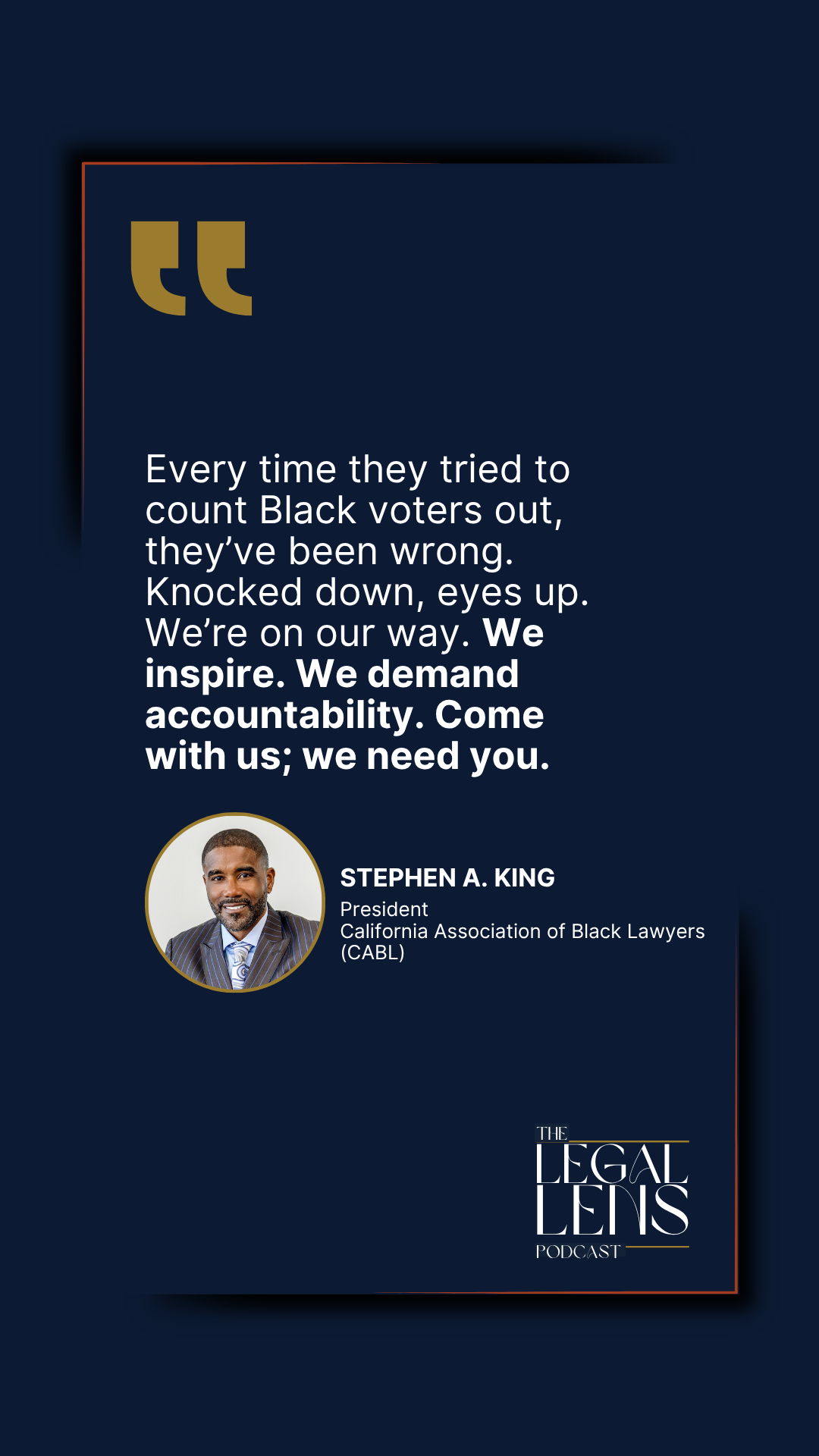
“Black voters in California, they really need to understand that this Supreme Court ruling significantly weakened important voting rights for Black America, and that will be here in California as well. Because there’s a ballot initiative that has qualified in November that is designed strategically to do exactly what is happening here. It’s basically diluting our power to vote… The November election is gonna set the precedent as to how voting and voting rights and the implications are gonna affect Californians, just like this case just affected the Louisiana residents.” – Attorney Stephen King.
Related Article: April Verrett on SEIU’s Vision for a “More Just Society,” the Power of Labor Unions, and Making History as the First Black President of SEIU
Why is the Young Adult Demographic Central to the Debate on Voter Dilution?
The young adult demographic is frequently at the center of discussions concerning voter dilution because this age group is statistically more susceptible to shifts in registration requirements. According to policy experts, individuals aged 18 to 24 often face unique logistical hurdles; they may move frequently for educational or early-career opportunities, making them more vulnerable to voter roll purges or identification discrepancies resulting from address changes.
Attorney Cox emphasized that the policies shaped by these electoral maps—ranging from the structure of student loan forgiveness programs to the regulation of fifty-year housing mortgages—disproportionately impact the long-term financial reality of younger generations. Consequently, civil rights organizations focus heavily on this demographic when analyzing the impact of new voting restrictions.
“We know that they’re coming for the vote of the Black folks ages eighteen to twenty-four because when we look at the folks who are most likely to be impacted by this ballot initiative, people who don’t have either the money to go get their birth certificate and their Social Security card and update their ID, these are Black folks ages eighteen to twenty-four. These, at the same time, are the very people who are going to be suffering the brunt of the decisions that get made… In two years, we may have lost the opportunity to win back the House of Representatives.” – Attorney Carmen-Nicole Cox
How Are Legal Organizations Responding to the Louisiana v. Callais Ruling?
In response to the Louisiana v. Callais ruling, legal organizations are shifting their focus from federal litigation to state-level lobbying and grassroots community education. Because the Supreme Court has raised the evidentiary standard required to challenge district maps, organizations like the California Association of Black Lawyers (CABL) and the National Bar Association are deploying resources directly into communities to navigate the new legal landscape.
Attorney King outlined several procedural steps that civil rights organizations are recommending to voters to ensure compliance with the evolving laws:
- Verify Registration Status Frequently: Voters are encouraged to check their status regularly at their state’s official portal to ensure they have not been removed from the rolls due to new administrative criteria.
- Identify Legislative Districts: Citizens are advised to learn their specific state legislative districts to understand which lawmakers are responsible for local redistricting efforts.
- Document Procedural Barriers: Legal organizations are asking voters to formally document and report any new procedural hurdles or identification requirements they encounter at polling locations to help build data for future legal challenges.
By taking these steps, organizations aim to establish a structured, data-driven response to the legal challenges presented by the ruling. As Attorney King noted, redistricting is a multi-year legal process, and maintaining an informed electorate is the primary strategy for navigating these complex statutory changes.
“We can’t beat them in the courts because they’re using the courts to manipulate and trying to manipulate the legislature and manipulate voting rights that people died for. We have to mobilize. We have to hit the streets. Black communities have fought for every opportunity district that existed, every state… They told us in twenty twenty that our votes would not matter, that Black voters in Georgia, Arizona, Pennsylvania, and Wisconsin decided the outcome of a presidential election. Knock down, eyes up, getting up. We’re on our way. We inspire. We demand accountability. Come with us. We need you.” – Attorney Stephen King
As the legal community continues to analyze the long-term implications of the Louisiana v. Callais ruling, it is helpful to reflect on the words of the late Supreme Court Justice Thurgood Marshall, quoted at the end of our episode: “This is our democracy. We must make it. We must protect it. We must pass it on.” Regardless of one’s political stance, understanding the mechanics of our legal system remains a fundamental component of civic responsibility.
Related Article: Carl Douglas: Fighting for Justice & the Rule of Law
Want to Hear More from Experts Like Stephen King and Carmen-Nicole Cox? Subscribe to the Legal Lens Podcast Today!
I have dedicated my career to helping litigants resolve their legal disputes through the mediation and dispute resolution process, and by helping dissect the legal issues that shape our public discourse and workplace dynamics, whether it be as a radio and podcast show host, or as a legal analyst in the news. My mission as the host of the Legal Lens radio show and podcast is to empower you with objective, expert-driven insights born from years of practice at the intersection of law and society.
Download and subscribe to the Legal Lens podcast today to hear more insights from leading experts like Attorney Stephen King and Attorney Carmen-Nicole Cox.
To download and listen to the show with Stephen King and Carmen-Nicole Cox on Apple or Spotify, click below:


To learn about all things Legal Lens, follow me on Instagram @iamangelareddockwright.
Follow Angela Reddock-Wright for more updates on upcoming episodes and legal analysis.
Angela’s Other Work
Learn more about my book – The Workplace Transformed: 7 Crucial Lessons from the Global Pandemic – here.
Learn more about my work as an employment and Title IX mediator at Angela J. Reddock-Wright | Signature Resolution and on LinkedIn @Angela J. Reddock-Wright, Esq., AWI-CH.
Book Angela
For media or booking inquiries, please reach out to danny@kwsmdigital.com.
This communication is not legal advice. It is educational only. For legal advice, consult with an experienced employment or civil rights law attorney in your state or city.