

As legal frameworks evolve, understanding the changes to voting rights and electoral law is essential for citizens and practitioners alike. You tune into the latest legal news and see that the foundational protections that have guided our elections for decades are undergoing significant shifts.
A recent Supreme Court decision regarding the Voting Rights Act has sparked a widespread discussion about the future of electoral maps. To help dissect what this means for communities across the nation, I invited a constitutional scholar and public defender to help us navigate this complex topic.
Dr. T. Anansi Wilson returned to the Legal Lens podcast to break down the recent decision of the United States Supreme Court (SCOTUS) in the Louisiana v. Callais case and its potential implications. Listen to the full episode below to hear Dr. Wilson’s perspective on this moment in legal history.
Navigating the Episode: Time Stamps
- 00:00 – Welcome back to The Legal Lens Show
- 02:00 – Transitioning from scholar to public defender in Kansas City
- 06:10 – Understanding the Supreme Court season and the shadow docket
- 08:00 – Breaking down opportunity seats and the Voting Rights Act
- 11:30 – The core arguments in Louisiana v. Callais
- 15:00 – The Fourteenth Amendment vs. “Colorblind” jurisprudence
- 19:10 – The majority holding: Partisanship as a proxy for race
- 24:00 – Analyzing Justice Elena Kagan’s powerful dissent
- 26:30 – The real-world consequences: Up to 70 House seats at risk
- 30:00 – Actionable steps: State constitutions, organizing, and court reform
The Transition from Legal Scholar to Public Defender
Before diving into the complexities of federal election law, we caught up on recent career developments. While they continue their scholarly work, our guest has recently taken on a full-time role as a public defender in Kansas City, Missouri. It is one thing to teach constitutional law; it is another to apply it daily in the courtroom.
Operating within the justice system provides a firsthand view of how constitutional principles are applied in practice. As someone who has built my career around bringing the law to light, as you can see from my background, I appreciate the dual perspective of academic rigor and practical application. Dr. Wilson highlighted their perspective on the systemic hurdles Black defendants face the moment they step before a judge.
“Wherever we go, we understand that Black people are under duress. We understand that the standards are higher for us to be successful, and the standards are much lower for us to be harmed. And we see that in the courtroom over and over again.” – Dr. T. Anansi Wilson
Dr. T. Anansi Wilson argues that this reality underscores the importance of having culturally competent representation. It also highlights an ongoing need to educate both the public and legal practitioners on the guarantees of the Fourth, Fifth, and Sixth Amendments.
How Does the Recent Supreme Court Decision Impact the Voting Rights Act?
The recent Supreme Court decision limits the Voting Rights Act by restricting the consideration of race when creating remedial congressional maps. To understand how we arrived at this point, Dr. Wilson discussed the trajectory of the Court over the last decade. They pointed to the earlier removal of pre-clearance requirements in Section 5 under Chief Justice John Roberts as a precursor to the current legal landscape.
Now, the Court has focused on Section 2 of the Voting Rights Act, which originally guaranteed that minority groups have an opportunity to elect their preferred candidates. The majority opinion posited that attempting to remedy racial dilution by considering race is a violation of the Constitution:
“[He]tell us that the Voting Rights Act was never meant to consider race, because if it does, it goes against the 14th Amendment, which whole purpose was to consider the racial policies, laws, and practices of the South in order to allow Black people to have full citizenship and personhood.” – Dr. T. Anansi Wilson
Dr. Wilson argued that this interpretation challenges the original intent of the Reconstruction Amendments. The Fourteenth and Fifteenth Amendments were explicitly drafted to address the disenfranchisement of Black Americans, and our guest believes that ignoring that historical context strips these laws of their intended purpose.
What is the Core Issue in Louisiana v. Callais?
The core issue in Louisiana v. Callais centers on whether creating a second majority-minority district to comply with federal law constitutes illegal racial gerrymandering. The factual background of this case involves several procedural steps. Initially, the NAACP and other groups challenged a Louisiana congressional map because it only included one opportunity seat out of six, despite Black residents making up a significant percentage of the state’s population.
A federal district court agreed that the map diluted Black voting power and ordered the state to draw a new map with a second opportunity seat. The state complied. However, a group of voters—identifying themselves as “non-African Americans”—then sued the state. They argued that because the state considered race to draw the new map, it resulted in discrimination against them.
“They sued, and they said, ‘Wait a minute. Because you considered race in creating a remedial map that the district court required you to do under the Voting Rights Act to stop the dilution of a racial minority’s voting power, you are now engaged in illegal racial gerrymandering.'” – Dr. T. Anansi Wilson
The Supreme Court, in a 6-3 decision, sided with the plaintiffs. They ruled that the state lacked a “compelling interest” to use race in creating the new map. According to Dr. Wilson, this effectively punishes the state for attempting to comply with the provisions designed to ensure fair voter representation.
How Do Partisan Politics Proxy for Race in Redistricting?
According to Dr. Wilson, partisan politics proxy for race in the South because voting patterns strictly align with racial demographics, making political affiliation a substitute for racial identity in electoral mapping. In states like Louisiana, Mississippi, and Alabama, demographic data shows distinct voting patterns. White voters often vote Republican at high rates, while Black voters frequently vote Democratic at similarly high rates.
Because of this polarization, drawing a map based purely on “partisan leanings”—which the Supreme Court permits—can result in maps that dilute Black voting power. Dr. Wilson expressed concern that this creates a legal dynamic where maps can be drawn to benefit a political party, but cannot be drawn considering race.
“In the South, race and political parties are completely congruent. So Black in the South is Democrat, 94, 95%. White people, 94, 95, sometimes 85%, are voting for a Republican. So partisanship becomes a proxy for race, but the Supreme Court will not let you say, think about or consider race.” – Dr. T. Anansi Wilson
Dr. Wilson noted that this dynamic can result in minority communities being structurally locked out of power. If the majority population consistently votes as a bloc and the courts forbid the creation of protective opportunity districts, the minority’s electoral influence is minimized.
Related Article: Kendall Scudder: Why the Texas Democratic Fight Defines the Future of America
What Are the Real-World Consequences for Voter Representation?
According to Dr. Wilson, the real-world consequences for voter representation include the potential loss of up to 70 congressional opportunity seats for minority communities nationwide. The ripple effects of Louisiana v. Callais extend beyond a single state’s borders, providing a potential blueprint for challenging minority influence at various levels of government.
The statistics discussed on the podcast outline potential shifts in representative democracy. If these legal precedents continue, the demographic makeup of elected bodies may change.
Here is a breakdown of the potential systemic losses outlined by our guest:
- Up to 70 House districts nationwide are at risk of having their representation altered.
- Latino communities could lose up to 12% of their representatives in Congress.
- Black representation could decrease significantly depending on future mapping in various states.
“We are finding ourselves with the same kind of processes and outcomes as Jim Crow. And it’s very serious if you tell somebody that they’re living in Cancer Valley in Mississippi, and there’s nothing they can do to get their representative to change their mind… what are you gonna do? Voting doesn’t matter.” – Dr. T. Anansi Wilson
In my various areas of expertise in dispute resolution, I often observe that when individuals feel excluded from decision-making processes regarding their communities, it can lead to heightened conflict and civic disengagement.
What Can Citizens and Congress Do to Protect Democracy?
As described by Dr. Wilson, both citizens and Congress can protect democracy by pursuing court reform, organizing at the local level, and leveraging state constitutions. While the Supreme Court’s ruling is significant, Dr. Wilson emphasized it is not the final word, noting that marginalized groups have historically innovated in response to legal challenges.
As Dr. Wilson highlighted, Justice Elena Kagan’s dissent accused the majority of using “untenable readings of statutory text” and displaying “disdain for congressional judgment.” Because the Court interpreted a statute rather than a constitutional amendment, Congress has the ability to address it legislatively.
Dr. Wilson outlined several potential structural responses from elected officials, including:
- Congressional Legislation: Congress could pass a new voting rights bill that explicitly defines what the law requires.
- Court Reform: Congress has the power to expand the court, implement enforceable ethics codes, and establish term limits.
- State-Level Amendments: Citizens can mobilize to pass referendums and amend state constitutions to guarantee fair mapping.
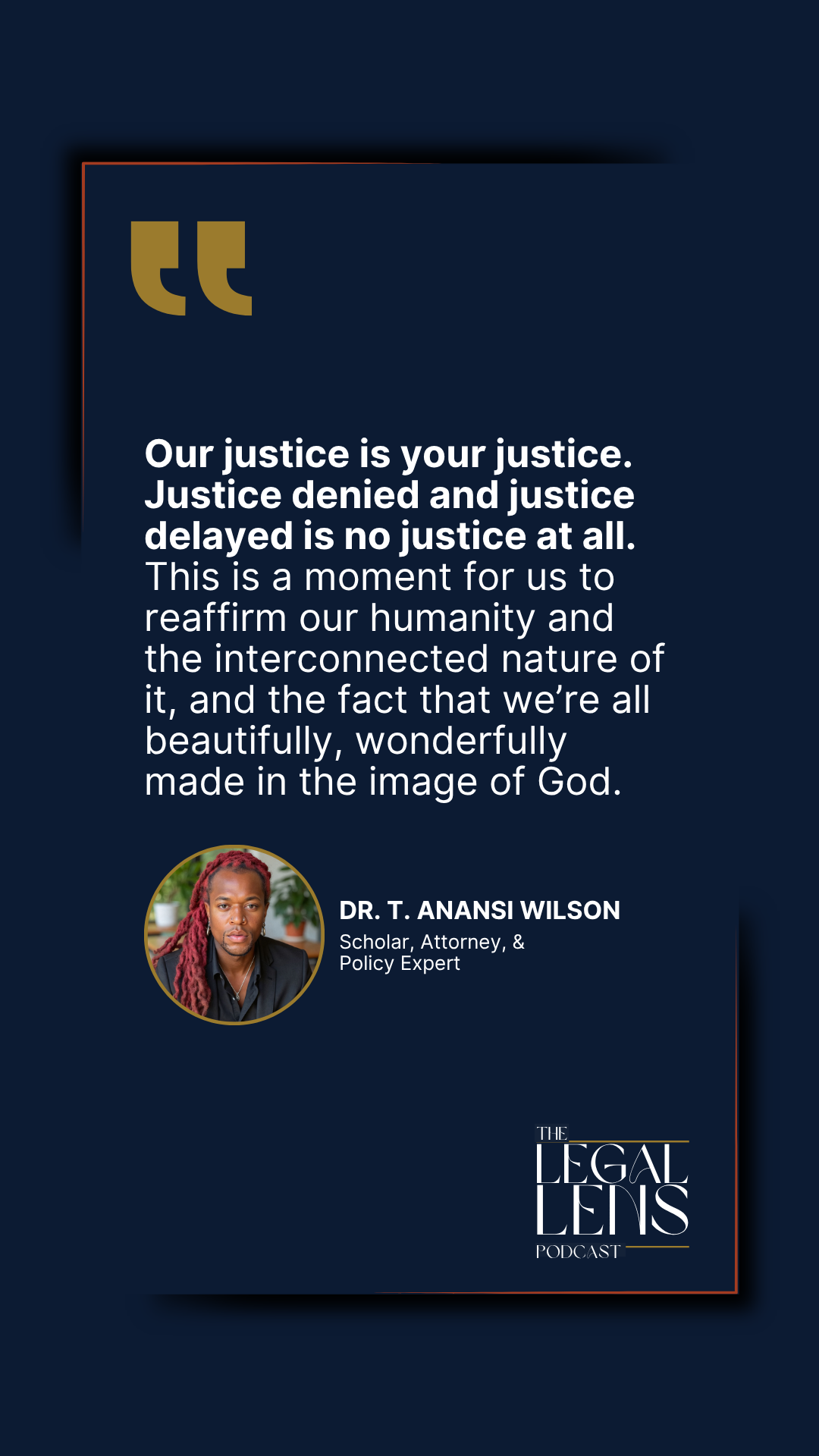
“This is a moment for us to reaffirm our humanity and the interconnected nature of it, and the fact that we’re all beautifully, wonderfully made in the image of God… I say this to our White and non-African American brothers and sisters out there, this is your John Brown moment.” – Dr. T. Anansi Wilson
My goal is to facilitate discussions that shed light on these complex legal shifts. Dr. Wilson encourages citizens to educate themselves, engage in local government, and focus on the historical long game to ensure our government reflects the people it serves.
[Reel #5]
Related Article: April Verrett on SEIU’s Vision for a “More Just Society,” the Power of Labor Unions, and Making History as the First Black President of SEIU
Want to Hear More from Experts Like Dr. T. Anansi Wilson? Subscribe to the Legal Lens Podcast Today!
I have dedicated my career to helping litigants resolve their legal disputes through the mediation and dispute resolution process, and by helping dissect the legal issues that shape our public discourse and workplace dynamics, whether it be as a radio and podcast show host or as a legal analyst in the news. My mission as the host of the Legal Lens radio show and podcast is to empower you with objective, expert-driven insights born from years of practice at the intersection of law and society.
Download and subscribe to the Legal Lens podcast today to hear more insights from leading experts like Dr. T. Anansi Wilson.
To download and listen to the show with Dr. T. Anansi Wilson on Apple or Spotify, click below:


To learn about all things Legal Lens, follow me on Instagram @iamangelareddockwright.
Follow Dr. T. Anansi Wilson and their incredible scholarly work to stay informed on the shifting landscape of constitutional law.
Angela’s Other Work
Learn more about my book – The Workplace Transformed: 7 Crucial Lessons from the Global Pandemic – here.
Learn more about my work as an employment and Title IX mediator at Angela J. Reddock-Wright | Signature Resolution and on LinkedIn @Angela J. Reddock-Wright, Esq., AWI-CH.
Book Angela
For media or booking inquiries, please reach out to danny@kwsmdigital.com.
This communication is not legal advice. It is educational only. For legal advice, consult with an experienced employment or civil rights law attorney in your state or city.