

This week on the Legal Lens show we welcomed Twyla Carter, Attorney-in-Chief and CEO of the Legal Aid Society of New York where she discusses the 150 year history of the organization and their efforts to create access to justice for all New Yorkers.
As described by Carter, the Legal Aid Society has spent over a century ensuring that “the people’s lawyer” is more than just a title. The mission of the Legal Aid Society of New York is that justice should be expected, not exceptional. Twyla Carter explains that providing a robust defense for the marginalized is not just about individual cases; it is about protecting the very integrity of democracy.
Listen to the full conversation with Twyla Carter below:
Navigating the Episode: Time Stamps
- 02:20 – Twyla’s “Why”: The journey to becoming a dedicated public defender.
- 07:05 – The Scale of Justice: An overview of the Legal Aid Society of New York as the nation’s oldest nonprofit law firm.
- 12:40 – Audacious Goals: Defining a New York where justice is the standard, not the exception.
- 14:45 – The AI Frontier: How the organization uses technology to handle 40,000+ helpline calls.
- 22:15 – The “Muffin” Debate: Questioning the criminalization of poverty and mental health.
- 29:00 – The Reality of Rikers: Why the distinction between jail and prison matters for pretrial rights.
- 33:25 – The Resource Gap: Fighting a $14 billion NYPD budget with limited nonprofit resources.
Twyla Carter’s Journey from Public Defense to Leadership
Before leading the largest nonprofit law firm in the country, Twyla Carter began her career in the trenches of the courtroom. Her commitment to the marginalized started early, as she went to law school with the singular, focused goal of representing those who could not represent themselves. She challenges the “public pretender” myth by highlighting the passion and brilliance found within the public defense community.
“I went to law school just to be a public defender, and that’s what my personal statement to law school said… we are the ones standing in the gap of injustice on their behalf.” — Twyla Carter
The path to leadership was paved with over a decade of experience in King County, NY, handling everything from misdemeanors to homicides. This intimate nature of her role allowed her to see the flaws in the system firsthand, particularly how access to justice is often curtailed by bureaucratic indifference and a lack of resources for the accused.
150 Years of the Legal Aid Society of New York
The Legal Aid Society of New York recently celebrated its 150th anniversary, marking a historic milestone in American jurisprudence. From handling 212 cases in 1876 to benefiting over 2 million people today through direct representation and policy work, the organization is a titan of civil rights. Carter notes that they are currently the largest law firm in New York, staffed by over 1,250 attorneys dedicated to the people’s interest.
“The Legal Aid Society is the largest and oldest public defense and civil legal services provider in the country… our mission is rooted in the very strong belief that no New Yorker or no one should be denied equal justice because of poverty.” — Twyla Carter
This massive operation covers 40 different units, including housing, immigration, and juvenile rights. By maintaining a presence in all five boroughs, the society ensures that low-income New Yorkers have a voice in a New York criminal legal system that would otherwise be deaf to their struggles.
Reimagining Justice: Moving Beyond Mitigation
For Twyla Carter, the goal is not simply to make a harmful system slightly less painful, but to fundamentally reimagine what justice looks like. This involves shifting the public perception away from law enforcement as the sole arbiters of safety. True safety, she argues, comes from meeting human needs. This includes stable housing, healthcare, and education, before a crisis ever reaches the courtroom.
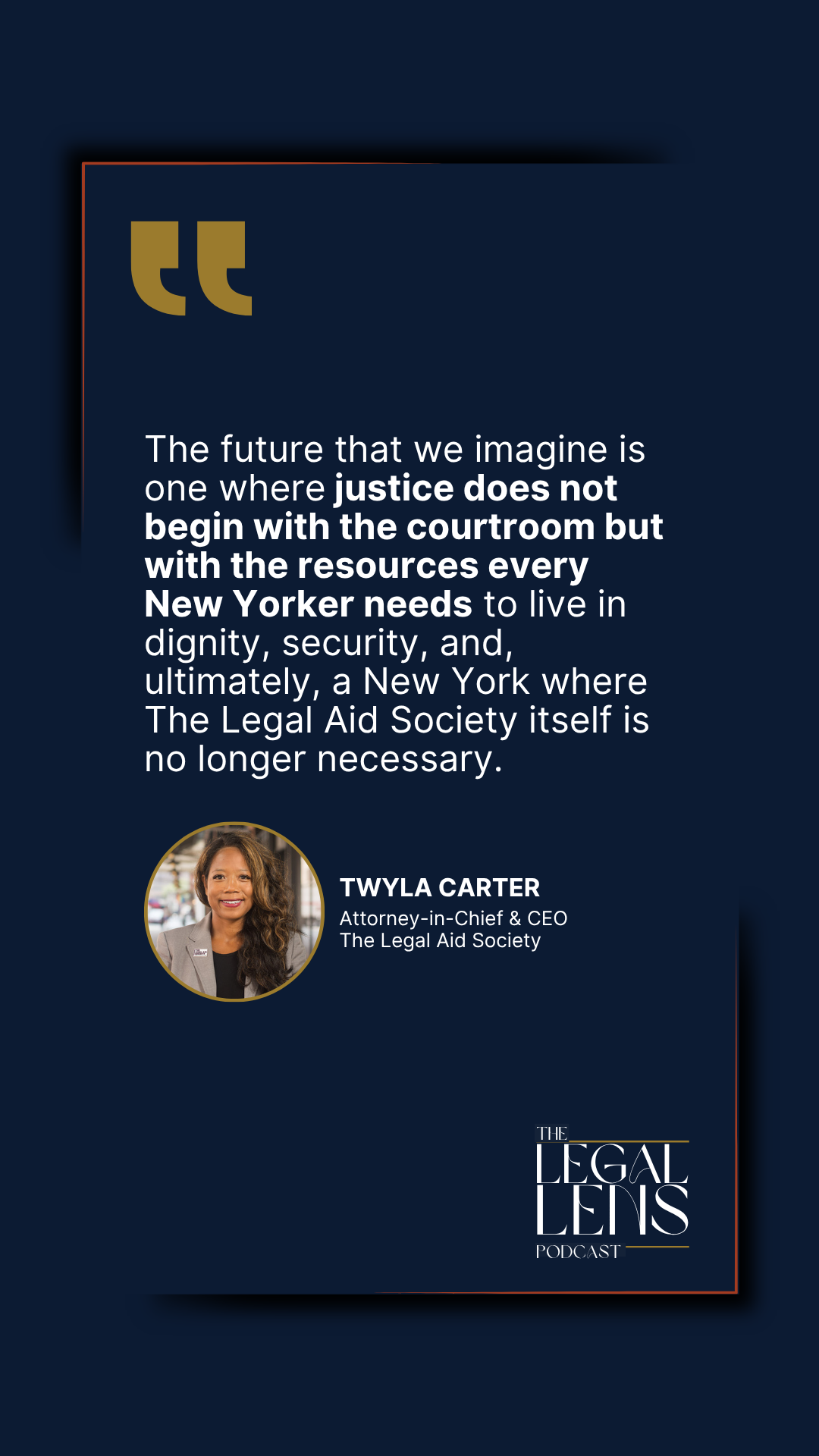
“Our vision is simple, but very audacious. And that is a New York where justice is expected and not exceptional… where the law is not a barrier, but it’s an actual bridge to a better life.” — Twyla Carter
Carter states this reimagining requires a holistic and empathetic approach. When a client walks through the door, they are often facing a web of intersecting issues, from criminal charges to the loss of public benefits. The Legal Aid Society’s interdisciplinary practice ensures that social workers and investigators work alongside lawyers to address the root causes of legal crises.
Bail and the Fight for Reform
The Legal Aid Society has been a leader in advocating for a cash bail system.Carter describes bail as a “ransom” that creates a two-tiered system of liberty. Those with wealth can purchase their freedom before trial, while those in poverty remain incarcerated, regardless of their actual risk to the community or the strength of the evidence against them.
“Working on bail reform… is the idea that one must pay a ransom, if you will, a dollar amount before you’ve gone to trial just to get out of jail. We know that there is something flawed with bail when someone… can afford to pay the ransom to get outta jail before trial.” — Twyla Carter
Her work with the Bail Project revealed that when people are provided with basic support services—like rides to court and reminders—they show up to 90% of their hearings. This proves that the threat of losing money is not the primary driver of court attendance; rather, it is the removal of structural barriers that ensures participation in the legal process.
The Reality of Rikers Island
The discussion then turned to the conditions at Rikers Island, a facility that remains a focal point of impact litigation for the Society. Carter provides clarification for the public: Rikers is a jail, not a prison. This means the vast majority of people suffering within its walls have not been convicted of a crime; they are there simply because they could not afford the “ransom” of bail.
“People don’t realize that Rikers Jail is a jail. It’s not a prison. So most of the people that are there are pretrial. They have not been convicted of anything… It really brings it into light when you understand that many of these people have not been convicted of anything.” — Twyla Carter
The Legal Aid Society has been at the forefront of the Nunez litigation, which addresses unconstitutional levels of violence and force within the city jails. By securing federal oversight and a remediation manager, the Society is fighting to ensure that even those in the darkest corners of the system are treated with basic human dignity.
Leveraging AI for Access to Justice
In an era where technology is often seen as a tool for surveillance, the Legal Aid Society is harnessing it for good. By partnering with Columbia Law School, they have developed an AI tool to help manage their 40,000 annual helpline calls. This allows the organization to efficiently identify legal issues and provide translated resources to thousands of people who may not need full representation but require immediate guidance.
“Harnessing in a meaningful and a thoughtful way, in a careful way, AI will allow us… to continue efficiently and effectively helping that many more people.” — Twyla Carter
This technological integration is part of a broader strategy to ensure the Society remains effective for the next 150 years. By combining elite human expertise with modern efficiency, Twyla Carter is ensuring that the Legal Aid Society of New York remains a constant force for good in an ever-changing legal landscape.
Want to Hear More from Experts Like Twyla Carter? Subscribe to the Legal Lens Podcast Today!
I have dedicated my career to helping litigants resolve their legal disputes through the mediation and dispute resolution process, and by helping dissect the legal issues that shape our public discourse and workplace dynamics, whether it be as a radio and podcast show host or as a legal analyst in the news. My mission as the host of the Legal Lens radio show and podcast is to empower you with objective, expert-driven insights born from years of practice at the intersection of law and society.
Download and subscribe to the Legal Lens podcast today to hear more insights from leading experts like Twyla Carter.
To download and listen to the show with Twyla Carter on Apple or Spotify, click below:


To learn about all things Legal Lens, follow me on Instagram @iamangelareddockwright.
Follow Twyla Carter and the Legal Aid Society of New York at www.legalaidnyc.org.
Angela’s Other Work
Learn more about my book – The Workplace Transformed: 7 Crucial Lessons from the Global Pandemic – here – https://angelareddock-wright.com/book/
Learn more about my work as an employment and Title IX mediator here Angela J. Reddock-Wright | Signature Resolution and on LinkedIn @Angela J. Reddock-Wright, Esq., AWI-CH.
Book Angela
For media or booking inquiries, please reach out to danny@kwsmdigital.com.
This communication is not legal advice. It is educational only. For legal advice, consult with an experienced employment or civil rights law attorney in your state or city.