

I have spent my career at the intersection of law and public discourse. My role isn’t just to provide commentary; it is to act as a strategic translator for the issues that define our era. Whether I’m serving as a neutral mediating an employment or Title IX case for clients, providing educational legal commentary on the latest in employment and workplace laws, or hosting my Legal Lens radio show and podcast, my 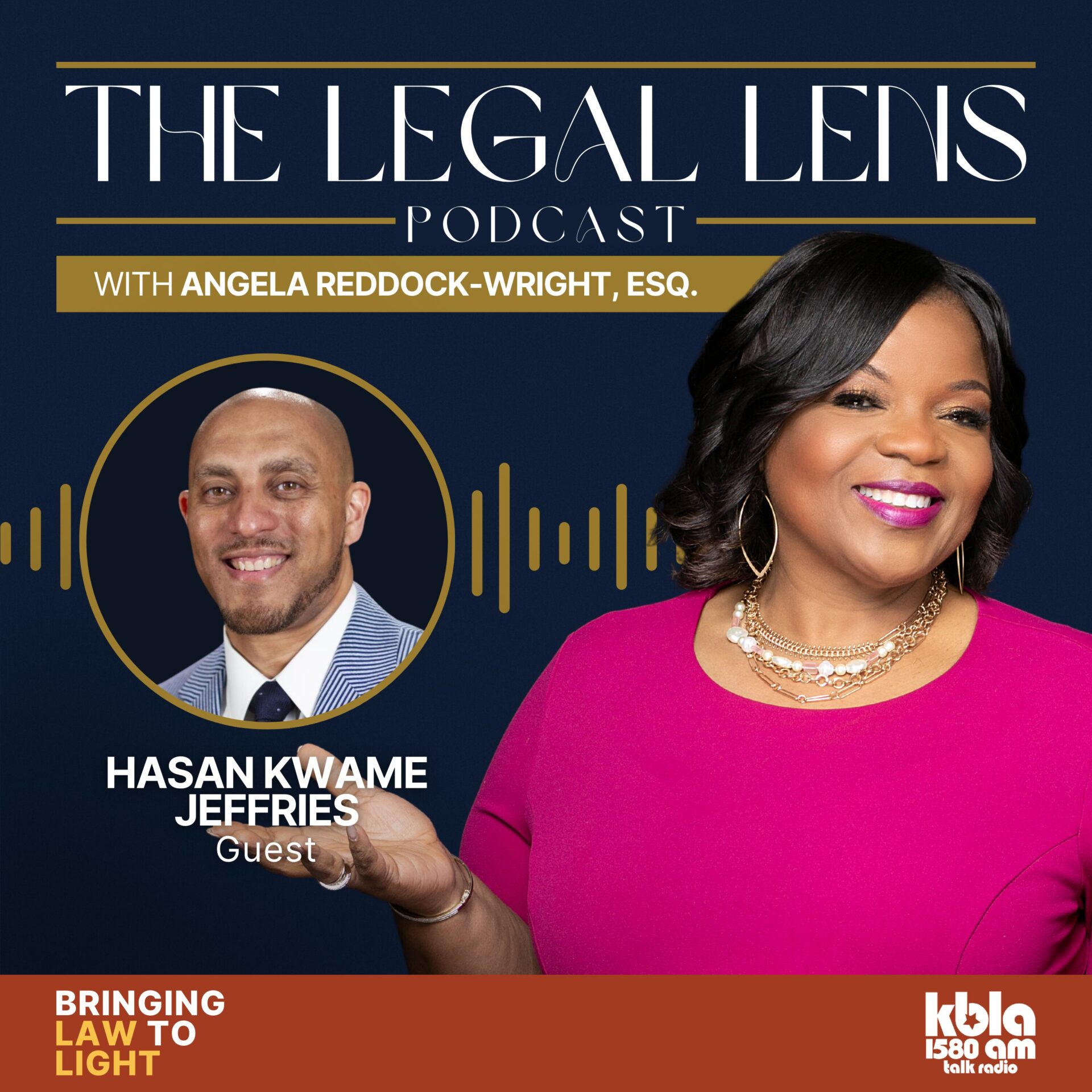 mission remains constant: helping people resolve legal problems through the mediation and dispute resolution process, and helping educate and enlighten everyday people on the legal and policy issues that impact their everyday lives.
In my latest episode of the Legal Lens Podcast, I sat down with Hasan Kwame Jeffries, a distinguished history professor at The Ohio State University and a leading expert on the Civil Rights Movement. He also is the brother of Congressional Democratic House Leader Kwame Jeffries.
From his deep academic research to his family legacy of service, Professor Jeffries shared a powerful perspective on why the “ashes” of our current democratic institutions might actually be the ground for a stronger future. You can find us on Apple Podcasts, Spotify, and anywhere you get your podcasts for free. You can also listen to the full episode below:
The Legal Lens: Key Moments with Hasan Kwame Jeffries
- 1:40 – The Jeffries Family Legacy: Service to the People
- 3:50 – Growing up in 1980s Brooklyn: A Formative Lens
- 7:00 – Is There a Modern-Day Civil Rights Movement?
- 13:30 – The Myth of 100% Unity in the 1960s
- 19:10 – “What Made You Think You Were So Special?”
- 25:30 – Hyperpolarization and the Political Memory of Gen Z
- 29:15 – The Radical, Real Dr. Martin Luther King Jr.
- 34:20 – Building a New Democracy Out of the Ashes
A Legacy of Service: From Brooklyn to the National Stage
Before he was an author and a scholar at one of the top universities in the country, Hasan Kwame Jeffries was a kid in Crown Heights and Bed-Stuy. Coming of age in the 1980s, he witnessed the dawn of mass incarceration and the crack epidemic—realities that weren’t being explained in his school textbooks. This dissonance fueled his desire to pursue Black history facts and scholarship as a means to understand the world.
However, his most profound influence was closer to home. The brother of U.S. House Minority Leader Hakeem Jeffries, Hasan, credits his parents (both social workers) with instilling a non-negotiable requirement for their careers.
“The one requirement, the one requisite was that it had to be whatever you chose to do, it had to be done in service to the people. Period, full stop. If you want to sweep streets, if that’s gonna make you happy, then let it be in a black neighborhood… We’re pouring into you. We expect a return, not for us, but to be paid to the community going forward.” – Professor Hasan Kwame Jeffries
Defining the Movement vs. the Struggle
We often fall into the trap of viewing Black History Month as a time to look backward at a singular, frozen event. Professor Jeffries challenges this by distinguishing between a “movement” and a “struggle.” While movements are short-term coalescing events around specific goals, like the abolitionist movement or the classical civil rights era, the struggle for freedom has been constant for 400 years.
He points out that we are currently living through the largest mass mobilization in American history. The 2020 protests following the murder of George Floyd involved 20 to 30 million people, dwarfing the 250,000 who attended the March on Washington. To understand the Black history figures of tomorrow, we must look at those organizing today.
“Movements actually… last only short periods of time. It’s hard to sustain the kind of energy, resources, momentum, that participation that you need for a genuine social movement. But what we do see is that African Americans have always engaged in struggle. From the moment we were brought to these shores… we’ve always engaged in this struggle for freedom.” – Professor Hasan Kwame Jeffries
The Myth of Post-Racial America and the Call to Fight
For years, a dangerous mythology suggested that the election of former President Barack Obama signaled a “post-racial” era. Professor Jeffries argues that this narrative left younger generations “shook” when faced with the resurgence of white supremacy. He shared a poignant story about a SNCC (Student Nonviolent Coordinating Committee) veteran, Cortland Cox, who had a blunt message for younger activists feeling overwhelmed by the current administration.
“Cortland Cox just cut to the chase and said, ‘What made you think that you were so special that you wouldn’t have to fight for your freedom too?’ And that was it. Every generation of black folk have had to fight for their freedom. Period. Full stop. This is your fight.” – Professor Hasan Kwame Jeffries
Related Podcast Episode: Alphonso David on the Global Black Economic Forum, Protecting Democracy and Civil Rights, and Why Principles Matter in Inconvenient Times
Beyond the “Dream”: Reclaiming the Radical Dr. King
When we celebrate Black History Month, we often see a sanitized version of Dr. Martin Luther King Jr.—frozen in 1963, dreaming on the steps of the Lincoln Memorial. Professor Jeffries insists that this version is of little use to us today. To find real solutions, we must look at the “Radical King”—the man who decried capitalism, militarism, and systemic racism right up until his assassination.
King wasn’t just dreaming; he was demanding a minimum income and a radical restructuring of society. If we are to move forward, we must stop looking for the “nice middle ground” and start engaging with King’s blueprint for revolutionary change.
“That version is a version that didn’t really exist… Dr. King frozen in 1963 on the steps of the Lincoln Memorial, dreaming about a world that doesn’t exist. That isn’t the King who actually lived. The radical King… in 1967, decrying militarism, decrying racism, decrying capitalism… talking about a check that is due.” – Professor Hasan Kwame Jeffries
Seizing the Opportunity in the Ashes
Despite the “crumbling of our democracy,” Professor Jeffries remains optimistic. He views the current attacks on DEI and affirmative action not just as a loss, but as an indictment of systems that weren’t built strong enough to endure. This “hyperpolarization” has politicized a new generation of leaders who are ready to build something better than what came before.
Whether you are looking for Hasan Kwame Jeffries’ Ted Talks or his academic work, his message remains clear: the destruction of old, fragile norms creates the space for a 30-year project to build a truly inclusive democracy.
“If you can wipe out 60 years of affirmative action and diversity, equity, and inclusion programs in six days, then they weren’t strong enough. They weren’t built into the system to endure. So okay, you’ve wiped them out. We’re gonna seize this moment to build something back that is gonna be better, that is gonna be stronger, that is gonna be more democratic.” – Professor Hasan Kwame Jeffries
Related Podcast Episode: Rev. Shavon Arline-Bradley on the NCNW’s 90-Year Fight for Black Women, Economic Justice, and the Power of the Black Church
Want to Hear More from Experts Like Professor Hasan Kwame Jeffries? Subscribe to the Legal Lens Podcast Today!
I have dedicated my career to helping litigants resolve their legal disputes through the mediation and dispute resolution process, and by helping dissect the legal issues that shape our public discourse and workplace dynamics, whether it be as a radio and podcast show host, or as a legal analyst in the news. My mission as the host of the Legal Lens radio show and podcast is to empower you with objective, expert-driven insights born from years of practice at the intersection of law and society.
Download and subscribe to the Legal Lens podcast today to hear more insights from leading experts like Professor Hasan Kwame Jeffries.
To download and listen to the show with Hasan Kwame Jeffries on Apple or Spotify, click below:


 To learn about all things Legal Lens, follow me on Instagram @iamangelareddockwright.
Angela’s Other Work
Learn more about my book – The Workplace Transformed: 7 Crucial Lessons from the Global Pandemic – here – https://angelareddock-wright.com/book/
Learn more about my work as an employment and Title IX mediator here Angela J. Reddock-Wright | Signature Resolution and on LinkedIn @Angela J. Reddock-Wright, Esq., AWI-CH.
Book Angela
For media or booking inquiries, please reach out to danny@kwsmdigital.com.
This communication is not legal advice. It is educational only. For legal advice, consult with an experienced employment or civil rights law attorney in your state or city.