

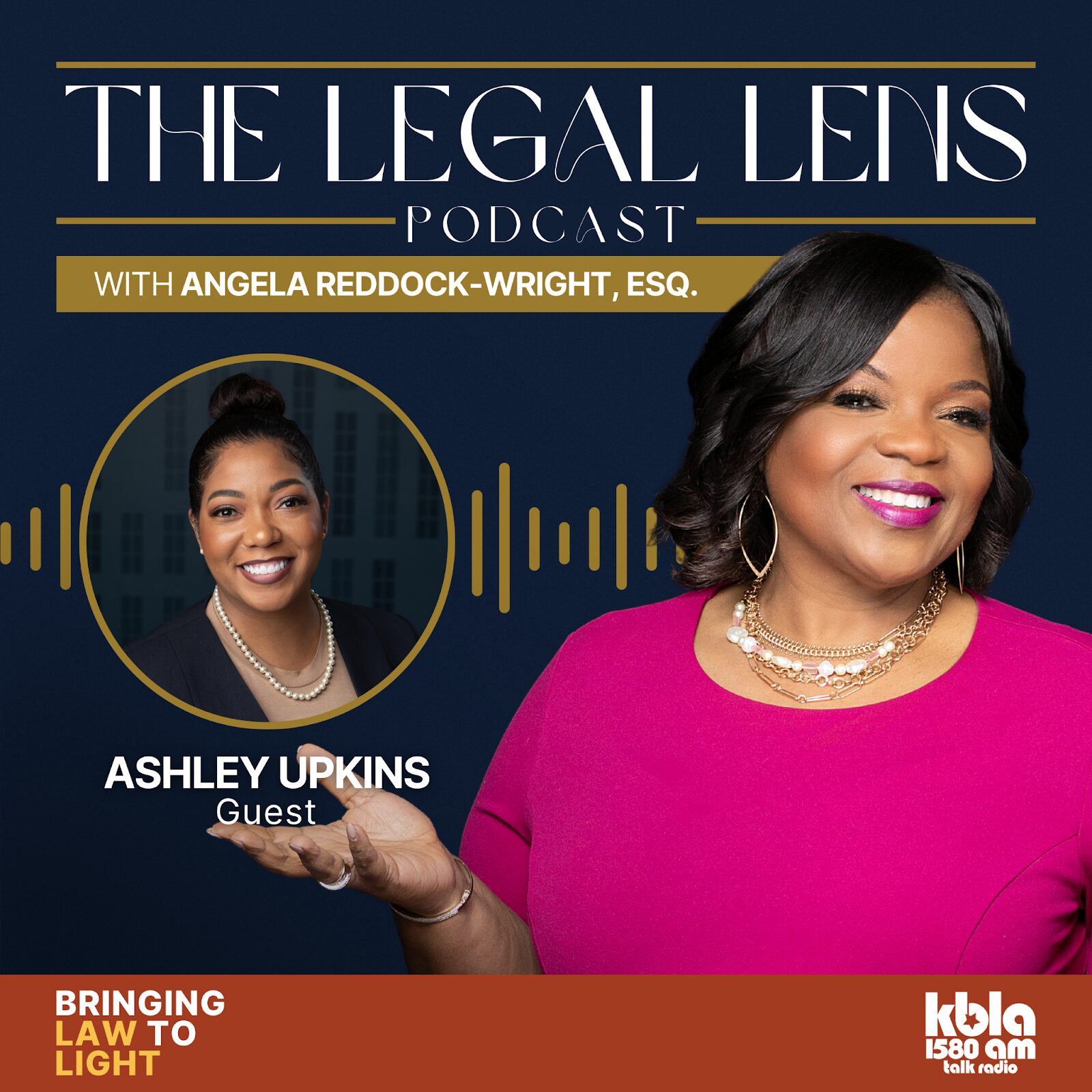
 The foundation of American democracy and the pursuit of justice are currently facing extraordinary challenges, demanding resolute leadership from our nation’s top legal advocates. It was truly an honor and a privilege to welcome a guest to The Legal Lens Podcast who embodies this resilience and commitment: Attorney Ashley Upkins, the current President of the National Bar Association (NBA), the largest and oldest network of African American attorneys in the U.S. and internationally. Attorney Upkins brings a unique perspective to this role. She also serves as in-house counsel at Silicon Ranch, one of the nation’s largest independent solar energy producers. In this riveting and necessary conversation, Ashley shares her inspiring path to legal leadership and delivers a powerful challenge to us all: to focus on our shared humanity, “do justice” in our spheres, and defend the rule of law.
For a deeper, more convenient dive into these critical topics, I strongly encourage you to listen to our full discussion on The Legal Lens Podcast. You can find us on Apple Podcasts, Spotify, Simplecast, and everywhere you get your podcasts for free. Alternatively, listen to the full episode in the player below:
Defending Democracy and Finding Common Ground: A Conversation with Attorney Ashley Upkins, President of the National Bar Association
Attorney Ashley Upkins‘ insights into how the NBA is mobilizing on the front lines, from combating threats to the rule of law to tackling massive job displacement, are invaluable in the current legal and social climate. Here are timestamps and topics covered to help better navigate the episode:
- 3:45 – Who is Attorney Ashley Upkins and What is Nashville’s True “Music City” History?
- 5:45 – The Power of Representation: How Clair Huxtable Inspired a Legal Leader
- 8:00 – From Outside Counsel to In-House Leader at Silicon Ranch
- 11:45 – The National Bar Association: Born Out of Rejection, Built on Inclusion
- 16:40 – The Current State of Black Lawyers and Fighting Threats to Opportunity
- 19:10 – From Statements to Solutions: The NBA’s Career Fair Initiative
- 23:55 – Defending the Rule of Law: Lawyers Unifying Against Constitutional Attacks
- 34:25 – NBA’s Key Initiatives: Expungement Clinics, AI/Global Innovation, and Student Support
- 37:05 – A Note of Hope: You Are Not Powerless, Keep Showing Up
Related Podcast Episode: Dr. Shakari Byerly on California Prop 50, the Power of the Black Vote, and the Fight Against Gerrymandering
Who is Attorney Ashley Upkins, and What is Nashville’s True “Music City” History?
Attorney Ashley Upkins proudly identifies as “born and raised” in Nashville, Tennessee, and when discussing her hometown, she was quick to correct a common historical misconception about how Nashville earned its famous nickname, “Music City.”
“So many times, people talk about music in Nashville, and you just hear about country music. But that’s not how they got their name. Nashville got its name from the Fisk Jubilee singers of Fisk University, an HBCU. They went and sang for Queen Victoria, and the queen said, ‘Oh, you’re from a very musical city,’ and that’s how we got the name Music City,” explained Upkins.
She emphasized that while country music is a part of Nashville’s history, its true musical roots are much richer, including gospel.
Related Podcast Episode: Rev. Shavon Aline-Bradley on the NCNW’s 90-Year Fight for Black Women, Economic Justice, and the Power of the Black Church
The Power of Representation: How Clair Huxtable Inspired a Legal Leader
Growing up, Attorney Ashley Upkins did not know any lawyers, and neither of her parents graduated from college. Yet, she knew she wanted to be a lawyer ever since she saw Phylicia Rashad play Clair Huxtable on The Cosby Show. She reflected on the profound impact of that representation:
“I just loved what she symbolized, right? Strength, grace, intelligence, and some humor. She still maintained her femininity despite being very strong and outspoken about her beliefs and her principles, so, from that point, I knew I wanted to be a lawyer. I wasn’t exactly sure what it meant, but I did know that it meant helping people who can’t speak up for themselves. That’s just one aspect of law, but that’s the part that influenced me growing up,” recalled Attorney Upkins.
Upkins also said that she also had dreams of being a ballerina, but the opportunity to make a meaningful difference in people’s lives ultimately turned law into her true calling.
Related Podcast Episode: Congresswoman Julie Johnson Joins the Legal Lens Podcast to Discuss the Government Shutdown, the Battle for Healthcare, and the Future of Redistricting in Texas and the U.S. Politics
From Outside Counsel to In-House Leader at Silicon Ranch
Ashley Upkins shared her non-traditional start in the legal field. Having her son while in undergrad at Vanderbilt University and graduating from Belmont Law, part of the first law school class, meant she had to make opportunities for herself rather than relying on formal avenues like big law firms.
“When I started practicing, there was a lot of uncertainty for me because I had my son while I was an undergrad at Vanderbilt. It wasn’t easy, but I really had to balance these two responsibilities. I had to go to class, write papers, and also make sure I was taking care of my son,” remembered Upkins.
Upkins also discussed another obstacle she overcame after graduating: a dearth of opportunities.
“When I graduated, I found that we didn’t have as many opportunities, and no formal opportunities, really, with Big Law or whatever formal opportunities that students expect upon graduation. We had to make those opportunities ourselves, so that’s what I did,” said Attorney Upkins with pride.
After hanging her own shingle and later serving as the managing partner of The Cochran Firm’s Nashville office, her diverse experience in personal injury, real property, and construction ultimately prepared her perfectly for her current role as in-house counsel at Silicon Ranch.
Upkins said this unique background gives her an edge.
“My personal injury experience has helped me immensely. Now that I’m leading litigation for Silicon Ranch, I understand deeply about the plaintiff’s point of view when you’re talking about actions against the company. I understand construction when you’re talking about these construction disputes and even with employment matters, and that’s really what helps shape how our employees think and feel when it comes to being a good leader within the company. So I’ve had the chance to have an impact, and it’s been wonderful,” said Attorney Upkins.
Upkins made a point of specifically shouting out Silicone Ranch as being “extremely supportive” of her role there, specifically CEO Reagan Farra and General Counsel Ricky Johnson. It would be remiss not give them a fitting and special shout-out here!
She also noted the company’s strong commitment to public service, as it was started by former Mayor and Governor Phil Bredesen, who she characterized as nothing short of a “phenomenal leader.”
“It’s just been an amazing opportunity to join an organization with people who are really doing good work and helping really power America for the environment, so I really do appreciate the opportunity and support they’ve given me,” smiled Attorney Upkins.
Related Podcast Episode: A New Voice for the “Purple District”: Assemblymember Rhodesia Ransom on CA Prop 50 and Saving Californian Jobs
The National Bar Association: Born Out of Rejection, Built on Inclusion
The NBA, which I am also a proud member of, where Attorney Ashley Upkins was sworn in as President on its 100th anniversary (though she is the 83rd President), has a profound origin story that many may not know. She noted the storied history.
“The National Bar Association is the largest and oldest network of attorneys, primarily made up of African American judges. It also includes lawyers, law professionals, and law students nationwide. I have the esteemed pleasure and honor of leading that organization, and the significance of that honor is not lost on me,” said Attorney Upkins proudly.
Upkins clarified that the NBA was not founded because Black lawyers wanted to be separate; it was born out of rejection, which she sees as central to its mission.
“One of the biggest misconceptions I like to correct is that many people think that a bunch of Black lawyers got together to go off by themselves. That’s not what happened. The National Bar was born out of rejection, so although African Americans had been, quote-unquote, allowed to become lawyers, they were not accepted into the American Bar Association (ABA). They were not allowed membership. It’s supposed to be open to all lawyers. We basically had to make our own opportunities. That was the genesis of this organization,” said Attorney Upkins.
In response, 12 founders, including Gertrude E. Rush, formed the NBA in Des Moines, Iowa. Crucially, Upkins pointed out that despite its origins, the NBA does not perpetuate that exclusion. She did, however, make a point to say that the ABA has since changed its policy.
“This is why I say we were born out of rejection. Because of that, we have members that are of all races and ethnic ethnicities because why would we perpetuate what was done to us?” elaborated Attorney Upkins.
Today, the NBA partners with the ABA, including filing an amicus brief against the current administration for its “attack on the rule of law.”
Related Podcast Episode: “Standing on Business”: Assemblymember Isaac Bryan on CA Prop 50, Incarcerated Firefighter Wages, and Protecting California Seniors from Eviction
The Current Status of Black Lawyers and Fighting Threats to Opportunity
While Attorney Ashley Upkins noted some recent positive upticks in African Americans entering law school, the overall number of Black lawyers has remained largely stagnant at approximately 67,000 for over a decade.
This lack of growth is concerning, especially as scholarships connected to DEI (Diversity, Equity, and Inclusion) initiatives are being pulled back.
“A lot of factors go into that. It’s not just financial, but there is also a socio-economic relationship at play, as well as just the social relationship with African Americans in law. Also, historically, the law has not always been on the side of the African Community, so we have to get over some of that and make sure that we’re getting access not just to justice but to educational opportunities in law. It’s been something that has been overlooked for too long,” said Attorney Upkins.
However, Attorney Upkins said there has been an increase in African Americans entering law school, which has been a positive trend she has noted. In response, Upkins said, the NBA is actively seeking to supplement and, at times, replace lost opportunities.
“The NBA is working with the National Black Law Students Association to really make sure we’re supporting those students. So when you have certain scholarships that are being pulled back because of their titling or alleged connection to DEI initiatives, it’s important to make sure we’re replacing those. A rose by any other name is still a rose. So, the goal is for those students to be educated and have opportunities, and that’s what we need to make sure we’re doing for those students,” explained Attorney Upkins.
Related Podcast Episode: Kara Gotsch of the Sentencing Project: Second Chances, the Truth About Mass Incarceration, and Threats to Criminal Justice & Sentencing Reform
From Statements to Solutions: The NBA’s Career Fair Initiative
When news broke that 300,000 Black women were being displaced from the workforce, Attorney Upkins realized that statements were not enough to address the crisis. The NBA’s proactive solution was a cost-free career fair held in D.C. for lawyers and non-lawyers alike.
“At the time, there was all this pressure to make a statement, but I didn’t think that was the move. A statement of solidarity is a great gesture, but that won’t pay your bills. What we chose to do instead as an organization was to take action and have a career fair at no cost to employers and, obviously, no cost to prospective employees or candidates. We had it the day before the Congressional Black Caucus Foundation programming, so we brought it to D.C. We had a queue showing up and probably about 25 employers with a large number of jobs available,” said Attorney Upkins.
She proudly reported that many candidates were employed as a result of the event. Furthermore, the NBA opened a careers tab on its website (nationalbar.org), typically a member benefit, to all job seekers and employers to ensure people can secure an income.
Related Podcast Episode: Alphonso David on the Global Black Economic Forum, Protecting Democracy and Civil Rights, and Why Principles Matter in Inconvenient Times
Defending the Rule of Law: Unifying on Common Ground
Addressing the challenges to the rule of law under the current administration, Attorney Upkins affirmed that the legal community, across varying political leanings, is largely unified around protecting the constitutional system of checks and balances.
Upkins emphasized the crucial role of lawyers as officers of the court who must be free to represent their clients and speak out against unconstitutional actions without being perceived as political enemies. This led to a powerful challenge for all Americans, lawyers, and non-lawyers.
“So many times there’s been this hyper focus on our differences in beliefs or nuances and not enough focus on our shared characteristics, our shared qualities, our shared goals for humanity. If we actually spend enough time not attacking, it may scare you about how much we’re alike than we’re not,” mused Attorney Upkins.
Related Podcast Episode: The Fragility of the Rule of Law: Shaylyn Cochran Joins the Legal Lens Podcast to Discuss the Unprecedented Fight for Civil Rights and Democracy
NBA’s Key Initiatives: Application Over Consumption
Attorney Ashley Upkins stressed that protecting the rule of law requires more than just courts; it requires action in the House, the Senate, and our communities. Ultimately, however, Upkins urged listeners not to feel hopeless, emphasizing the power of small changes by a large group of people.
Upkins urged a shift from consumption to application of information, and highlighted three key areas where the NBA is applying action:
- Expungement Clinics: The NBA is executing “100 clinics for a thousand futures” to help over 1,000 people get their records sealed or expunged, providing access to housing and jobs.
- Code Black: An initiative to build a future in AI and global innovation, focusing on the African Continental Free Trade Area Agreement and working with HBCUs.
- Endorsing Dr. Kimberlé Crenshaw’s Report: The NBA is endorsing the African American Policy Forum’s new report, Anti-Blackness is the Point: Racism, Misogyny, and Donald Trump’s Assault on Equal Opportunity, as a stand against any assault on equal opportunity and civil rights.
A Message of Hope: You Are Not Powerless
In closing, as always, we asked Attorney Ashley Upkins to provide a glimmer of hope for you, our audience, and she did not disappoint, offering a rousing message of resilience:
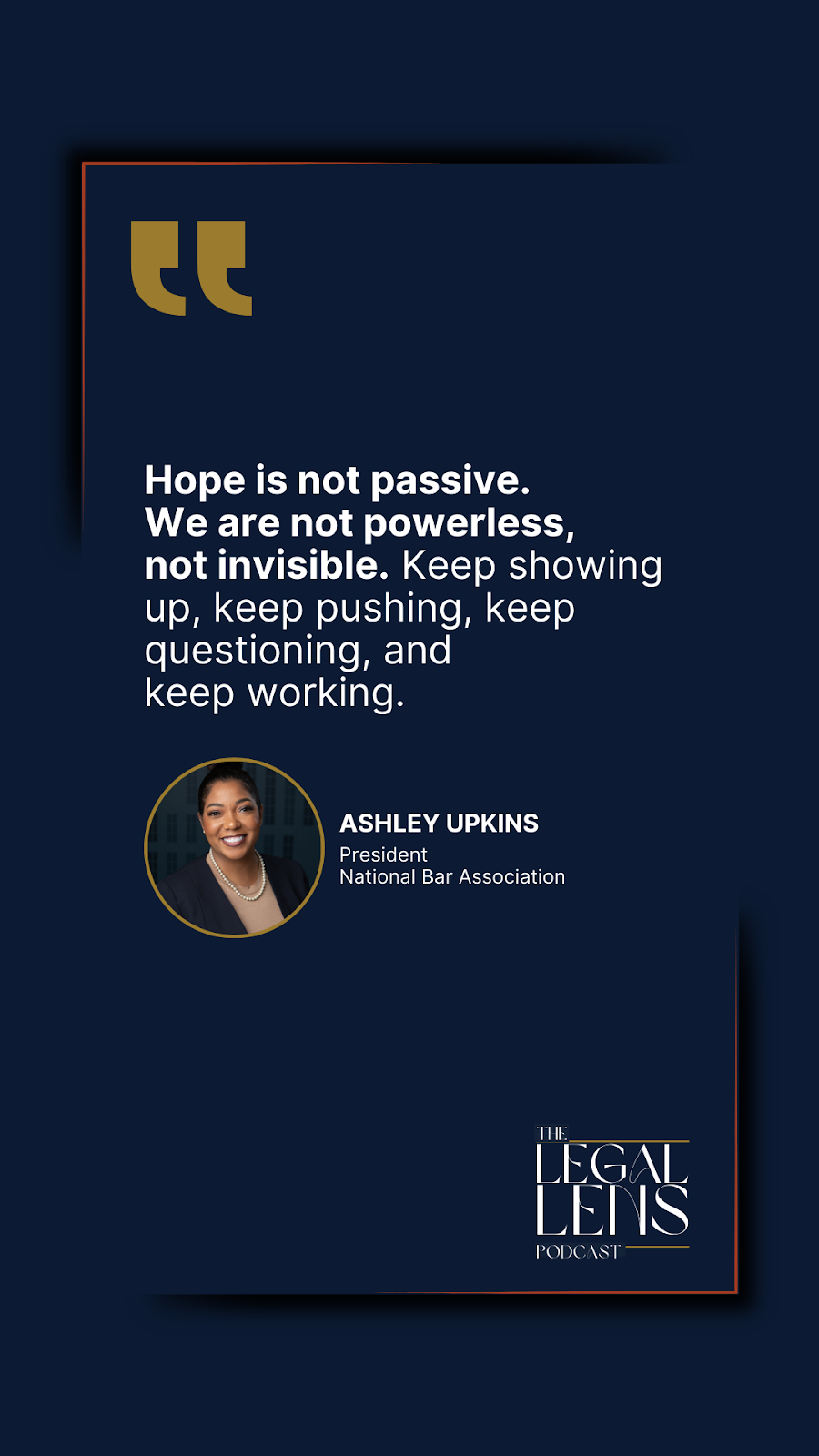
“Hope is not naive. Hope is not passive. We are not powerless. We are not invisible. We are part of a long line of advocates, leaders, earth shakers, freedom builders, and truth tellers. And so with that, I’m asking everyone to keep showing up, keep pushing, keep questioning, and keep working,” said Attorney Upkins.
Related Podcast Episode: Attorney Rachel Rossi Joins the Legal Lens Podcast to Discuss Judicial Appointments, the Importance of Supporting Nonprofits, Coalition-Building, and More!
Do You Want to Hear More Powerful Insights from Leading Legal Experts Like Attorney Ashley Upkins? Subscribe to and Download the Legal Lens Podcast Today!
Our conversation with Attorney Ashley Upkins provided a vital blueprint for navigating this current moment: by leveraging our professional platforms, leading with shared values, and transforming knowledge into applied action. She reminded us that justice is an ongoing pursuit, and we each have a responsibility to “do justice” where we stand.
Listen to this full episode of The Legal Lens Podcast to hear Attorney Upkins’ complete perspective on Simplecast, Apple Podcasts, or Spotify, and subscribe to never miss a critical conversation.


 Also, to learn about all things Legal Lens, follow me on Instagram @iamangelareddockwright.
For media inquiries, please reach out to josh@kwsmdigital.com.
This communication is not legal advice. It is educational only. For legal advice, consult with an experienced employment law attorney in your state or city.